
B.C.’s new budget proposes raising taxes on the lowest income bracket and postponing several large capital projects, with the provincial deficit projected to rise to a record $13.3 billion in the upcoming fiscal year.
This falls short of the provincial government’s previously stated goal of cutting the deficit in the near term.
Specifically, the proposed budget hikes the tax rate on B.C.’s lowest income bracket by 0.54 percent, which would bring the rate up to 5.6 percent on the first $50,363 of taxable income earned after July 1 of this year.
Government officials say this will lead to around 60 percent of B.C. taxpayers paying more tax next year at an average increase of $76 more per person paid in taxes.
Calculations based on the budget documents put out by the province show that those earning more than $140,000 who don’t qualify for extra tax credits will pay up to an additional $201 in taxes.
Meanwhile, several tax credits and cost-offset measures for lower-income British Columbians are being increased, including a tax reduction credit for 2026 of $690 for those with a net income up to $25,570, and proportionally phasing out entirely by $44,952. This represents an increase from the previous amount of $575.
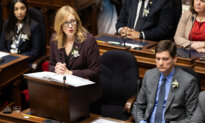
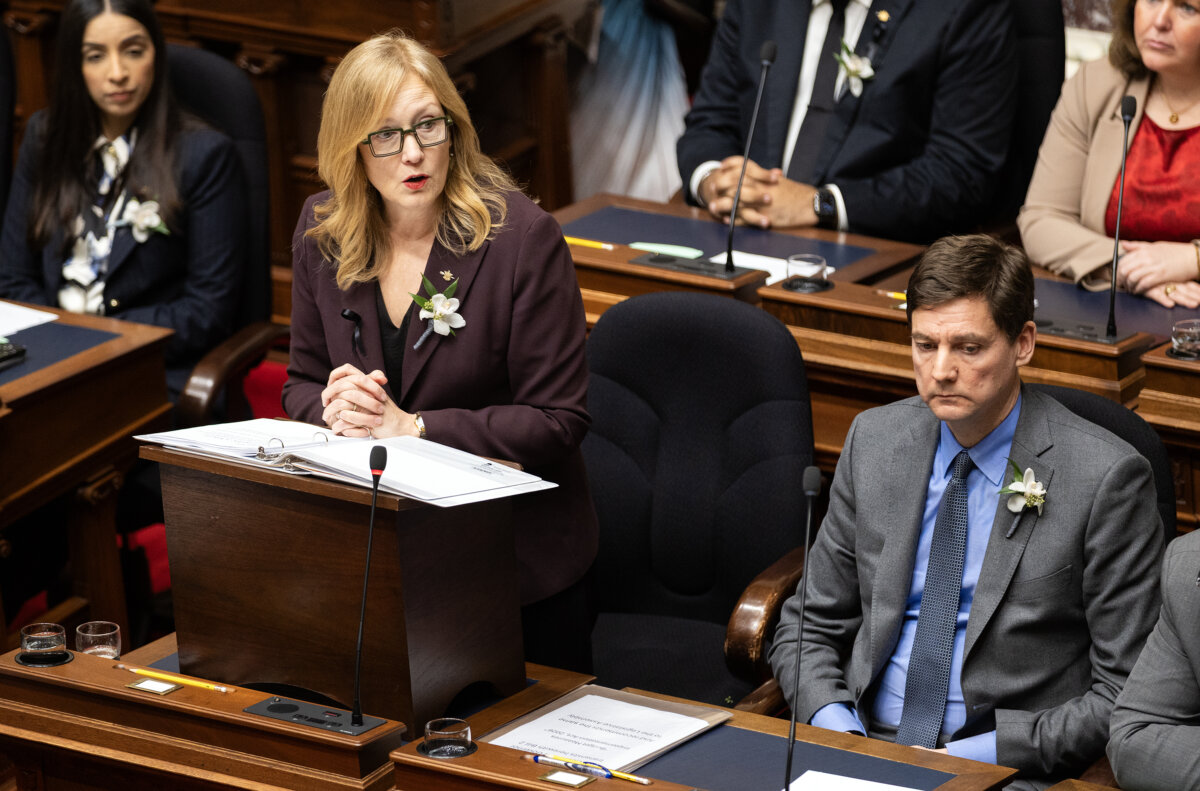
B.C.’s Finance Minister Brenda Bailey said the province is making “disciplined decisions” while announcing the proposed budget in the provincial legislature Feb. 17.
“We must be disciplined, focused and honest about the choices ahead. We must assume this pressure on our revenue is the new normal and operate accordingly,” she said.
“We are in a period of serious fiscal pressure.”
Some of the measures referenced by Bailey include a reduction in the province’s public sector, with about 15,000 full-time public sector positions set to be eliminated in the next three years.
However, the budget also proposes $330 million in additional funding for ChildCareBC, $475 million total for children and youth with disabilities, $131 million more in funding for mental health and addictions treatment in the province, $2.8 billion in new health funding, and $634 million in new funding for K-12 education, all over three years.
The province expects to spend much more than it brings in next fiscal year, with the deficit projected to rise to $13.3 billion, up 38 percent from about $9.6 billion in the current fiscal year.
Despite the deficit being projected to rise by $3.7 billion, Bailey said it will decrease “over time” thanks to structural changes in reducing the public sector and higher tax revenues.
“Nobody worries about the deficit more than I do,” Bailey told media Feb. 17, adding that “nothing could be further from the truth” when asked if she has given up on trying to bring the deficit down.
Shannon Salter, who serves as deputy minister to B.C. Premier David Eby, wrote in a recent email that the province’s deficit is “unsustainable.”
Capital projects being postponed include a number of planned new long-term care homes, student housing development at the University of Victoria, and expansion of cancer care and hospital capacity in Burnaby.
The budget’s capital project spending decreases would lower it to $18.7 billion next fiscal year, down from a previously forecast $20.4 billion. Budget documents say this is expected to decrease further to $16.1 billion by the 2028 fiscal year.
Bailey said the province will move forward on capital projects by “re-pacing” construction timelines on long-term care homes, the Burnaby hospital redevelopment, and student housing.
“These are not cancellations,” she said. “This is a recognition that the province needs to strategically resequence projects to address fiscal pressures.”
Conservatives Respond
B.C. Conservative finance critic Peter Milobar said the budget is the apex of a “decade of decline” that has been worsened by the province’s NDP government. Specifically, he pointed to a surplus when the NDP took power in B.C. in 2017.
“After ten years of NDP mismanagement, this budget is an assault on seniors, working families, and the small businesses that drive our economy,” Milobar said in a Feb. 17 press release.
He told reporters at the B.C. legislature B.C.’s government is not doing enough to help B.C.’s industry and is overspending.
“From 2022 till now, we’ve seen forestry drop by $1.3 billion. 2022 was long before Donald Trump,” he said, adding that Eby’s government “very clearly” has an issue with overspending.
“We have a budget this year that has $200 million less in revenue than they were projecting last year for this time this year, yet we have an extra $3 million on the deficit that they were projecting,” he said.
Milobar criticized the proposal to cut 15,000 public sector jobs, saying there is no defined timeline of exactly how or when the jobs will be eliminated.
“The only thing they’ve very clearly cut is six long-term care homes and hospital expansion redevelopment in Burnaby,” he said.
The Canadian Press contributed to this report.
 Friends Read Free
Copy
Facebook
Tweet
Friends Read Free
Copy
Facebook
Tweet