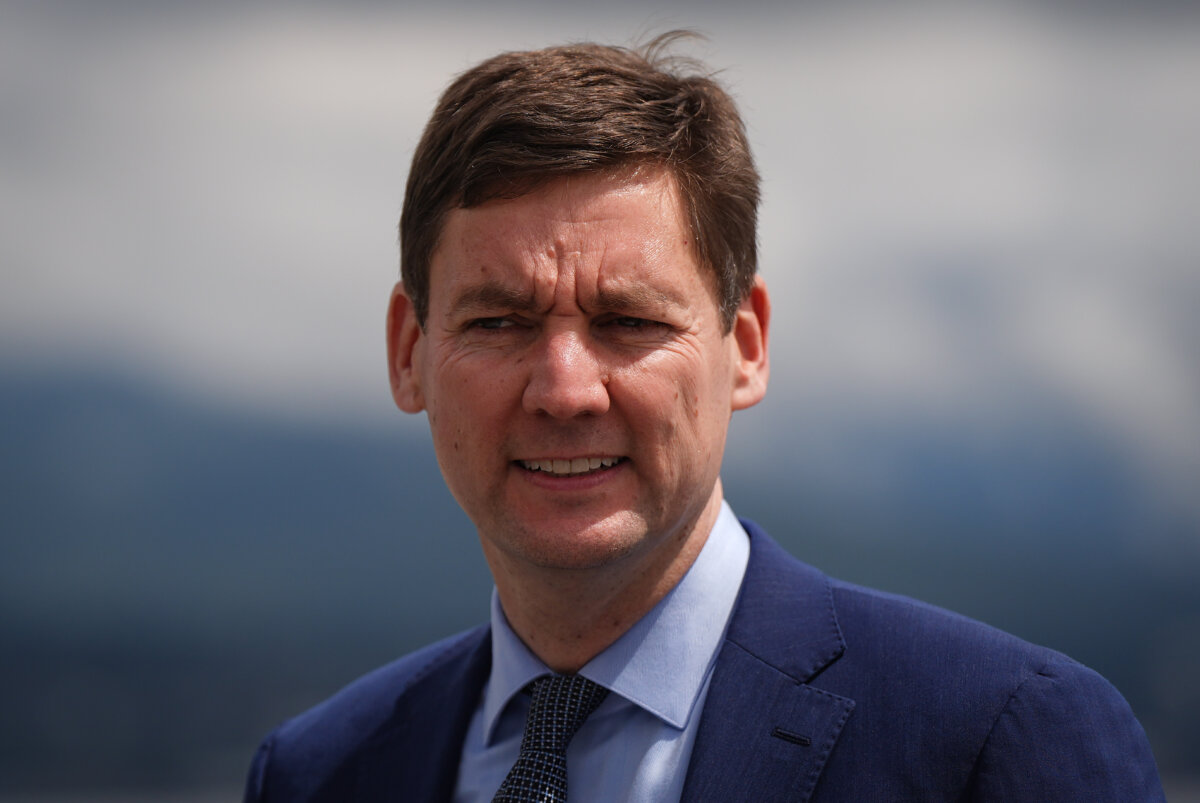

British Columbia Premier David Eby has signalled a lack of interest in a pipeline extending from Alberta to the northern coast of B.C., following Alberta Premier Danielle Smith’s push for it at a recent first ministers meeting.
“It’s not my job to come in and tell Premier Smith that her vision for a north coast pipeline is many, many years off and there’s no proponent,” he told reporters in Osaka, Japan, during a trade mission to East Asia on June 3.
The premier added that his province already has a “massive taxpayer-owned pipeline,” saying there needs to be discussions “about maximizing value from that pipeline.” Eby was referencing the Trans Mountain pipeline, which carries crude and refined products from Edmonton to the B.C. coast. The federal government purchased the pipeline expansion project from Kinder Morgan in 2018 for $4.5 billion after the company abandoned the project, citing opposition in British Columbia.
Eby suggested in May he would consider a pipeline if Smith was able to convince the federal government to approve one, but noted that his focus was on decarbonizing his province’s economy.
B.C. Energy Minister Adrian Dix made further comments on the issue during a June 4 press conference, saying that the idea of a pipeline in the province “doesn’t make sense to us.”
He said the province wants to see “practical proposals,” while noting that the Trans Mountain pipeline had increased to $34 billion in costs after Kinder Morgan had initially pegged the expansion to cost $5.4 billion.
Both Eby and Dix have said British Columbia isn’t in favour of the ban on oil tankers along its coast being lifted, a move that would be essential for such a project.
Prime Minister Mark Carney met with provincial and territorial premiers on June 3 to discuss infrastructure and energy project priorities. That meeting did not conclude with any specific commitments to projects, but focused on streamlining the overall process for advancing them.
Alberta Premier Smith said she had pushed at the meeting for a “grand bargain” of Ottawa supporting both a pipeline running from northwest B.C. to the port of Churchill, Man., as well as a carbon capture and storage network known as the Pathways project.
She said the pipeline would generate roughly $20 billion a year in revenue, which would be a “pretty good value proposition.” The revenue would go toward the $10 billion to $20 billion Pathways project, she said.
Manitoba Premier Wab Kinew has also said he supports the idea of making the city of Churchill a key shipping hub.
Prior to the first ministers meeting, Smith said it would be easier to bring Alberta oil to refineries on the East Coast using ships travelling through Hudson Bay, as opposed to shipping it through a pipeline built across Quebec. The Quebec government has repeatedly signalled opposition to a pipeline, and Smith said she wanted to “work with where I think we’re going to have the most success.”
Carney has said there were opportunities for an oil pipeline that would bring “decarbonized oil” to markets in Asia and Europe. He has not confirmed whether he would approve a pipeline, but has called for Canada to become an “energy superpower” in both “conventional” and clean energy.
 Friends Read Free
Copy
Facebook
Tweet
Friends Read Free
Copy
Facebook
Tweet