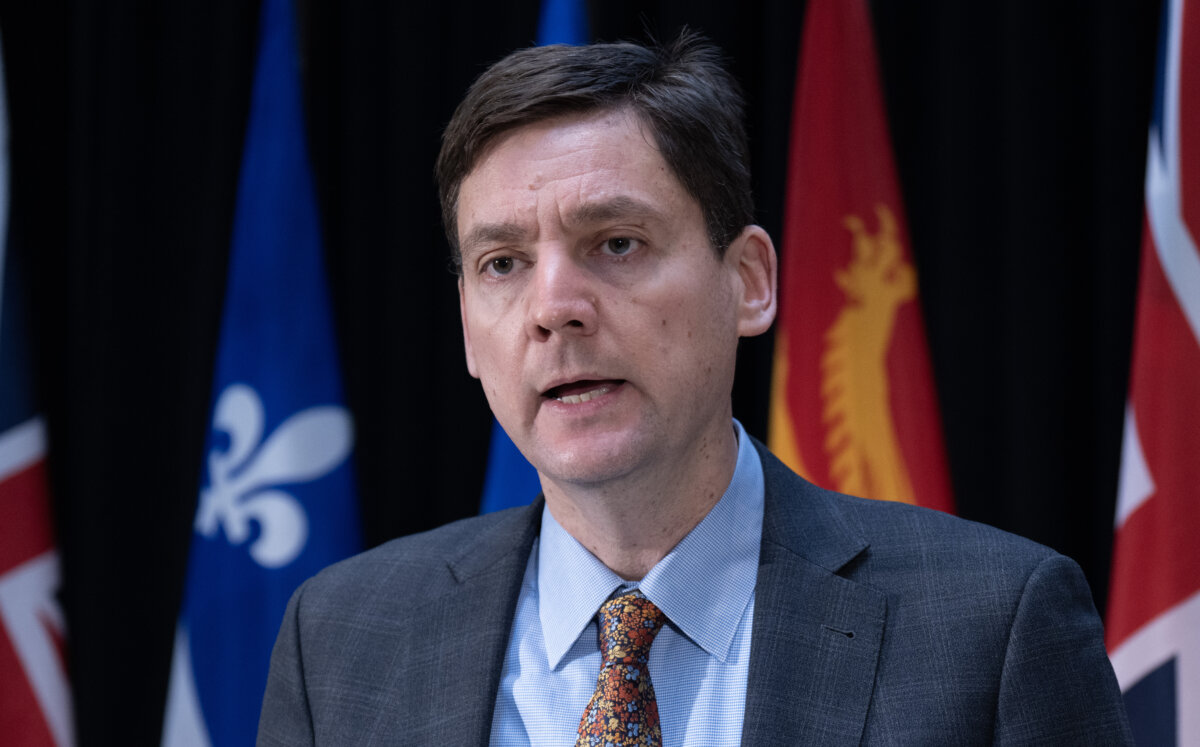

The British Columbia government will push amendments that will temporarily suspend portions of the province’s Declaration on the Rights of Indigenous Peoples Act (DRIPA), to address concerns over interpretation of the act by the province’s highest appellate court, B.C. Premier David Eby said during a news conference on April 1.
Eby confirmed plans to push the amendments when asked about the matter by a reporter during the conference held in Victoria.
“We’re going to get these amendments through, we have to. There was a court decision … from the Court of Appeal on this act, that interpreted it in a way that was quite different than that intended by the legislature,” he said. “That has created significant legal liabilities for the province of British Columbia.”
Eby was referring to a decision by the court on Dec. 5 last year to rule in favor of the Gitxaala Nation, which had challenged the mineral tenure system under the Mineral Tenure Act, R.S.B.C. 1996, c. 292. The Court of Appeal reversed an earlier ruling by the B.C. Supreme Court that DRIPA was not legally enforceable.
The Court of Appeal’s ruling stated that the province’s free-entry mineral tenure system under the Mineral Tenure Act was inconsistent with UNDRIP Article 32, because mineral claims could previously be registered without consultation with affected First Nations. UNDRIP refers to the United Nations Declaration on the Rights of Indigenous Peoples, which has been adopted into law in B.C. as DRIPA, and also adopted federally by the Liberal government.
Legal experts say the court’s ruling is significant for the application of UNDRIP in the province.
“This decision is an important victory for Indigenous groups because the majority of the Court of Appeal found that UNDRIP is part of BC and Canadian law with ‘immediate legal effect,’ and attracts the presumption of conformity,” law firm Olthuis Kleer Townshend LLP said in December 2025 in reaction to the ruling.
Responding to Eby’s comments that the province would amend DRIPA, Grand Chief Stewart Phillip said the act was essential to maintaining the “ambitious timeline” proposed for major projects in B.C.
“It’s important to acknowledge that British Columbia is facing real economic challenges, and First Nations are essential and equal partners in addressing those challenges,” British Columbia Assembly of First Nations Regional Chief Terry Teegee added. “We stand united in our opposition to any amendments to gut the Declaration Act, which seeks to affirm and protect our rights.”
Interim B.C. Conservative Party Leader Trevor Halford, whose party says the government’s adoption of DRIPA is creating uncertainty in the province when it comes to land rights, expressed skepticism about the proposed suspension of parts of DRIPA for up to three years, saying it would result in “pushing accountability beyond the next election in fall 2028.”
The issue of DRIPA and aboriginal title rights have gained more attention in B.C. in recent years, with cases such as last year’s B.C. Supreme Court ruling that awarded aboriginal land title to the Cowichan Tribes for roughly 750 acres of land in Richmond, which includes private property.
 Friends Read Free
Copy
Facebook
Tweet
Friends Read Free
Copy
Facebook
Tweet