The B.C. government wants to seize three properties in the province’s Lower Mainland, alleging its owners were part of an operation to produce fentanyl in clandestine laboratories, according to court documents.
The director of the province’s civil forfeiture office filed a notice of civil claim in B.C. Supreme Court on Aug. 13. The claim seeks to seize three properties in Langley, three vehicles, and $1,860 in cash linked to a suspected fentanyl production operation that involved imported specialized equipment using the name of a fake company.
B.C.’s civil forfeiture law allows the government to initiate legal proceedings against property it believes to be either the proceeds of unlawful activity or used to facilitate such activity. It is one of the tools the province has recently strengthened to combat money laundering and other forms of criminal activity.
While the forfeiture office does not need to prove that a charge was laid or a conviction was recorded against any of the defendants, it must provide sufficient evidence that the forfeiture needs to be granted.
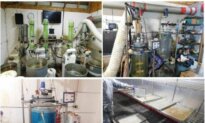
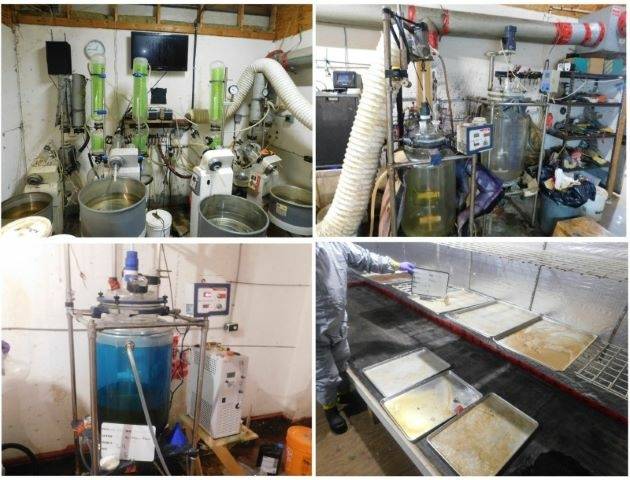
Details of the manufacturing operation mentioned in the Aug. 13 lawsuit match those released by the RCMP in April, after the federal police force discovered three separate illicit fentanyl production labs near the City of Vancouver in the municipalities of Pitt Meadows, Mission, and Aldergrove.
Those labs were equipped with specialized gear typically found in academic or professional research facilities, the RCMP said, adding that two suspects were arrested at one of the fentanyl labs, with one claiming to be a chemist with an advanced degree in organic chemistry.
No one has yet been charged in the case.
The Aug. 13 lawsuit names Langley residents Cesar Douglas Escobar-Calderon, Harpal Singh Gill, and Michaela Marie Butler Christensen, also known as Michaela Marie Gill, as defendants. The document notes that Escobar-Calderon was arrested after the RCMP executed a search warrant on March 26 in a Pitt Meadows facility that was later found to be a clandestine drug lab.
Properties
The forfeiture office is asking that Escobar-Calderon’s townhouse and Gill and Butler’s house in the City of Langley, and another property owned by a company under Gill’s name, One Oak Construction Ltd., in Aldergrove, a community in the Township of Langley, be handed to the government. The city and township are both part of Metro Vancouver.
“Some or all the funds used to acquire or maintain the Real Property were proceeds of the Unlawful Activity or tax evasion in breach of the Income Tax Act,” reads the document, adding that the “Real Property was used by the defendants as an instrument of unlawful activity, namely, the laundering of proceeds of crime.”
The lawsuit describes how the defendants allegedly executed the drug manufacturing operation, and notes that all three properties being claimed by the forfeiture office were subjected to an RCMP search warrant on March 26, with officers finding evidence related to drug production.
The forfeiture office is also asking that the government seize three vehicles the defendants allegedly used for their illegal activities, as well as cash found by officers during the search warrants.
Civil Forfeiture
The province has expanded its use of civil forfeiture in recent years, such as through legislation announced in 2023, which introduced a number of amendments to the Civil Forfeiture Act.
Amendments included the creation of unexplained wealth orders—a type of court order that requires individuals to explain how they acquired or maintain their assets. The funds collected from the sale of forfeited assets are used to support crime prevention and victim services programs, or to compensate victims, according to the province.
The amendments were based on recommendations in the Cullen Commission, a public inquiry into money laundering in B.C. that began in 2019 and released its final report in 2022. It concluded that billions in illicit funds linked to organized crime and drug trafficking had an effect on B.C.’s real estate, gaming, and luxury vehicle sectors.
The changes to the civil forfeiture law also came after a multi-year money laundering investigation failed to yield charges in 2023, with B.C. Premier David Eby saying the lack of charges were an illustration of the loopholes in federal financial crime law.
That investigation involved then-suspect Paul King Jin, who had been accused of involvement in moving millions of dollars through B.C. casinos and Chinese bank accounts.
Fentanyl Precursors
The Aug. 13 lawsuit alleges that the fentanyl lab operations involved purchasing equipment from overseas, but it does not specify the source of the equipment or the origin of the chemicals used in fentanyl production.
Meanwhile, Canadian investigative journalist Sam Cooper says the drug operation linked to the three B.C. properties reflects trends seen in the drug trafficking industry, where precursors are often supplied by groups with ties to the Chinese Communist Party (CCP). He said Mexican cartels handle the distribution and Canadian criminal networks, in collaboration with other groups, establish industrial-scale production in provinces like British Columbia.
He told The Epoch Times in a previous interview that, according to his investigative work, the Chinese regime is heavily involved in fentanyl trafficking.
China has been identified as the “ultimate geographic source of the fentanyl crisis,” with nearly all illicit fentanyl precursors being produced in that country, according to a U.S. government report published last year.
That report also found that the CCP “directly subsidizes” the manufacturing and export of illicit fentanyl materials through tax rebates, provides monetary grants and awards to companies “openly” trafficking the materials, and “strategically and economically” benefits from the fentanyl crisis.
 Friends Read Free
Copy
Facebook
Tweet
Friends Read Free
Copy
Facebook
Tweet