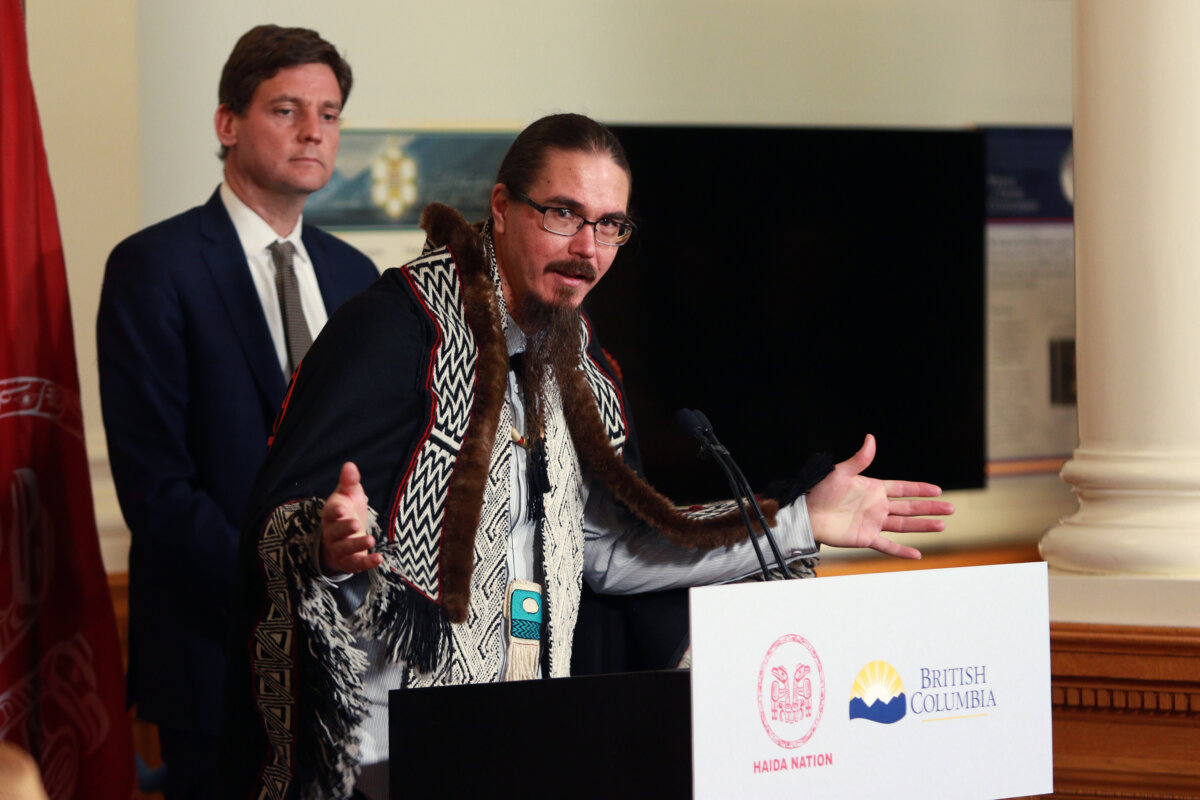

B.C.’s Supreme Court officially recognized the Haida Nation’s aboriginal title to the Haida Gwaii islands on Sept. 5.
The Supreme Court recognition affirmed an April 2024 decision between the Haida Nation, B.C., and Canada in granting land title rights to all of the Haida Gwaii islands north of Vancouver Island, B.C., apart from public infrastructure and private land.
NDP MLA Spencer Herbert celebrated the recognition Sept. 10, saying he was headed to Haida Gwaii with Minister of Environment and Parks Tamara Davidson to meet with the Haida Nation council and local government, business, and community leaders.
“Negotiations, and collaborating together for a better future is the best path forward, creating opportunity, prosperity, and certainty for all,” Herbert wrote in a Sept. 10 post on X.
The Haida Nation and B.C. reached an agreement on April 14 of last year known as the “Rising Tide” Haida Title Lands Agreement following a previous 95 percent vote in favour of the agreement by residents of Haida Gwaii on April 6. The agreement was unanimously backed by everyone present in the B.C. legislature at the time of the vote on April 29 and agreement received royal assent on May 16 with the support of the federal government.
“Today Haida ancestors are dancing in celebration that the discrimination they endured in our colonial past is now behind us, and that the governments of the Haida Nation, Canada and British Columbia are forging a new path where we can foster the jurisdictional space for Haida laws to grow and deepen, without conflict, and based on yahguudang[,] respect,” the Haida Nation wrote Sept. 5, adding that “doing so will benefit not only the lands, water, people and all beings of Haida Gwaii, but all people in BC and Canada.”
B.C. Conservatives say that the deal opens up the way for infringements on private property rights and positions B.C. NDP Premier David Eby as holding too much power over non-transparent deals, with B.C. Conservative Leader John Rustad saying in a Sept. 9 news release that “thousands of British Columbians face uncertainty over their homes, property, and livelihoods.”
“David Eby himself has said this model will be a ‘template’ for the rest of the province. That should send a chill down the spine of every single property owner in British Columbia.”
Fellow B.C. Conservative MLA Scott McInnis, who also serves as Conservative critic for Indigenous Relations and Reconciliation, said that the agreement “has created enormous legal and economic uncertainty – not just for Haida Gwaii, but for all of British Columbia.”
“Private property rights are the foundation of a free society and a strong economy,” he added.
The B.C. Conservatives are asking that the Supreme Court’s decision be immediately appealed at the B.C. court of appeal, vowing to ensure protection of private property rights throughout the province and “commit to full consultation with all British Columbians on future agreements.”
The NDP and Haida Nation have said Rustad’s remarks are unwarranted as the land title agreement affirmed by the B.C. Supreme Court doesn’t pertain to private property or public infrastructure. In a Sept. 10 email to The Epoch Times, Herbert said the deal represents a major step forward while still ensuring full respect for private property rights and B.C. law.
 Friends Read Free
Copy
Facebook
Tweet
Friends Read Free
Copy
Facebook
Tweet