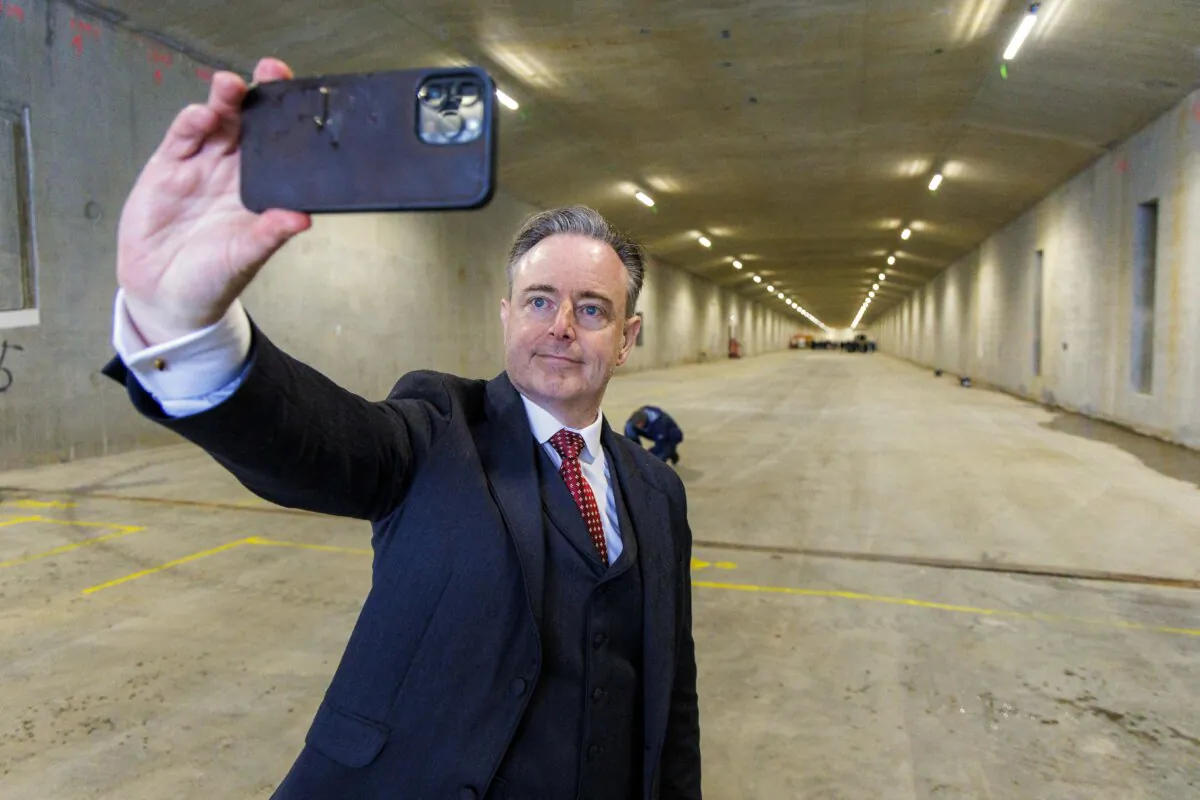

Belgian Prime Minister Bart De Wever has launched a broadside against Europe’s green transition, warning that current EU climate and energy policies are accelerating deindustrialisation.
On Jan. 29 at The Future of Europe conference, hosted by Belgian newspapers De Tijd and L’Echo, De Wever said Europe had made a series of “dogmatic choices” on energy and climate that have weakened its industrial base.
“Let’s be very realistic, ladies and gentlemen, the decarbonization of Europe will be a synonym of the deindustrialization of Europe, and it’s already happening,” said De Wever, who is the leader of the Conservative Flemish nationalist party N-VA.
“We were addicted to cheap fossil fuels flowing in from Russia.
“China is profiteering from the war. They’re getting the cheap oil, the cheap gas. America is no longer supporting Ukraine. They’re selling us the arms, and we are stuck with bills, crazy energy prices.”
EU leaders have prioritised a renewables-first energy strategy alongside the goal of achieving climate neutrality by 2050, a central pillar of European Commission President Ursula von der Leyen’s European Green Deal.
“Competitiveness, productivity, and innovation are the three horses,” De Wever said.
“Sustainability in the Green Deal, that’s the carriage. And I have the impression … we put the carriage before the horses.”
The Belgian leader said environmental regulations have made it increasingly difficult for Europe to meet its own energy needs or develop strategic industries such as mining and refining critical raw materials.
He said that this had “made life extremely complicated” with environmental rules that make it “impossible to provide our own energy needs, that make it impossible to mine for rare minerals in Europe, we have no military capacity to provide for them elsewhere.”
“The Chinese are everywhere, South America, Africa. We are nowhere,” he said.
De Wever singled out Europe’s resistance to nuclear power as a strategic error, calling it “the stupidity of the century.”
“We made dogmatic choices against nuclear energy,” he said.
He also questioned the economic realism of Europe’s offshore wind and hydrogen ambitions, noting that projects are becoming increasingly difficult to finance.
He was told by the industry that politicians in Europe need to “create a market for green hydrogen,” he said.
“Then I feel like in the Soviet Union, if a politician has to create a market, this sounds like subsidies until eternity,” he said.
De Wever said that he had discussions with steelmakers who told him Europe is no longer an attractive place to invest without massive public support.
“You cannot be competitive if the artery of your economy, your energy, has to be so heavily subsidized,” he said.
“The petrochemical industry is no longer investing. They’re leaving us. And even the ones who are going to bring sustainable production … they say, ‘Very nice environment to create in Europe, see you later, going to China.'”
Similar concerns have been voiced by Polish Prime Minister Donald Tusk, who has called for a review of the European Green Deal, warning that high energy prices risk destabilising democratic governments.
Speaking in Strasbourg on Jan. 22 last year, Tusk said some EU regulations had led to a situation in which “energy prices are too high,” adding that high energy prices could topple democratic governments.
“High energy prices might bring the downfall of many democratic governments,” he told members of the European Parliament.
“It’s unacceptable that our European energy is the most expensive.
“If it cannot be the cheapest, at least it should be more or less on the same level as in other countries.”
Tusk mentioned ETS 2, an EU carbon-trading scheme scheduled to start in 2027.
Aimed at reducing CO2 emissions from fuel combustion in buildings, road transport, and other sectors, the program makes fuel suppliers responsible for tracking and reporting emissions.
“You can believe me. The political impact is terribly predictable. It will be a very bad, disastrous political impact if the energy prices continue to rise,” he said of the scheme.
The Epoch Times has contacted the European Commission for comment.
 Friends Read Free
Copy
Facebook
Tweet
Friends Read Free
Copy
Facebook
Tweet