
Prime Minister Mark Carney said Canada plans to maintain sanctions on Russia, including on its oil, after the U.S. government announced a 30-day pause on one element of its sanction regime amid spiking oil prices.
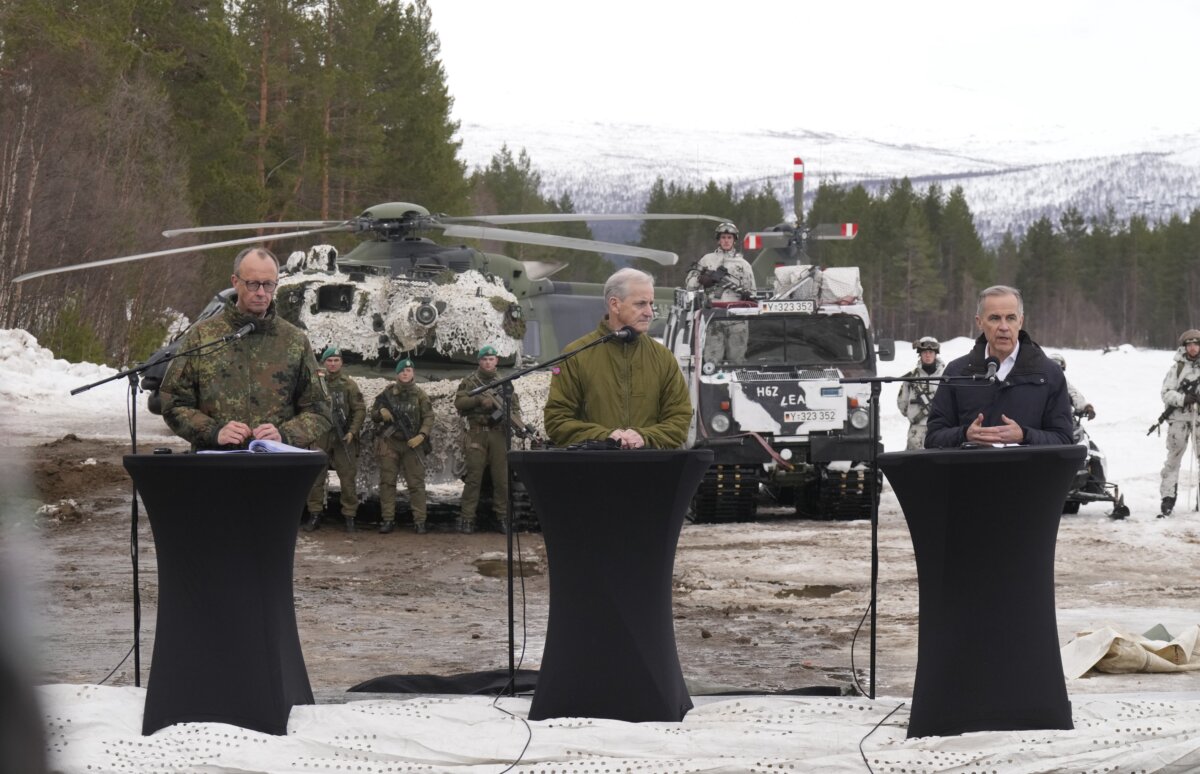
Carney made the comments to reporters on March 13 while in Norway, where he visited NATO troops taking part in a cold weather military exercise. He was speaking alongside German Chancellor Friedrich Merz and Norwegian Prime Minister Jonas Gahr Støre.
Merz said G7 leaders held a virtual meeting on March 11, and expressed opposition to the U.S. plan to lift some sanctions on Russian oil for a 30-day period. The meeting convened by France, which chairs the G7 this year, focused on the Iran war and rising energy prices.
“Six out of seven were clearly [of] the opinion that we should not release the sanctions against Russia, and we were a little bit surprised that we heard this morning that the American government decided differently,” Merz said.
U.S. Treasury Secretary Scott Bessent announced the measure on March 12, saying it’s meant to help stabilize energy markets.
The measure temporarily allows countries to purchase Russian oil currently stranded at sea.
“This narrowly tailored, short-term measure applies only to oil already in transit and will not provide significant financial benefit to the Russian government, which derives the majority of its energy revenue from taxes assessed at the point of extraction,” Bessent said in a statement.
The Kremlin welcomed the move and said it would cover 100 million barrels of Russian crude oil, equal to almost a day of production globally.
Analytics firm Vortexa said around 7.3 million barrels of Russian oil are floating in storage, while 148.6 million barrels are currently on vessels in transit.
German Chancellor Merz said pressure should not be reduced on Russia as it continues its war against Ukraine, and Carney said he fully agrees.
“Canada’s position is to maintain sanctions on Russia, maintain sanctions including on the shadow fleet, which is moving this oil,” Carney said.
Canada has previously imposed various rounds of sanctions on Russia in relation to the so-called “shadow fleet” of oil tankers the country operates in a bid to avoid sanctions.
The Canadian prime minister said that beyond its aggression against Ukraine, Russia maintains “tight cooperation” with Iran.
The U.S. and Israeli attacks on Iran have caused a shock in the oil market as Tehran retaliated by targeting ships in and around the Strait of Hormuz. About 20 percent of the world’s oil production transits through the maritime chokepoint south of Iran, which separates the Persian Gulf and the Gulf of Oman.
The price of oil has increased by nearly 50 percent since the start of the conflict on Feb. 28.
Earlier this week, the 32 countries in the International Energy Agency (IEA) agreed to release 400 million barrels of oil from emergency reserves to help stabilize the market. This is only the sixth time the agency has taken this measure, including two releases in 2022.
The IEA says that exports of crude and refined products through Hormuz has been reduced to less than 10 percent of their pre-conflict levels.
Canada has no strategic oil reserve. Countries that are net exporters of oil, like Canada, are not required by the IEA to keep a stockpile, but other net exporters, like the United States, still retain one.
Reuters contributed to this report.
 Friends Read Free
Copy
Facebook
Tweet
Friends Read Free
Copy
Facebook
Tweet