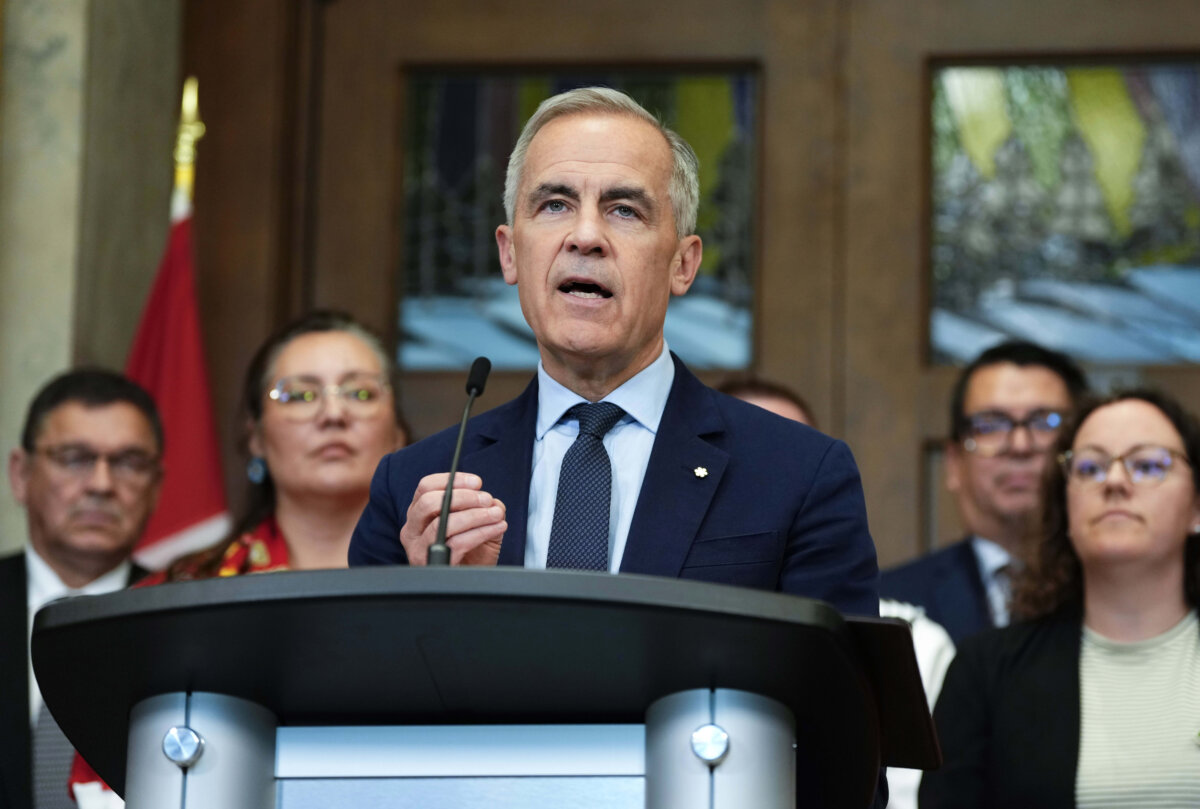

Canada will implement an additional 25 percent tariff on steel imports from China before the end of July, among new measures aimed at bolstering Canada’s steel industry and preventing steel dumping in the Canadian market, Prime Minister Mark Carney says.
Ottawa said the measure will ensure Canadian steel producers are “more competitive” by protecting them against trade diversion from other countries. It will apply to steel imports from all non-U.S. countries containing steel melted and poured in China.
Speaking to reporters in Hamilton, Ont., on July 16, Carney said steel products from partners that do not have a free trade agreement with Canada will see the tariff rate quota levels be reduced to half of 2024 volumes. A 50 percent tariff will apply to any imports beyond those levels.
Additionally, for non-U.S. partners with which Canada has a free trade agreement, Ottawa will introduce a tariff quota level for steel producers equal to 2024 volumes and apply a 50 percent tariff on steel imports above those levels.
Carney said Canada’s existing steel arrangement with the United States and Mexico would not change. But he said given the current “dynamics in global trade,” Canada will be reassessing its existing trade arrangements with all partners while taking into account U.S. steel negotiations with other countries.
“What happens in those [countries] will affect what happens here,” he said.
In March, U.S. President Donald Trump imposed 25 percent tariffs on Canadian steel and aluminum imports. He raised those tariffs to 50 percent in June.
Ottawa announced new steel quotas on June 27 to bolster the industry in response to U.S. tariffs, by imposing a 50 percent surtax on steel imports exceeding 2024 levels from countries with which Canada does not have a free trade agreement.
Ottawa is also pledging $70 million in Labour Market Development Agreements to provide training and income supports for up to 10,000 impacted steel workers, as well as $1 billion for the Strategic Innovation Fund to help steel companies advance projects and facilitate the production of new steel products.
The federal government also began requesting back in March that recipients of federal grants switch to using Canadian steel and aluminum instead of U.S. products.
Canada’s steel and aluminum sectors employ a total of 150,000 workers, with the country’s steel production being centred in Hamilton, Ont., and the province of Quebec being the leader for aluminum.
Trump imposed 25 percent steel and 10 percent aluminum tariffs during his first term as president, later granting exemptions to several countries like Canada, but keeping tariffs on China. The United States has accused China of dumping cheap steel onto the global market and harming American steel producers.
Trump had imposed a series of tariffs on Canada in recent months, including 25 percent tariffs on goods not covered under the United States-Mexico-Canada Trade Agreement (USMCA), and 25 percent tariffs on automobiles and auto parts. Trump sent a letter informing Carney on July 10 that the tariffs on non-USCMA goods would be increased to 35 percent.
Trump has also threatened to impose tariffs on semiconductors, pharmaceuticals, as well as 50 percent tariffs on copper.
Carney had previously said that he had an agreement with the White House to reach a trade deal before a deadline of July 21, but he moved the deadline back to Aug. 1 following Trump’s July 10 letter. Carney also suggested on July 15 that there was “not a lot of evidence right now” that any country could achieve an agreement with the United States that would not involve tariffs.
 Friends Read Free
Copy
Facebook
Tweet
Friends Read Free
Copy
Facebook
Tweet