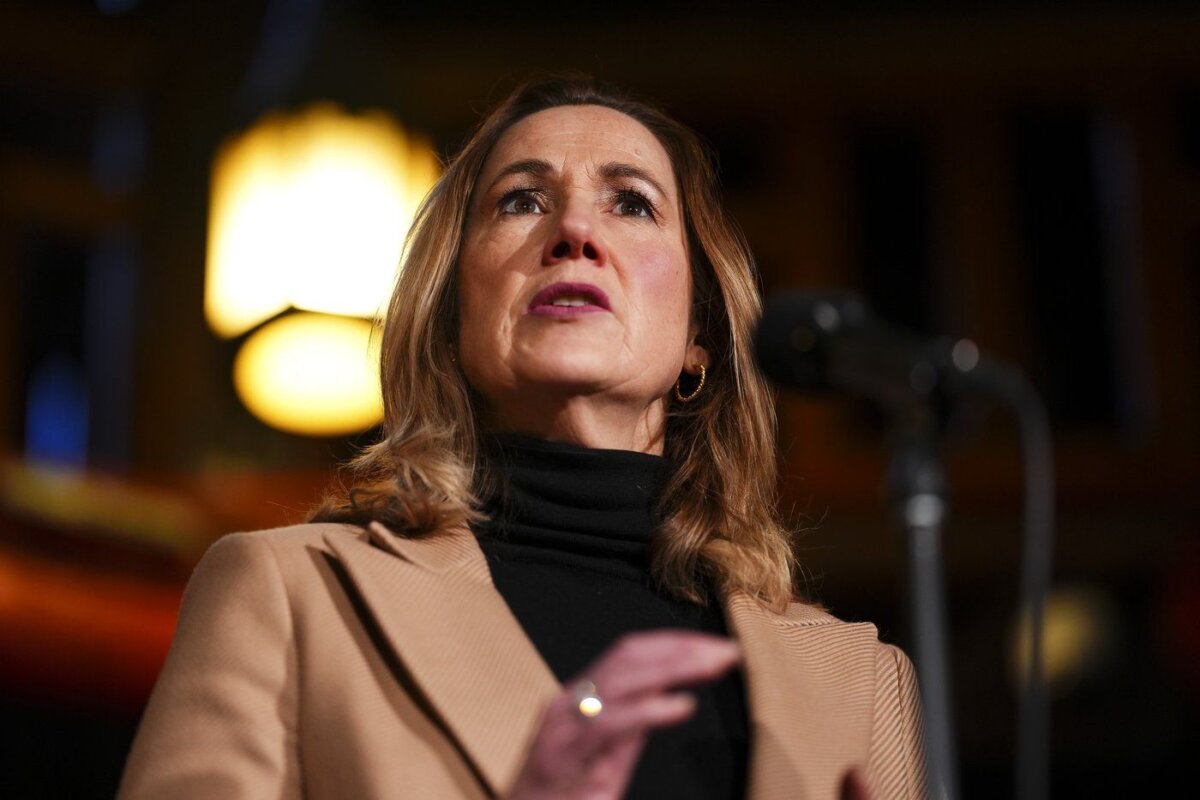
Canada’s ambassador to the United States, Kirsten Hillman, said she will be leaving her position in the new year. Her announcement on Dec. 9 comes as Canada prepares to enter high-stakes negotiations on renewing the U.S.-Mexico-Canada Agreement (USMCA or CUSMA) in 2026.
Hillman said she will stay available to Canada’s negotiating team in the “months ahead,” as well as helping her successor learn their way around the position, in a statement posted on social media on Dec. 9.
“While there will never be a perfect time to leave, this is the right time to put a team in place that will see the CUSMA Review through to its conclusion,” Hillman wrote in her Dec. 9 statement, adding that she thanks Prime Minister Mark Carney for his “strong leadership” while she has served.
Hillman was appointed as acting ambassador to the United States in 2019 by former Prime Minister Justin Trudeau and began serving as ambassador in March 2020. In June of this year, she became Canada’s lead negotiator as Ottawa seeks to secure a new trade and security agreement with Washington amidst increasing tariffs.
Prior to her post as ambassador, Hillman served as deputy ambassador to the United States, where she assisted in renegotiating the North American Free Trade Agreement during U.S. President Donald Trump’s first term and reaching agreement on USMCA in November 2018. She also worked as the chief negotiator in crafting the Comprehensive and Progressive Agreement for Trans-Pacific Partnership, signed in 2018.
In the statement announcing her upcoming departure, Hillman also noted reaching a deal between the United States and Canada on aluminum tariffs, navigating the “unprecedented disruptions of the COVID-19 pandemic,” and renegotiating the Safe Third Country Agreement.
The Safe Third Country Agreement is a treaty signed between the United States and Canada in 2004 that rules on how each country deals with asylum claimants at land border crossings. With Hillman as diplomatic lead, it was expanded in March 2023 along the whole Canada-U.S. land border and to increase cooperation between Washington and Ottawa.
In terms of tariffs, Canada is currently subject to a 50 percent U.S. sectoral duty on steel, aluminum, and copper, as well as 25 percent on furniture and certain auto parts, in addition to a 35 percent tariff on the majority of non-USMCA-compliant goods exported to the United States. Canada’s lumber sector is also subject to significant tariffs.
Previously, Canada had a 25 percent tariff on all non-USMCA-compliant goods. However, the rate was raised to 35 percent Aug. 1 when Ottawa and Washington failed to reach an agreement.
Trump ended all trade talks with Canada Oct. 23 over the airing of anti-tariff ads sponsored by the government of Ontario.
Hillman also noted her role in securing the release of Michael Kovrig and Michael Spavor from Chinese custody in September 2021. The two were detained in 2018 for more than 1,000 days by the Chinese regime in a retaliatory move for the arrest of Huawei executive Meng Wanzhou in Vancouver as the result of a U.S. extradition warrant request carried out by Canadian law enforcement.
“In a relationship as deep and complex as ours, pressing and consequential issues arise almost daily,” Hillman wrote. “Yet none was more personal to me than the hundreds of hours I spent with U.S. and Chinese counterparts working for the release of Michael Kovrig and Michael Spavor.”
Hillman was thanked for her service by Carney, as well as Trudeau, who said she “worked tirelessly to build up our economy and resolve multiple trade disputes,” and was “a real patriot.”
U.S. Ambassador to Canada Pete Hoekstra also praised Hillman, saying she was “awesome and well-respected.”
 Friends Read Free
Copy
Facebook
Tweet
Friends Read Free
Copy
Facebook
Tweet