
Canada’s counter-tariffs on American goods, ranging from seafood to furniture and worth $20 billion, went into effect just after midnight on Sept. 8 as Canadian Prime Minister Mark Carney sought to hit back following the collapse of trade talks last month.
Canada says its tariffs match Washington’s dollar for dollar, and cover about 6 percent of the $333.6 billion the United States exported to Canada last year. RBC Economics, the research arm of the Royal Bank of Canada, said the Canadian tariffs could hit some U.S. businesses hard but were unlikely to dent growth overall.
Canadian Finance Minister François-Philippe Champagne announced the tariffs on Aug. 25, following the collapse of trade talks between Washington and Ottawa on Aug. 21.
U.S. President Donald Trump immediately imposed tariffs on $20 billion of Canadian exports to the United States beginning on Aug. 22.
When Champagne announced Ottawa’s response, he said counter-tariffs would be introduced on a sliding scale of 15, 25, and 50 percent, with the highest levies applied to specific dairy products, cosmetics, and select lumber products.
Canada said it was simply matching the U.S. tariffs dollar-for-dollar.
“Tariffs [on U.S. imports] will have real consequences for Canadian workers, businesses, and communities across our nation. Canada must respond, and today we are in a proportionate, targeted, and strategic way,” Champagne said at the time.
Canadian Prime Minister Mark Carney said last week that he saw three by-election wins on Aug. 31 for his Liberal Party as support for his government’s policies.
“At this consequential time for Canada, voters have placed their trust in our government’s plan,” he said on Sept. 1.
Trump has warned Carney of the consequences of his policies.
“It is very good for Canadian Politicians like Prime Minister Carney to make President Donald J. Trump ‘the enemy,’ until their Economy collapses, then it will prove to be very bad for Politics — Worse than anything that has ever happened to a Canadian Politician. Just watch!” he wrote in a Sept. 3 post on Truth Social.
Eight of Canada’s provinces have restricted or banned sales of U.S. alcoholic products, with the Distilled Spirits Council saying exports to Canada fell more than 70 percent year over year.
U.S. Trade Representative Jamieson Greer said on Aug. 26 that Washington has not banned any Canadian goods outright so far.
Trump Threatens Bombardier Ban
In a Sept. 7 post on Truth Social, Trump suggested he would ban aircraft produced by the Canadian company Bombardier unless they began manufacturing
The poor relationship between the Trump administration and various Canadian politicians has had other ramifications.
Last month, Trump signed an executive order renaming Lake Ontario as Lake America amid a war of words with Ontario Premier Doug Ford.
Canadian Industry Minister Mélanie Joly responded by saying, “We’ll always call it Lake Ontario, period.”
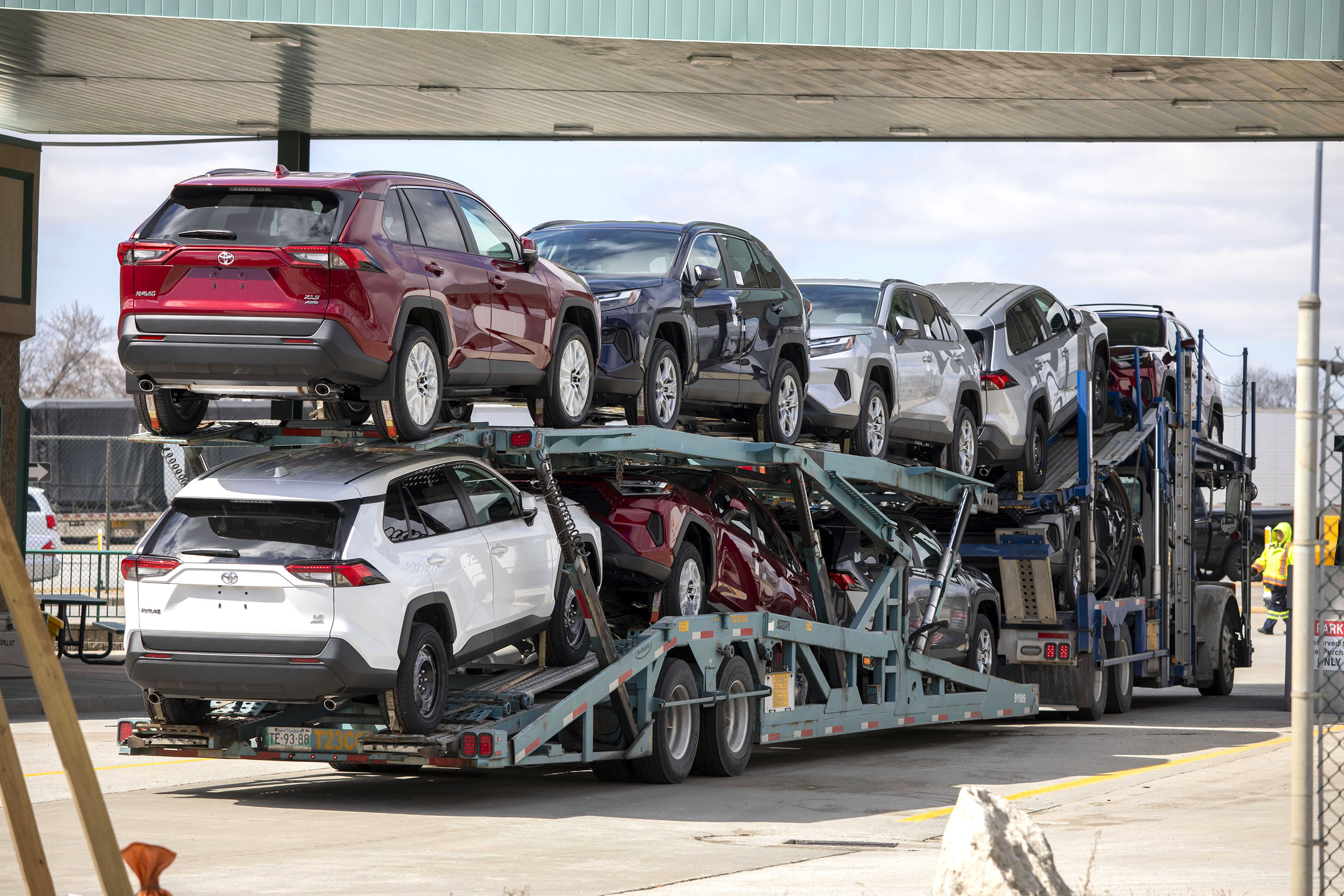 A car hauler truck gasses up at a duty-free station before crossing into Detroit in the United States, in Windsor, Canada, on April 1, 2025. (Bill Pugliano/Getty Images)
Trump has also said he would impose 50 percent tariffs on Canadian vehicles, auto parts, and steel from 2027 if Canada does not “fall in line.”
“We want the cars to be made in Detroit and in South Carolina and in Tennessee and in all of our places where we make cars,” Trump said on Sept. 2. “We don’t want them to be made in Canada.”
Such a tariff could raise vehicle prices across North America, because parts and finished vehicles often cross the border repeatedly during the production process.
The Associated Press contributed to this report.
 Friends Read Free
Copy
Facebook
Tweet
Friends Read Free
Copy
Facebook
Tweet