
News Analysis
The federal government has made a very public foreign policy shift to deepen ties with Europe amid uncertainty in the Canada-U.S. relationship, but changes are also afoot regarding how Ottawa deals with Asia.
Under pressure to find new markets, all eyes are on how Canada will manage India and U.S. adversary China when it comes to dealings with Asia.
A first major sign of the foreign policy realignment took place with Prime Minister Mark Carney inviting Indian Prime Minister Narendra Modi to attend the G7 summit in Canada in mid-June.
Relations between Canada and India had been in turmoil since 2023, when Ottawa accused New Delhi of being involved in the assassination of Hardeep Singh Nijjar on Canadian soil. Nijjar was a Sikh gurdwara leader advocating for the creation of an independent Sikh state within India. New Delhi has denied the allegations.
The Carney government is apparently willing to look past that event in pursuit of larger strategic interests. It’s the path that the U.S. administration under President Joe Biden had adopted, offering lukewarm support for Canada at the time in its dispute with India, and a path that the new administration has continued under President Donald Trump.
Carney and Modi agreed at the summit to appoint new high commissioners to oversee the respective diplomatic missions, after tit-for-tat expulsions last year.
Though this marked a major breakthrough, Ottawa has remained careful and deliberate in its approach.
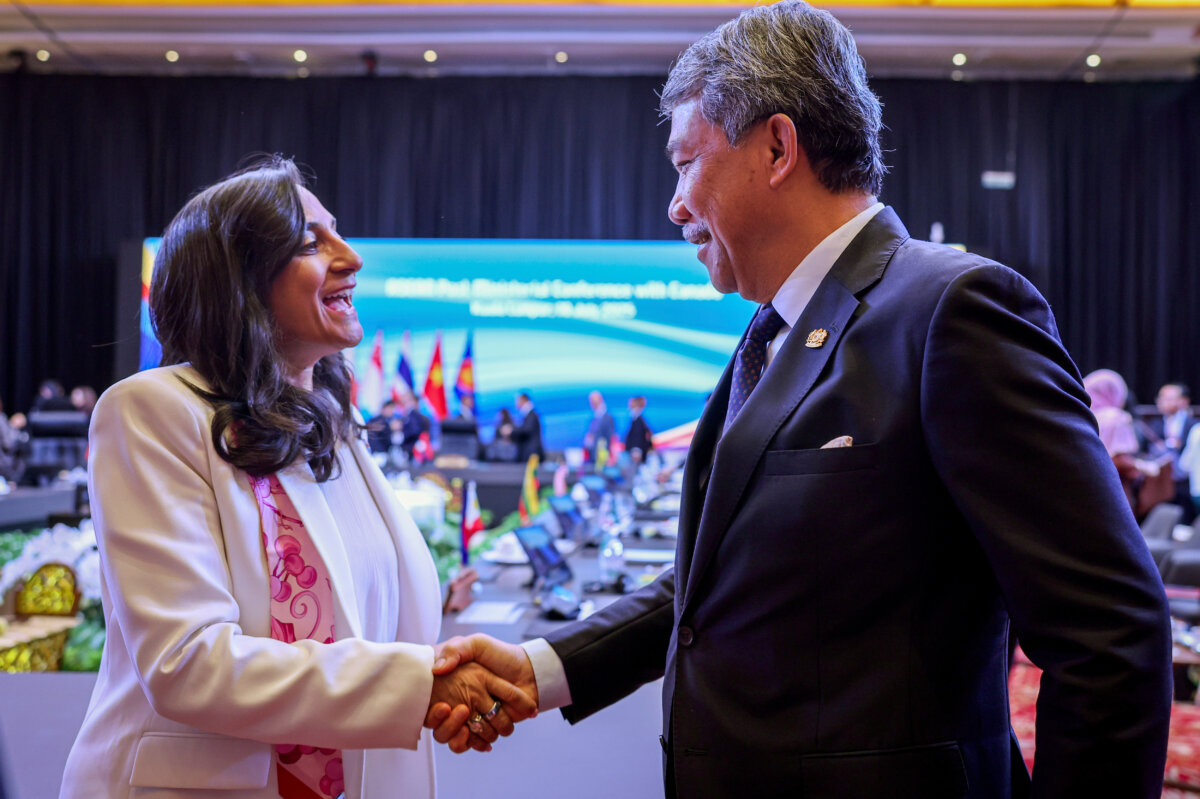
Foreign Minister Anita Anand was conducting her first visit to Asia in her new role last week when she said the strategy with India continues to be that of taking it “one step at a time,” while noting that Modi’s visit represented a “significant step” in the relationship between the two countries.
She said the law enforcement dialogue with India, presumably in the case of Nijjar, would continue.
“In terms of the next steps, those will be taken prudently and in due course. But that timeline will be steady, not immediate, and I will leave it at that,” she told reporters on July 10 while attending the Association of Southeast Asian Nations (ASEAN) meeting in Malaysia.
Anand would not provide details on when the appointments of high commissioners would take place or whether trade talks would resume. The talks were suspended by Canada before then-Prime Minister Justin Trudeau was about to publicly accuse New Delhi of having a hand in the assassination of Nijjar.
Anand also noted that geopolitical shifts in the world since 2022 have led Ottawa to reshape its foreign policy.
“The global strategic environment has shifted significantly since 2022, the global economy is under stress, and the global strategic environment is seeing more conflict,” she said, without elaborating. Russia invaded Ukraine in 2022 and the global economy saw heightened inflation following COVID-19 policies.
“Therefore it is important for us to revisit our policy, not only in the Indo-Pacific, but generally speaking,” Anand added. The minister said this would be done not only to focus on the values adhered to by the government, such as the protection of civilians and multilateralism, but also to “ensure that foreign policy is an extension of domestic interest, and particularly domestic economic interests.”
Focus on the economy has been a notable change between the Trudeau and Carney governments, with the latter recently passing legislation to circumvent previous Liberal laws impeding the development of major projects.
Asia Strategy
If the domestic objective is clear, and while the pivot to Europe has already overcome hurdles with the signing of agreements, less has been said or done when it comes to Asia.
The revisiting of Canada’s broader foreign policy, and its Indo-Pacific Strategy in particular, has yet to be fleshed out by Ottawa.
The federal government released the Indo-Pacific Strategy in late 2022 and touted it as a means to grow Canada’s domestic economy, in line with Anand’s recent comments. The strategy also prioritized cultivating “important key relationships” with India and with ASEAN and its 10 member states, which includes Indonesia and Vietnam.
Anand said last week she put pressure on ASEAN to conclude the negotiations on the free-trade agreement with Canada, noting that the regional bloc is the fourth-largest economy in the world.
The Indo-Pacific Strategy also established a framework on how to deal with China. It came on the heels of the Meng Wanzhou affair, which caused a diplomatic freeze with Beijing and changed how the Liberal government interacted with China. Acting on a U.S. extradition warrant in December 2018, Canada arrested the Huawei executive, who was accused of fraud. China in response detained Canadian citizens Michael Kovrig and Michael Spavor for over 1,000 days.
The Strategy calls China an “increasingly disruptive global power” while noting that the Indo-Pacific offers “significant opportunities” for Canadian exporters. It says Canada’s approach to China is to cooperate in certain areas such as climate change while challenging it in other areas.
“In areas of profound disagreement, we will challenge China, including when it engages in coercive behaviour—economic or otherwise—ignores human rights obligations or undermines our national security interests and those of partners in the region,” the strategy says.
Beijing has not been oblivious to the shifting dynamics in Canada’s foreign policy in recent months.
Amid uncertainty in the trade relationship with the United States, with Ottawa retaliating against the Trump administration’s tariffs, the Chinese Embassy has been advocating for rapprochement with Canada.
Meanwhile, Ottawa and Beijing are also currently engaged in a trade conflict, which is more predicated on strategic power plays than a purely commercial issue.
Canada followed the U.S. lead in imposing tariffs on Chinese steel, aluminum, and electric vehicles in October 2024.
Beijing did not immediately retaliate against Ottawa. Retaliation came when Washington started imposing tariffs on Canada in March. At that time, Canadian officials were messaging that Canada and the United States should work more closely together to confront Chinese trade practices instead of engaging in a trade conflict.
Ottawa also said at the time that it was considering matching U.S. tariffs on China. A core concern of the Trump administration regarding China has been its practice of using third-party countries to ship goods to the United States to circumvent tariffs.
Commentaries in Chinese state media said Beijing’s tariffs were meant as a warning to Ottawa not to side with Washington as the Trump administration was ramping up pressure on China.
The counter-tariffs imposed by Beijing on the Canadian agriculture and food sectors, in response to Ottawa’s tariffs on Chinese steel, aluminum, and electric vehicles, have been causing angst among producers and affected provinces.
Kovrig, a former diplomat who now works for the think tank International Crisis Group, pushed back on the idea of getting closer to the Chinese Communist Party for economic benefits, or sacrificing “Canadian manufacturing for agricultural exports.”
“It’s a devil’s bargain in which the long term costs would outweigh the benefits for Canada,” he said in a July 14 social media post introducing his in-depth analysis of the issue.
Engagement
Ottawa has been reserved in how it has portrayed recent diplomatic developments with Beijing.
Carney spoke to Chinese Premier Li Qiang in early June, and a readout from the Prime Minister’s Office said the two had discussed the “importance of engagement” and agreed to “regularize channels of communication” between the two countries.
Beijing’s public messaging has been more geared toward suggesting that Canada is particularly eager to re-engage. The Chinese Embassy said the call between the leaders has “injected strong impetus into the development of bilateral relations.”
A similar scenario played out for the meeting between Anand and her Chinese counterpart Wang Yi while in Malaysia last week. A readout of the meeting issued by Global Affairs Canada provided few details but noted the two ministers highlighted the importance of having regular communications, including through various formal mechanisms.
The readout says the ministers discussed the conflicts in Ukraine and the Middle East and also discussed “challenges and opportunities in the bilateral relationship and agreed to remain in touch with each other.”
The readout from the Chinese side said the meeting had taken place at Anand’s request and that she said “Canada attaches importance to developing relations with China.”
These diplomatic exchanges are taking place amid trade tensions between Ottawa and Washington, but Carney and U.S. President Trump are both sounding concern when it comes to China.
Carney has previously said that Trump has been a “transformational” president in the way he has dealt with Beijing.
“Starting from his first presidency, [he had] clarity about geopolitical and economic competition from China,” Carney said in late May.
Trump has sought to address the significant U.S. trade deficit with China and to rebuild his country’s manufacturing base. His administration’s military priority is also to deter war with China, according to U.S. Secretary of Defence Pete Hegseth. The U.S. administration has also been asking allies to align with its strategy on China, with U.S. Treasury Secretary Scott Bessent saying in February that Canada could match U.S. tariffs on China.
Carney had close dealings with Chinese state entities in late 2024 before entering politics when he was chair of Canadian multinational investment firm Brookfield Asset Management. He met with Beijing’s mayor, whose government said Carney had pledged to expand Brookfield ’s business in the city. Carney was also board chair of the investment firm when it secured a US$276 million loan from the state-owned Bank of China.
In his capacity as prime minister, Carney has called China the “biggest security threat” Canada faces, due to foreign interference and increasing involvement in the Arctic.
At the G7 summit in Alberta, member countries issued a specific statement on the need to counter transnational repression, an aggressive form of foreign interference that can involve threats and violence against dissidents. While it wasn’t directed at any particular country, security bodies have identified China as the foremost perpetrator of foreign interference.
 Friends Read Free
Copy
Facebook
Tweet
Friends Read Free
Copy
Facebook
Tweet