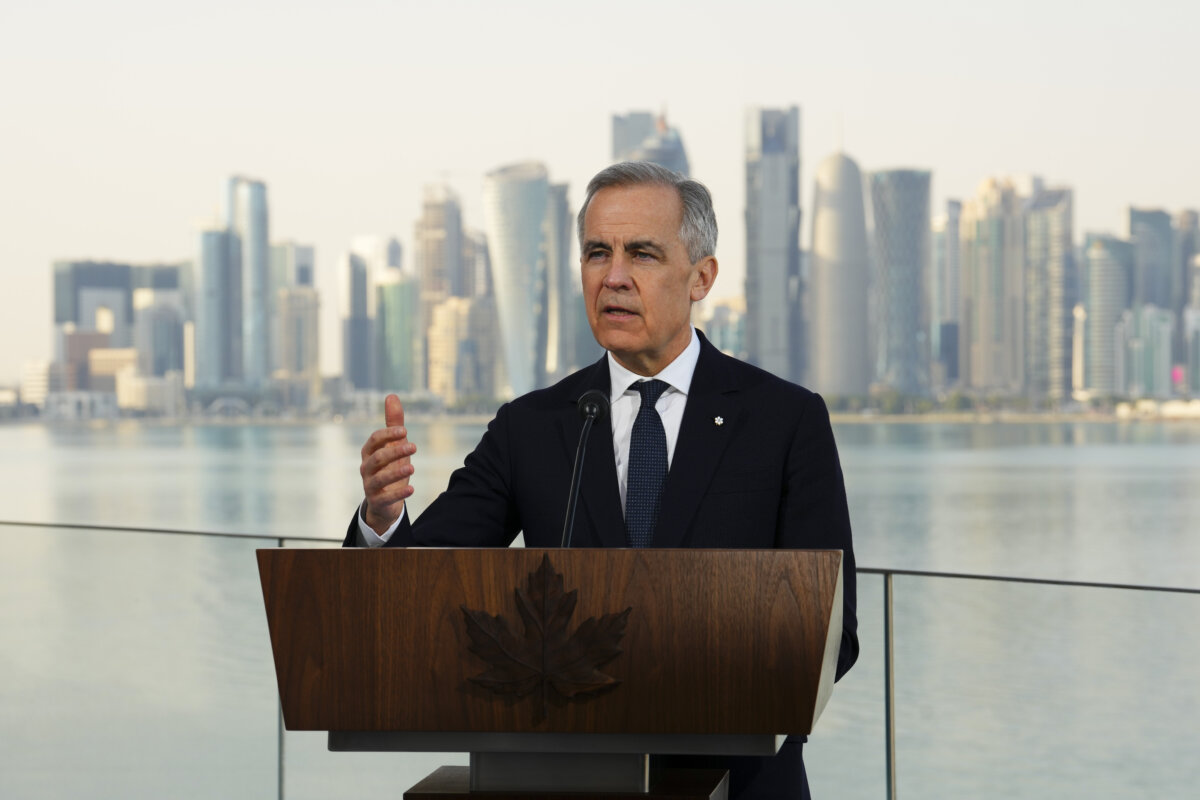
As the second phase of the peace plan for the Gaza Strip gets under way, Prime Minister Mark Carney says he accepted a role in U.S. President Donald Trump’s new governing body to oversee the territory.
“The president raised it with me a few weeks ago,” Carney said on Jan. 18 during his visit to Qatar. “I said, in principle, yes.”
The White House announced on Jan. 16 the appointment of the executive founding members of the “Board of Peace,” which aims to provide strategic insight, mobilize international resources, and ensure accountability during Gaza’s transition and reconstruction.
Some of the founding executive members include U.S. Secretary of State Marco Rubio, U.S. special envoy to the Middle East Steve Witkoff, Trump’s son-in-law Jared Kushner, World Bank President Ajay Banga, and former British Prime Minister Tony Blair.
Carney spoke on the matter during a press conference in Doha, Qatar, after being asked by reporters why he accepted the role on the Board of Peace and whether it’s acceptable for Canada to pay a $1 billion participation fee. Official terms of board participation haven’t been released, but a U.S. official told The Associated Press a $1 billion contribution would secure permanent membership on the board, whereas no contribution is required for a three-year membership. The funds collected would go to Gaza’s reconstruction.
Carney did not say whether Canada will pay $1 billion, but said he wants financial contributions to have the “maximum impact.” Carney said Canada has to make “every effort possible” to alleviate suffering in the Gaza Strip with humanitarian aid, and work to stabilize the area and eventually move towards peace and a two-state solution.
The prime minister said his decision to agree “in principle” to join the Board of Peace is “consistent” with Canada’s objectives.
“With respects to the specifics of the Board of Peace, we haven’t gone through all the details of the structure, how it’s going to work, what financing is for, etc. And so we will work through those in the coming days,” Carney said.
The leaders of a number of other countries have also received invitations in recent days, including Russian President Vladimir Putin and European Commission President Ursula von der Leyen, who haven’t yet confirmed whether they will join.
Other countries have agreed to participate, including Argentina, Hungary, Vietnam, and Belarus.
Along with the executive board for the Board of Peace, the White House announced the formation of a Gaza Executive Board, which includes Witkoff, Kushner, and Blair, along with regional and international political figures. Among those are Turkish Foreign Affairs Minister Hakan Fidan, senior Qatari official Ali Al-Thawadi, and Egyptian intelligence chief General Hassan Rashad.
Israel has objected to the composition of the Gaza Board, which includes Cypriot-Israeli businessman Yakir Gabay, but no Israeli official.
Board Role and Future Steps
The role of the Board of Peace, chaired by Trump, will include oversight of the newly formed National Committee for the Administration of Gaza. The committee will manage day-to-day operations in the Gaza Strip to include running core public services and civil institutions.
The Strip has been run by Hamas since the terrorist group took over in 2007. The group launched raids inside Israel in October 2023, leading to military operations by Israel to dismantle Hamas and return its kidnapped citizens.
Hamas agreed to most of Trump’s 20-point peace plan last fall to end the conflict, which included returning Israeli hostages.
While Hamas accepted handing power over to a transitional technocratic governing body, the group did not signal an intent to abandon its weapons as the plan stipulates. Hamas said in December it would hand over its weapons to a Palestinian authority if Israel completely withdraws. A part of the Gaza Strip remains under Israeli control.
Hamas also said it accepts the deployment of United Nations force to monitor the borders and the ceasefire.
Trump’s plan does not include the deployment of a U.N.-led force but rather a temporary “International Stabilization Force” (ISF), which has received the backing of the U.N. Security Council.
The White House on Jan. 16 announced that U.S. Major General Jasper Jeffers has been appointed commander of the ISF. Jeffers currently serves as commander for the Special Operations Command Central.
Details about the stabilization force’s composition and eventual deployment have yet to emerge. The force would be tasked with maintaining security and demilitarizing the Gaza Strip, which could lead to flash points with local armed groups.
 Friends Read Free
Copy
Facebook
Tweet
Friends Read Free
Copy
Facebook
Tweet