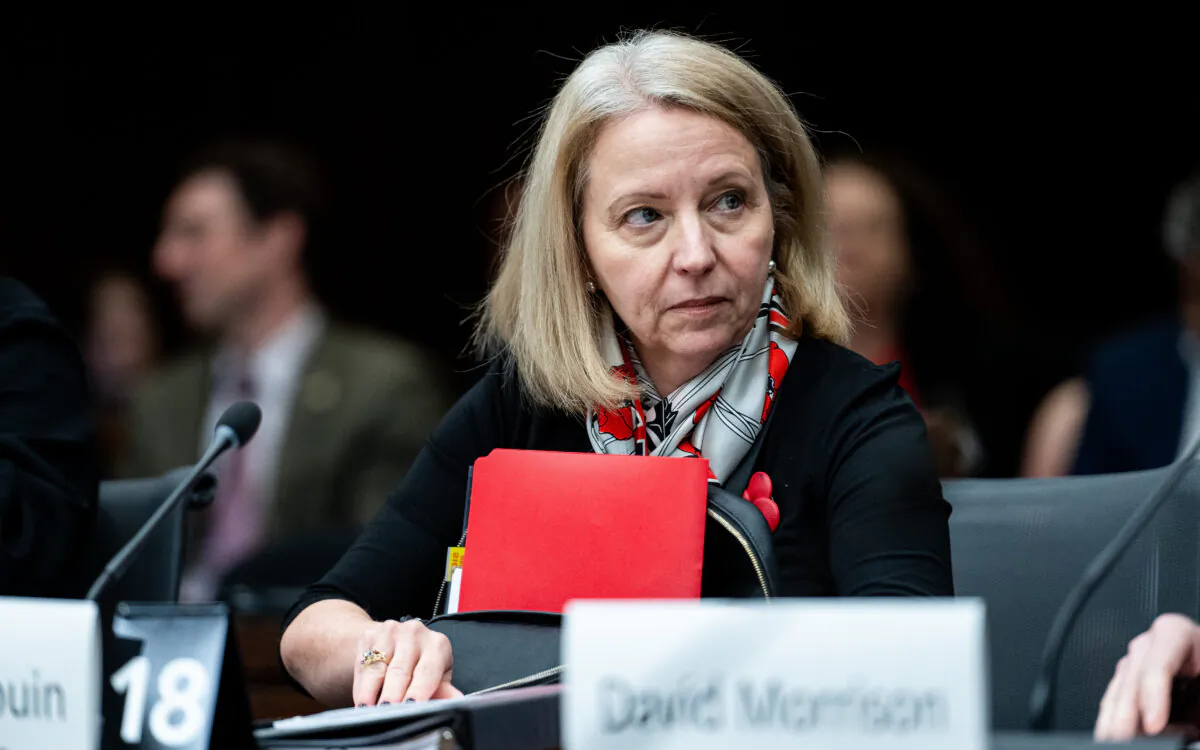

The Canadian prime minister’s National Security and Intelligence Advisor Nathalie Drouin has met with her Indian counterpart Ajit Doval, saying the two committed to “non-interference.”
“We discussed our respective security concerns and committed to non-interference including refraining from transnational repression,” Drouin said in a Sept. 20 statement. “We also agreed on the importance of reciprocal exchange of information and mutual responsiveness.”
The high-level meeting in India on Sept. 18 marked a further step in the rebuilding of bilateral relations between Ottawa and New Delhi. In recent years, Canada has accused agents of India of being involved in serious crimes in Canada, while India has accused the Canadian government of not cracking down on Khalistani activists who seek to carve an independent country out of India’s Punjab.
India’s Ministry of External Affairs also issued a statement following the meeting between Drouin and Doval in New Delhi, but it did not mention transnational repression. The ministry said the meeting was part of the regular bilateral security dialogue between the two countries.
“They had productive discussions on advancing the bilateral relationship including in areas such as counter terrorism, combating transnational organised crime and intelligence exchanges,” said the ministry’s statement, adding the two advisers acknowledged the “clear momentum” for rebuilding trust and cooperation.
Drouin’s visit came after Indian Prime Minister Narendra Modi visited Canada in June to attend the G7 Leaders’ Summit. The visit marked a reset in the relationship, and Ottawa and New Delhi subsequently re-appointed high commissioners.
Relations between Canada and India had plummeted in September 2023 when then-Prime Minister Justin Trudeau accused India of having a hand in the assassination of pro-Khalistan activist Hardeep Singh Nijjar on Canadian soil. Nijjar was organizing a secession referendum at the time.
India has denied being involved in violence in Canada, calling the accusations “absurd and motivated” and a way to deflect from “Khalistani terrorists and extremists” being “provided shelter in Canada.”
Trudeau’s accusations were later followed by Ottawa expelling six Indian diplomats on Oct. 14, 2024, including its high commissioner, saying they were “persons of interest” in the Nijjar assassination. India responded in kind by expelling Canadian diplomats. On the same day, the RCMP had also said Indian agents were involved in “serious criminal activity” on Canadian soil, including homicides.
The major moves by Ottawa and the federal police force had taken place two days after Drouin had met with her counterpart Ajit Doval in Singapore. Drouin told a House of Commons committee afterward she had presented Doval with evidence of the alleged illegal activities linked to India, along with options for New Delhi to address the matter.
Meanwhile, New Delhi said in a statement on Oct. 14, 2024, that Ottawa had “not shared a shred of evidence.”
“We were prepared for this accusation to resurface,” Drouin told the committee. She went on to explain how Ottawa hence made a “strategic decision” for Drouin to share information with the Washington Post under the cover of anonymity in order to spread the Canadian government’s message to a wide audience.
The Post reported on Oct. 14 that India’s Home Affairs Minister Amit Shah had allegedly authorized attacks against Sikh separatists in Canada. This information was not in the public domain before the Post’s article was published.
Drouin and Deputy Minister of Foreign Affairs David Morrison told the House committee they had not shared classified information with the Post. When pressed by an MP, Morrison admitted he had confirmed the information about Shah to the journalist. “The journalist called me and asked me if it was that person. I confirmed it was that person,” Morrison said.
Even though senior officials made the link between India’s Home Affairs Minister and acts of violence in Canada, Drouin later said India’s Prime Minister Narendra Modi was not involved.
“The Government of Canada has not stated, nor is it aware of evidence, linking Prime Minister Modi, [External Affairs Minister Subrahmanyam] Jaishankar, or NSA Doval to the serious criminal activity within Canada,” Drouin said in a November 2024 statement.
The Canadian Security Intelligence Service (CSIS) broached the Nijjar assassination case and foreign interference by India in its 2024 annual report. The report was released on June 18, shortly after Modi’s visit to Canada.
“Links between the Government of India and the Nijjar murder signals a significant escalation in India’s repression efforts against the Khalistan movement and a clear intent to target individuals in North America,” said CSIS.
The spy agency added that some Canadians are involved in “legitimate and peaceful” advocacy for the Khalistan cause, while “only a small group of individuals are considered Khalistani extremists because they continue to use Canada as a base for the promotion, fundraising or planning of violence primarily in India.”
CSIS said this threat of extremism drives Indian foreign interference activities in Canada.
 Friends Read Free
Copy
Facebook
Tweet
Friends Read Free
Copy
Facebook
Tweet