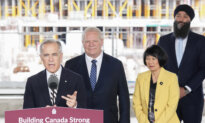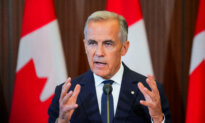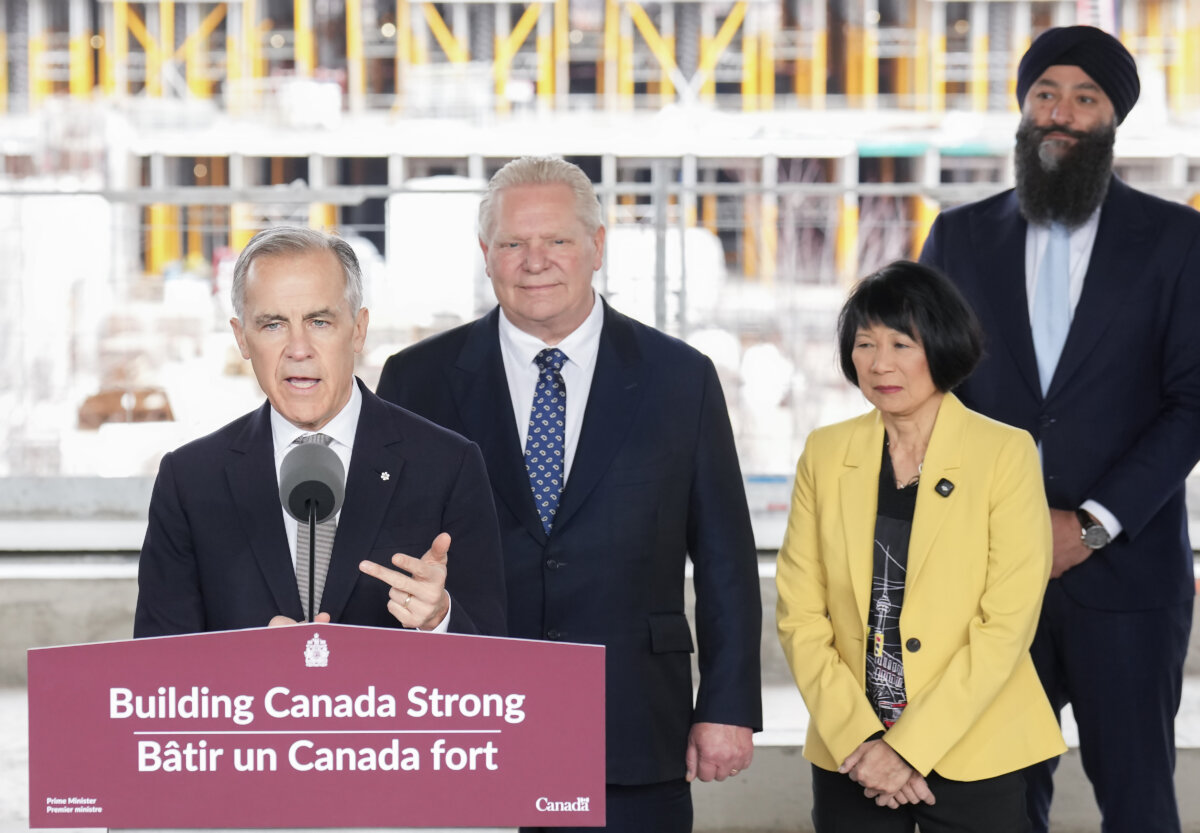
Prime Minister Mark Carney said forced labour occurs around the world when asked whether he believes the practice takes place in China, adding that some parts of China are at a “higher risk” of it.
Carney’s remarks came in response to questions from reporters on March 30, days after Liberal MP Michael Ma drew controversy over his interaction with a witness during a parliamentary committee meeting on electric vehicle policies. Ma appeared to dismiss the existence of forced labour in China while challenging witness Margaret McCuaig-Johnston, who is a China expert and former senior public servant.
Ma later apologized for his remarks but didn’t clarify whether he believes forced labour takes place in China, instead saying it takes place around the world.
Carney’s remarks on March 30 also come as the government confirmed Finance Minister François-Philippe Champagne will be in China this week to discuss trade and investments.
“I followed this issue over the years in China and elsewhere, and there is evidence … there’s existence, I should say, of child labour and forced labor around the world,” Carney told reporters when asked whether he believes there is forced labour in China.
“We recognize that this is a global issue that we need to be vigilant on, and not assume that … it’s not an issue in certain countries, including in certain developed countries.”
The prime minister said that companies have a reporting obligation in Canada in ensuring their supply chains are free of forced labour.
“There are parts of China that are higher risk and therefore [there needs] to be diligence,” Carney added.
Regarding Michael Ma, Carney said the MP apologized as appropriate and that he remains in the Liberal caucus. Ma, a first-time MP from Toronto, defected from the Conservatives in December 2025. Shortly afterward, he accompanied Carney to China in January as the only Liberal backbencher.
Conservatives criticized Carney’s response on the issue of forced labour in China, saying he’s sidestepping the question.
“Mark Carney dodges question about forced labour in China, giving the EXACT SAME answer as his Liberal MP who denied Beijing’s human rights abuses,” Conservative MP Chris Warkentin, who serves as his party’s whip, said on social media. “The question wasn’t about the world – it was specifically about China.”
Controversy
Ma’s comments in the meeting of the House of Commons industry committee on March 26 drew criticism from opposition MPs and human rights advocates.
In her remarks to the committee, McCuaig-Johnston, citing a Human Rights Watch report, said that components used in Chinese EVs are made with aluminum produced using forced labour from the ethnic minority Uyghurs. The House of Commons declared in 2021 that the Chinese Communist Party’s treatment of Uyghurs amounts to genocide.
“Your claim about forced labour in Shenzhen—have you witnessed this yourself? Have you been there ever?” Ma asked McCuaig-Johnston. Shenzhen is a key manufacturing hub in China.
Ma later apologized for his comments, saying he “inadvertently came across as dismissive of the serious issue of forced labour.” When asked by a reporter last week whether he believes there is forced labour in China, Ma said it takes place around the world.
The controversy surfaced as Chinese electric vehicles (EVs) are about to enter the Canadian market, following a deal Ottawa made with Beijing in January. In exchange for China removing or reducing tariffs on some Canadian agricultural and seafood products, Canada is allowing the entry of up to 49,000 Chinese EVs at a preferential duty.
Ottawa slapped a 100 percent surtax on Chinese EVs in late 2024, following in Washington’s footsteps. The nearly 50,000 EVs will benefit from the “most-favoured nation” tariff of 6.1 percent.
Forced Labour
The focus on forced labour in China, which is well documented by governments and human rights groups, is taking place ahead of another high-level visit.
Carney said the issue of forced labour could “technically” be brought up during meetings with Chinese officials, given that the economic dialogue with Beijing includes supply chain integrity issues.
“It would be part of the discussions as it is in other situations where we’re developing trade and after we’ve developed the trade agreements,” Carney said.
Champagne was asked by reporters on March 30 what he intends to do to make sure Chinese EVs imported in Canada do not have components made by forced labour. He said supply chain integrity is always something that his government raises during trade discussions.
Carney and Champagne both said that Canada has robust protections against the importation of goods made by forced labour. Parliament has legislated in recent years to strengthen regulations around the issue, but enforcement has been patchy.
Officials from the Canada Border Services Agency (CBSA) told a House of Commons committee late last year that since 2020, 48 shipments suspected of containing goods made with forced labour have been detained by the agency.
Out of those, 37 were released, two were prohibited, seven were re-exported, and one was abandoned, said Alexander Lawton, executive director of CBSA’s Commercial Programs Directorate.
Parliament amended the Customs Tariff in July 2020 to prohibit the import of goods made by forced labour.
By comparison, the United States detained a total of nearly 42,000 suspected shipments and denied nearly 23,000 from 2022 to 2026. The United States is taking action under the Uyghur Forced Labor Prevention Act.
 Friends Read Free
Copy
Facebook
Tweet
Friends Read Free
Copy
Facebook
Tweet