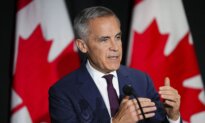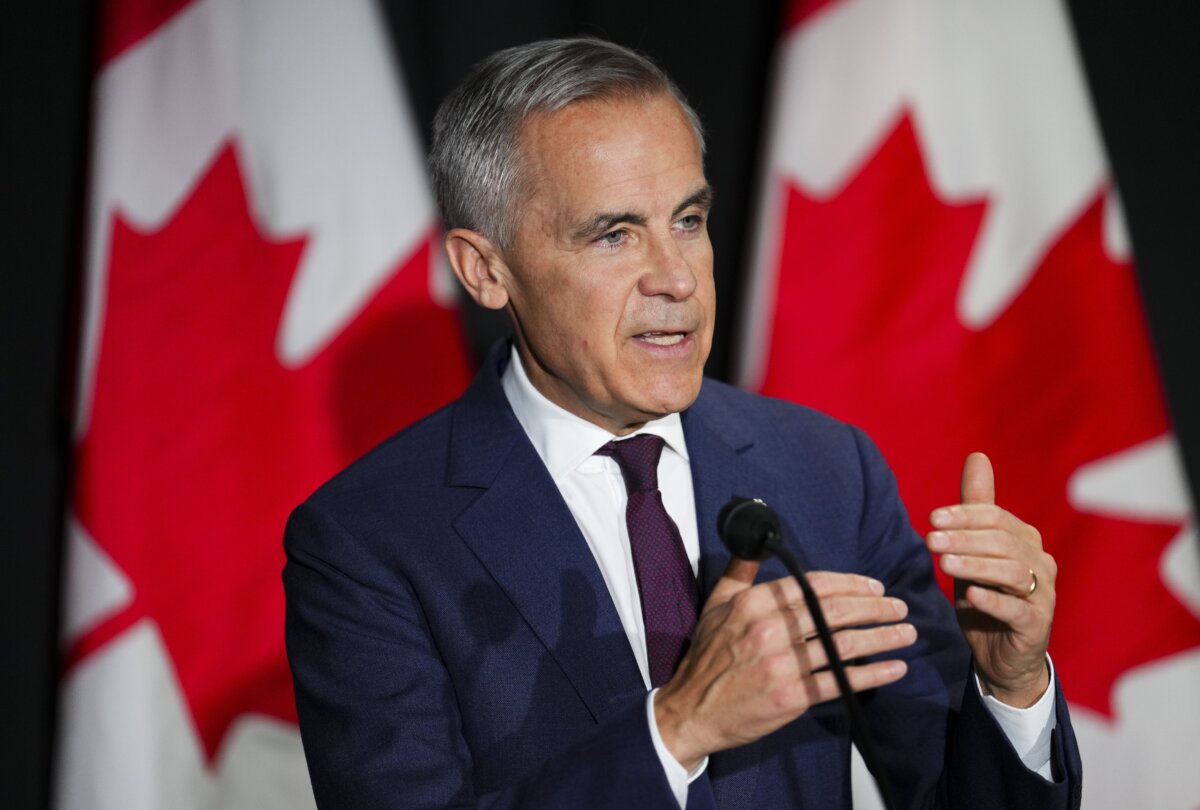

Canadian Prime Minister Mark Carney may be heading to Washington next week, his office says, but at this point, any discussions he has with U.S. President Donald Trump are likely to centre around World Cup soccer, not trade.
The Prime Minister’s Office has confirmed Carney is contemplating a trip to D.C. for the final draw on Dec. 5 for the FIFA World Cup 2026 tournament, but says no arrangements for any additional events in the U.S. capital have been established.
Canada, the United States, and Mexico are jointly hosting the 2026 World Cup, and the draw conducted by the Fédération Internationale de Football Association (FIFA) on Dec. 5 will establish the groups for the participating nations.
Canada and the United States have not participated in formal trade discussions since Trump ended talks on Oct. 23, and Carney has not appeared to be concerned about the pace of progress.
He told reporters while attending the G20 Leaders’ Summit in Johannesburg, South Africa, on Nov. 23 that he’s been busy with the federal budget and attempting to secure investment in Canada.
“We’ve had discussions. I’ve been busy,” Carney said when asked if he had spoken to Trump.
When reporters asked for more details on those conversations Carney replied, “Who cares? I mean, it’s a detail. I spoke to him. I’ll speak to him again when it matters.”
The prime minister added in French that he would likely speak with Trump within the next two weeks, before switching back to English to say, “I look forward to speaking to the president soon, but I don’t have a burning issue to speak with the president about right now.”
If Carney attends the FIFA draw next month it will be the first time he has seen Trump face-to-face since a private dinner on Oct. 29 in South Korea prior to the Asia-Pacific Economic Cooperation (APEC) summit.
Trump has also said he’s in no rush to resume trade negotiations with Ottawa.
When the president ended talks last month, he threatened to increase the tariff rate by 10 percent, citing Ontario’s $75 million anti-tariff ad campaign featuring excerpts from a 1987 radio address from late U.S. President Ronald Reagan. The ad used clips that appeared to condemn protectionist tariffs similar to those Trump has imposed on Canada.
The speech was made at a time when Reagan leveraged tariffs against Japan for what he called unfair trade practices, but he said it was a move he didn’t like making, adding that long-term use of tariffs increase prices and negatively impact U.S. workers.
Trump told reporters after the APEC summit that Carney had apologized to him for the controversial anti-tariff ad, but said he did not speak to him about trade.
“No, but I have a very good relationship,” Trump told a reporter aboard Air Force One on Oct. 31 when asked about resuming negotiations with Carney. Trump added that the prime minister had “apologized for what they did with the commercial, because it was a false commercial.”
Carney’s Comments Criticized
Opposition parties have criticized the prime minister’s weekend comments on Trump talks.
Tory Leader Pierre Poilievre noted during question period on Nov. 24 that Carney said he would speak to the president “when it matters.” The Tory leader said it matters now.
“He said there are no issues of importance to discuss,” Poilievre said. “In fact, he said, ‘who cares.’ We care about the workers who’ve lost their jobs and don’t have paycheques to make their mortgage payments. Why doesn’t he care?”
Canada-U.S. Trade Minister Dominic LeBlanc, who was at the forefront of the trade negotiations before they took a turn for the worse, rebuffed Poilievre’s comments.
“Just because the leader of the Opposition keeps repeating the same line over and over again doesn’t make it real,” LeBlanc said during question period. “We are going to continue to support Canadian workers and the Canadian economy and negotiate a deal with the United States.”
Poilievre said a central part of Carney’s election platform was that he was the best person to handle the “existential threat” of Trump’s tariffs but he has yet to secure a trade deal or any tariff relief.
Eight months have passed since Trump started to impose tariffs on goods imported from Canada and he has increasingly leveraged more tariffs against Canada since spring, raising its 25 percent tax on all imports that do not fall under the United States-Mexico-Canada Agreement (USMCA) to 35 percent on Aug. 1.
Trump has also implemented a 50 percent tariff on copper and aluminum imports, a 35 percent tariff on softwood lumber, and a 25 percent tax on heavy-duty trucks. He more recently put a 100 percent levy on branded drugs whose manufacturers don’t have plants in the United States, and a 50 percent tax on kitchen cabinets and bathroom vanities and a 30 percent tariff on upholstered furniture is in the works.
The countdown is also underway for a planned review of the USMCA trade agreement in 2026, during which the White House is expected to pursue the renegotiation of specific elements of the pact.
Tariffs could be incorporated into the USMCA renegotiations if Canada fails to secure an agreement with Trump prior to this review.
Reuters and Matthew Horwood contributed to this report.
 Friends Read Free
Copy
Facebook
Tweet
Friends Read Free
Copy
Facebook
Tweet