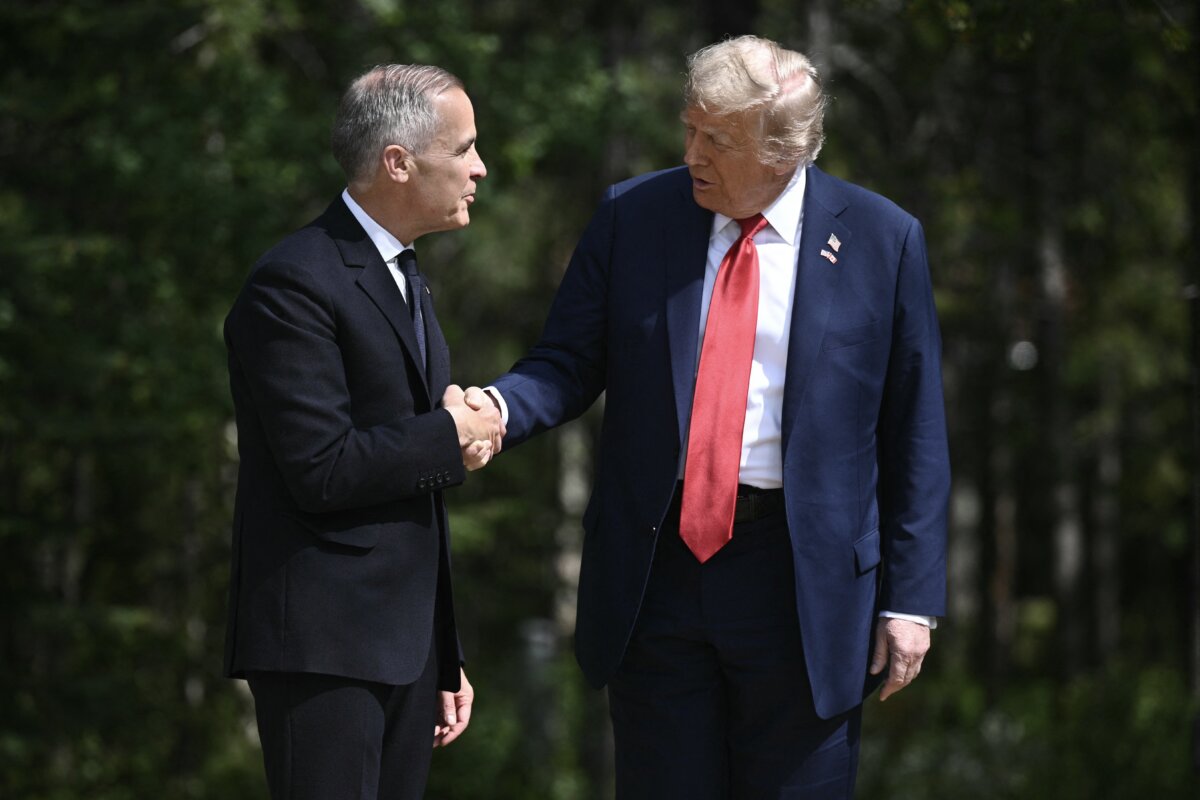

As a trade deal with the United States remains elusive, Prime Minister Mark Carney defended his government’s efforts and noted that negotiations are difficult.
Carney has come under fire from opposition party leaders for winning an election campaign on the promise of not backing down before U.S. President Donald Trump, but now facing a scenario where U.S. tariffs against Canada could remain in place even if a deal is reached.
Carney said on July 15 this could be expected given how things are playing out in other jurisdictions.
Announcing measures related to the steel industry in a press conference July 16 in Hamilton, Ont., Carney said he is working on getting the best deal possible with the United States.
“We will continue to work constructively for a deal, but it has to be a deal that works for Canadians and Canadian workers,” Carney said. “And part of the reason why we don’t have a deal is that deal is not yet on the table.”
Carney said the negotiations with the United States have been “long” and “tough.”
In a July 10 publicly released letter to Carney, Trump threatened to put 35 percent tariffs on all incoming Canadian goods not covered under the USMCA free trade deal. This would be an increase of 10 percentage points over the current rate.
His letter cited specific complaints regarding fentanyl entering the United States from Canada and “extraordinary tariffs” applied by Canada to U.S. dairy farmers through the supply management system. Trump gave a deadline of Aug. 1 before the new rate comes into force.
Trump also noted how Canada had retaliated against U.S. tariffs. Only Canada and China implemented counter-tariffs.
Carney would not say whether Canada will be maintaining tariffs on the United States if a deal is reached. “We’ll see what the final agreement is,” he said, adding that the best agreement would be one with “low tariffs.”
Touching on the ongoing softwood lumber dispute, Carney said a trade deal with the United States could include quotas on softwood lumber exports and “some element of managed trade.”
Canada and the United States have had no agreement on softwood lumber since 2015, and Carney said he agrees with B.C. Premier David Eby that resolving the dispute could be part of a larger trade deal.
The prime minister said resolving the matter is a “top priority” while adding that the United States is “running on a slightly different timetable” on the issue.
Trump’s public messaging has been that his country doesn’t need a variety of products coming from Canada.
Energy Minister Tim Hodgson said July 11 that Canada has “many important cards” in trade talks with the United States, particularly in terms of “energy and natural resources.” Hodgson said that the United States does need Canadian products, especially automobiles, steel, aluminum, lumber, uranium, potash, and electricity.
Meanwhile, opposition leaders have criticized the Carney government over the latest developments.
Conservative Leader Pierre Poilievre said in a social media post on July 16 that Carney has folded to U.S. trade demands. He said that “accepting permanent U.S. tariffs on Canada” is “a complete and utter capitulation.”
NDP Interim Leader Don Davies posted July 14 that “Carney promised ‘elbows up’ during the election – Canadians expect him to keep that promise.”
 Friends Read Free
Copy
Facebook
Tweet
Friends Read Free
Copy
Facebook
Tweet