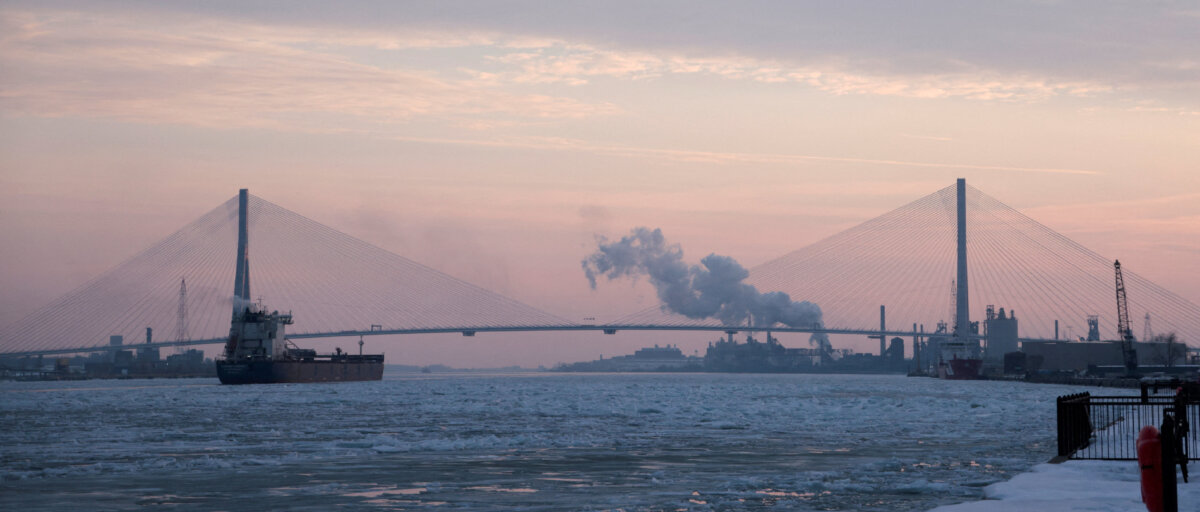

Prime Minister Mark Carney answered reporters’ questions on July 16 about Canada’s revised toll-collection agreement with the United States for the Gordie Howe International Bridge, though many details remain unclear.
Under the previous agreement signed in 2012, all of the toll revenue for 36 years was to go to the Canadian government, given that it agreed to finance the full construction costs for the bridge, which came to $6.4 billion. After Canada had fully recouped the costs, toll revenues were to be split with the state of Michigan.
After the United States delayed the opening of the Gordie Howe bridge last month following its criticism of the original deal, the two countries made a new agreement on July 10 to open the bridge at the end of the month.
Under the new agreement, Canada will split “net revenues … after operational costs” with the United States for 15 years, Carney said on July 16 in London, Ont. Expenses include staffing, maintenance, snow removal, and other such costs, he said.
Still, details about the agreement remain murky, as Carney insisted that “any sharing of the toll revenue won’t happen until all of the debt is repaid.”
He said for the first few years, “net revenues” are expected to be negative.
“We expect that after those costs, for the first few years, net revenues will be modest. In fact, we expect them to be negative as traffic ramps up,” he said.
When asked if he could share more details about the deal signed between the two countries, Carney said the incentives between Canada and the United States are aligned because the regional economic investment in Michigan is “obviously good for Michigan, but it’s also good for Canada because it’s going to reinforce the traffic” over the bridge.
He also defended the net revenue being split with Michigan earlier than had been agreed to previously.
“All of the portions that go to the U.S. government will be reinvested in economic development, regional economic development in the area, the U.S. side of the area, obviously, which is pro-cyclical,” he said. “It reinforces you know, more traffic, higher revenues, more investment, and that’s the way it moves forward.”
Six Conservative MPs sent a letter to Canada-U.S. Trade Minister Dominic LeBlanc on July 12, saying that Carney signed a “terrible deal for Canada,” given that “Canada paid 100% of the cost” of building the bridge in exchange for a promise that it would receive all toll revenue until the cost was repaid.
The MPs also asked in their letter what authority the United States has gained over toll rates, if the deal changed the bridge’s ownership or governance, if any bridge revenue will be placed into the economic development fund before Canadian taxpayers recoup the project’s full cost, and what Canada received in return for signing the deal.
Conservative MP Shuv Majumdar, who is his party’s Canada-U.S. relations critic, said on July 16 that Ottawa has made a “concession” on the bridge, and asked for the full details of the deal to be released.
U.S. Ambassador to Canada Pete Hoekstra has said that his country is revisiting the deal because the project has gone over budget and faced delays, altering the business model under which it was originally agreed upon. He also argued that the new bridge is diverting revenue from the existing, privately owned Ambassador Bridge, rather than generating all new revenue.
 Friends Read Free
Copy
Facebook
Tweet
Friends Read Free
Copy
Facebook
Tweet