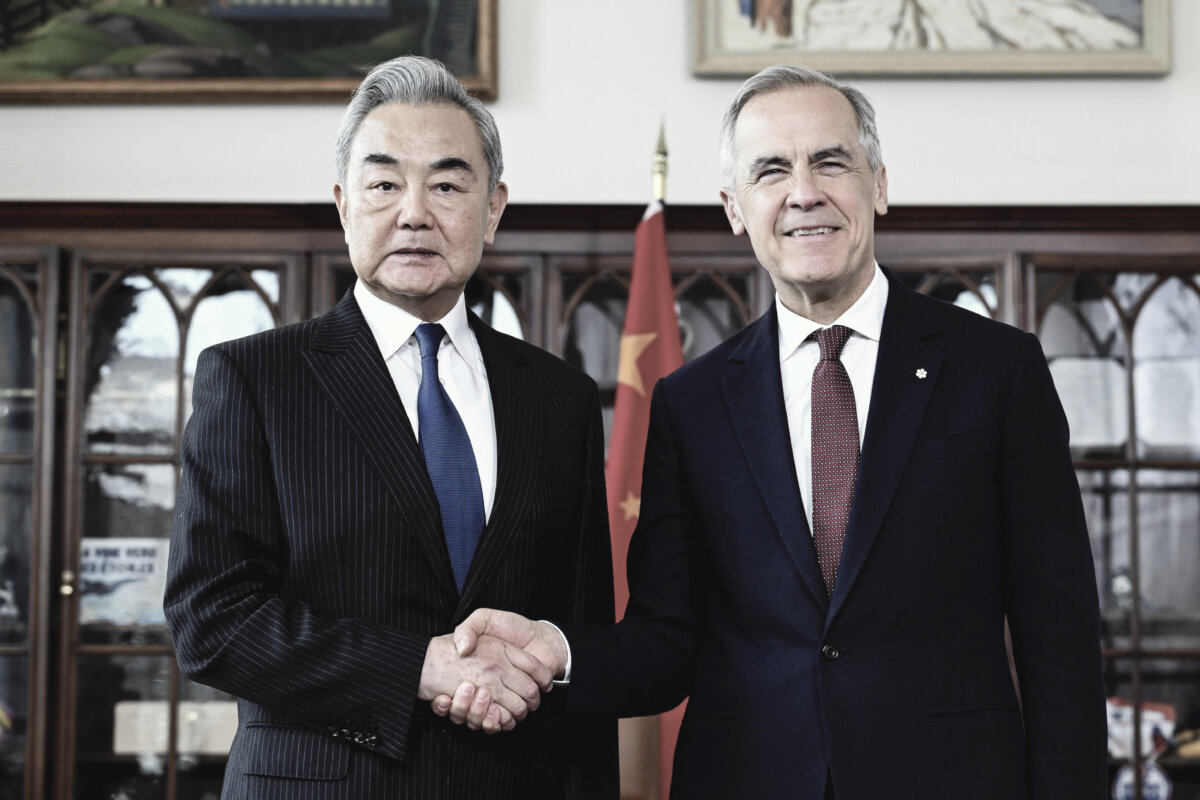
As Prime Minister Mark Carney met with Chinese Foreign Affairs Minister Wang Yi on May 29 in Ottawa, measures were taken to limit media coverage of the event.
The handshake between the two men was initially supposed to only be captured by official photographers, per the prime minister’s itinerary released by his office.
After some pushback from the Parliamentary Press Gallery, however, media were allowed to briefly enter Carney’s office across from Parliament Hill to capture the handshake with Wang. After less than 30 seconds, reporters were asked to leave the room by a cabinet press secretary.
Neither Wang nor Carney made any comments to reporters, and no press conference was scheduled for that day.
The Epoch Times reached out to the prime minister’s office but didn’t hear back.
During Wang’s last visit to Canada in 2016, he criticized a Canadian reporter who had asked about human rights in China during a press conference with then-Foreign Affairs Minister Stéphane Dion.
Before his meeting with Carney, Wang went to the Global Affairs Canada headquarters a few kilometres from Parliament Hill to meet with Foreign Affairs Minister Anita Anand.
The two ministers offered public opening remarks at the beginning of their meeting.
Anand said her government wants to deepen ties with China “responsibly” and increase exports to 50 percent, “while safeguarding Canada’s economic and national security interests and values.”
Anand did not publicly raise concerns about issues like foreign interference or human rights, but said that Canada and China “must address critical issues and priorities to ensure the safety and security of our peoples.”
Wang noted how the relationship with Canada has progressed since Anand became foreign minister last year. He said if ties continue to improve, Canada could double its exports to China.
Wang said there have been “ups and downs” in the bilateral relation which have provided “many important lessons.”
“We must uphold mutual respect, seek common ground while reserving differences, maintain strategic independence, and pursue mutual benefit and win-win cooperation,” he said.
The previous government of Justin Trudeau was building deeper ties with China after it came to power in 2015, but pulled back on engagement following the Meng Wanzhou affair.
Canada enforced a U.S. extradition request for Huawei executive Meng in late 2018 who was wanted for fraud. China in apparent retaliation arbitrarily detained Canadians Michael Kovrig and Michael Spavor for over 1,000 days.
Following this development, the Trudeau government took a series of actions to protect the Canadian economy against Chinese industrial takeovers and espionage, including by banning Huawei from the 5G wireless infrastructure.
Later in his term, Trudeau called for holding a public inquiry into foreign interference after leaked intelligence depicted widespread meddling by Beijing.
The Foreign Interference Commission concluded that China is the foremost perpetrator of foreign interference in Canada. The commission said that meddling might have impacted results at the riding-level in the 2019 and 2021 elections, but did not impact the overall results.
During the 2025 election campaign, Carney called China the top security threat to Canada because of foreign interference.
The federal government has since made efforts to increase ties with Beijing as it seeks to diversify trade away from the United States amid tariffs imposed by the Trump administration.
These efforts culminated with Carney visiting China in January and establishing what he described as a “new strategic partnership.”
Wang’s visit aims to advance the implementation of that partnership, according to Global Affairs Canada. This is the first visit by a Chinese foreign affairs minister to Canada since 2016.
Wang said he has invited Carney to visit China again in November to attend the meeting of the Asia-Pacific Economic Cooperation summit.
 Friends Read Free
Copy
Facebook
Tweet
Friends Read Free
Copy
Facebook
Tweet