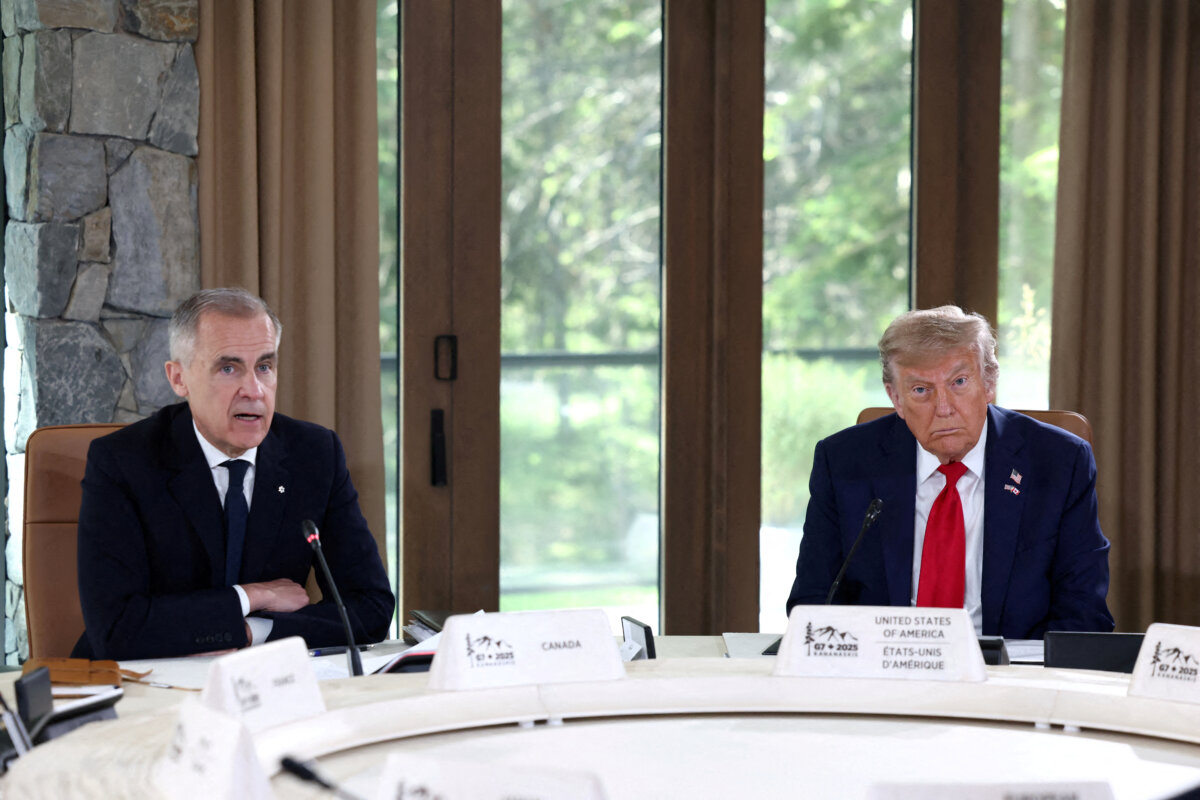

Prime Minister Mark Carney says he will safeguard Canadian economic interests and work with Washington on a new trade deal by Aug. 1 in light of U.S. President Donald Trump’s new threat of 35 percent tariffs on Canada.
The prime minister had previously said the two countries are aiming to reach a new deal by July 21.
“Throughout the current trade negotiations with the United States, the Canadian government has steadfastly defended our workers and businesses,” Carney said late on July 10. “We will continue to do so as we work towards the revised deadline of August 1.”
Trump posted a letter to his Truth Social Platform just after 8 p.m. EST on July 10, saying Canada has done little to cooperate with the United States on the fentanyl crisis, and that he was imposing a 35 percent tariff on Canadian imports beginning Aug. 1.
“As you will recall, the United States imposed Tariffs on Canada to deal with our Nation’s Fentanyl crisis, which is caused, in part, by Canada’s failure to stop the drugs from pouring into our Country,” he wrote.
“Instead of working with the United States, Canada retaliated with its own Tariffs. Starting August 1, 2025, we will charge Canada a Tariff of 35% on Canadian products sent into the United States, separate from all Sectoral Tariffs.”
Trump also vowed to hit back with even higher levies if Canada decides to raise its tariffs in response. Canada imposed a set of counter-tariffs after Washington imposed tariffs on Canadian imports earlier this year, but has since removed some of those counter-measures.
“These Tariffs may be modified, upward or downward, depending on our relationship with your country,” Trump said.
Carney said Ottawa is committed to working with its southern neighbour on several issues, including tackling the fentanyl crisis.
“Canada has made vital progress to stop the scourge of fentanyl in North America,” he wrote on X. “We are committed to continuing to work with the United States to save lives and protect communities in both our countries.”
Carney said his government is working with the provinces to strengthen Canada’s economy, and is also working to diversify its trading partners.
“We are building Canada strong. The federal government, provinces and territories are making significant progress in building one Canadian economy,” he said.
“We are poised to build a series of major new projects in the national interest. We are strengthening our trading partnerships throughout the world.”
Conservative Leader Pierre Poilievre called Trump’s latest tariff announcement “another unjustified attack on Canada’s economy.”
A July 10 social media post by the Tory leader said the tariffs will “damage” both countries.
“All Canadians must come together to defend our economy,” he said. “Conservatives stand ready to do everything we can to secure the best deal for Canada.”
The White House was originally set to announce new trade deals with multiple countries by July 9, but has since changed the timeline to Aug. 1.
Canadian exports to the United States are currently subject to 25 percent tariffs, except for products that fall under the United States-Mexico-Canada Agreement. In addition, Canada is also subject to sectoral tariffs that are applied to all countries, such as those on steel, aluminum, and the newly announced copper tariffs set to take effect on Aug. 1.
Trump said in his July 10 letter that the new 35 percent tariff is “separate from all Sectoral Tariffs.”
Ongoing Trade Dialogue
Trump’s letter said no tariffs would be charged on Canadian companies that opted to “build or manufacture” products in the United States.
The letter also referred to Canada’s supply management system in the dairy sector, saying Canada charges “extraordinary” tariffs of up to 400 percent on U.S. dairy farmers’ products.
“And that is even assuming our Dairy Farmers even have access to sell their products to the people of Canada,” Trump wrote. “The Trade Deficit is a major threat to our Economy and indeed our National Security.”
Parliament recently passed legislation introduced by the Bloc Québécois to keep the supply management system off-limits in trade negotiations. Supply management refers to a system that regulates the production, pricing, and imports of dairy products, eggs, chicken, and turkey to ensure a predictable market. The system was created in 1972 in response to decreasing prices in the sectors, and it imposes tariffs of up to 300 percent on products from other countries.
Canada’s tariffs on American dairy imports are implemented after U.S. dairy farmers fill their tariff rate quota. In this case, the tariff rate quota allows a specific amount of dairy products to be imported for free or at a lower tariff rate, while imports exceeding that quantity are subject to the higher tariff.
Canada had to increase the limit for U.S. exporters during the first Trump presidency to secure his agreement for the United States-Mexico-Canada Agreement.
Trump said on June 27 that he was ending trade talks with Canada over its planned digital services tax (DST) which imposes a 3 percent levy on tech companies such as Netflix collecting revenue from Canadian customers. Ottawa said on June 29 that it was rescinding the DST, and that trade talks have resumed.
Fentanyl Trafficking
Canada responded to fentanyl- and illegal migration-related tariffs late last year and early this year by implementing increased border protections, deploying more helicopters and drones, and assigning additional personnel to border security as part of a $1.3 billion plan. Canada also appointed a “fentanyl czar,” listed Mexican cartels as terrorist groups, and launched a Canada-U.S. joint strike force to combat cross-border drug crime.
Canadian officials have been making the point that the amount of fentanyl being trafficked into the United States from Canada is very small.
A July 1 report from American think tank Manhattan Institute found that large Canadian-border seizures were “relatively rare,” with only 1 percent of fentanyl pills, capsules, or tablets seized along the Canadian border. The report cited the U.S. southern border shared with Mexico as a much larger problem.
“Counties along the Mexican border account for only 2.35% of the U.S. population; but in 2023–24, they hosted about 40% of the nationwide quantity of fentanyl appearing in large seizures, for both powder and pills,” the report said. “By contrast, counties in the lower 48 states that border Canada account for 3.1% of the U.S. population but only 1.2% of the powder and just 0.5% of the pills obtained in large seizures.”
American officials, however, have expressed concern about fentanyl precursors from China being diverted from Canada into the United States, and drug cartels operating in Canada.
“They’re sailing around to Vancouver and coming in by air,” FBI Director Kash Patel told Fox News in May.
“You know who has to step in? It’s Canada, because they’re making it up there and shipping it down here.”
 Friends Read Free
Copy
Facebook
Tweet
Friends Read Free
Copy
Facebook
Tweet