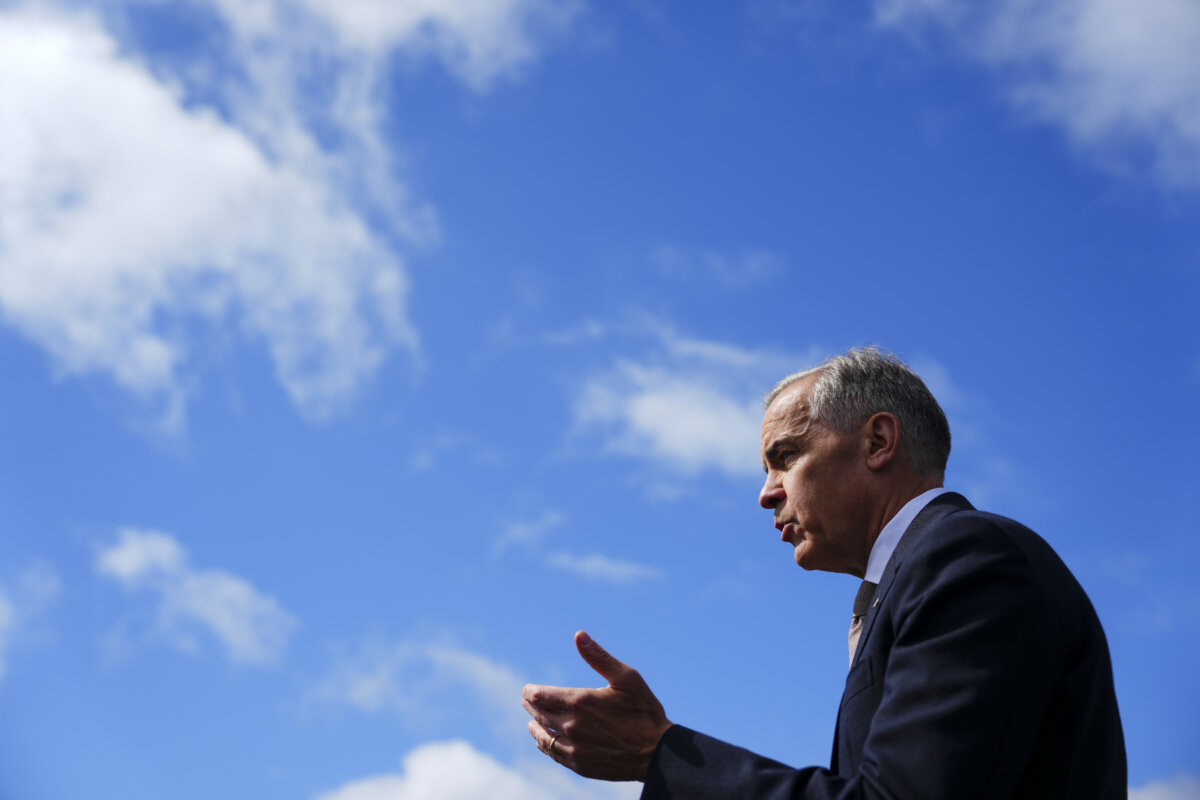

Prime Minister Mark Carney says Alberta Premier Danielle Smith’s decision to add a referendum question to the province’s Oct. 19 referendum ballot could “backfire,” comparing it UK’s Brexit vote a decade ago.
Carney told reporters in Ottawa on May 25 that separation votes can be presented as a way to “strengthen your hand in a future negotiation,” but that this can be a “very dangerous bluff.”
“I saw firsthand what happened in the United Kingdom when the view was, ‘vote for this, it’ll be soft, and then we’ll negotiate.’ And they’re still, 10 years later, trying to undo what people didn’t think they were voting for, but what they ended up having,” Carney said.
The 2016 Brexit vote saw a slim majority of people in the United Kingdom vote for the country to leave the European Union, which was then finalized in 2020. Supporters of Brexit point to gains in sovereignty and policy flexibility, while critics argue the economic downsides have outweighed the benefits so far.
Smith announced on May 21 that her government would include a question on separation in the province’s upcoming referendum ballot. The Oct. 19 ballot will ask: “Should Alberta remain a province of Canada or should the Government of Alberta commence the legal process required under the Canadian Constitution to hold a binding provincial referendum on whether or not Alberta should separate from Canada?”
Alberta Court of King’s Bench Justice Shaina Leonard ruled shortly before Smith’s announcement that Elections Alberta improperly approved a citizen-led separatist petition, finding that the province had not met its constitutional duty to consult First Nations. She said that because secession would directly affect Treaty rights, such consultations must take place before a petition process of this kind can proceed.
The campaigners behind the referendum question had managed to collect 301,620 signatures, far exceeding the 178,000 required, which is equal to 10 percent of the total votes cast in the last provincial election.
In her reasoning for adding a separation question to the ballot, Smith said that while she favoured a sovereign Alberta within Canada, she was “deeply troubled by an erroneous court decision that interferes with the democratic rights of hundreds of thousands of Albertans.” Smith said it was unlikely that Elections Canada would be allowed to hold a referendum on separation, given that the appeal process would take several months or even years, which was why her government was adding the question to the ballot.
Carney was asked if he had advised Smith against putting a separation referendum question on the ballot, to which he responded, “the premier doesn’t always take my advice.” The prime minister added that it is “not helpful” to ask such questions.
Carney also said that Albertans had not given the mandate to the United Conservative Party government to pursue a referendum on separation, and no such referendum had been mentioned during the 2023 provincial election.
“It wasn’t on the ballot paper, wasn’t in the mandates or platforms of the governing party and the official opposition,” he said.
Carney said the federal government is reviewing Smith’s ballot question to see if it triggers the Clarity Act. That 2000 law, passed following the 1995 Quebec independence referendum, allows for the House of Commons to decide whether a provincial referendum question is clear before it is put to voters.
“We have an obligation as a federal government to look at the question and decide whether it’s consistent. That is underway. If there are questions about the clarity of the question, that will be a role for Parliament,” Carney said.
Carney said there is a “strong case” for a united Alberta within Canada, and the federal government would continue making the case for that. Carney said the recent deal he made with Smith that could lead to a new oil pipeline to the West Coast is an example of “co-operative federalism” to hold Canada together.
That deal decrees that Alberta’s effective industrial carbon price will increase to $130 a tonne by 2040, compared to the Liberal government’s previous proposal of $170 per tonne by 2030. Construction on the pipeline could begin as early as Sept. 1, 2027, and Alberta expects it could be completed by 2034.
Conservative MP Michelle Rempel Garner, whose riding is in Alberta, said on May 25 that Carney “has no right to wag his finger.”
“The reality is that there is a lot of frustration in Alberta after 10 years of Liberal policy that essentially shut down the energy sector’s growth and stymied a lot of projects,” Rempel Garner said at a press conference in Ottawa.
Referring to Carney’s tenure as the governor of Bank of England and what transpired with Brexit at the time, as well as his role as the head of the U.N’S Net-Zero Banking Alliance, she said Carney and the Liberals “need some humility at this moment.”
“[On Brexit] he came out as part of Project Fear, and it backfired. I would strongly caution him from doing that again, and the tone that he gave this morning was not responsible in that regard,” she said.
“What we need to do right now is that the Liberals need to project hope, not fear, and to do that they have to start addressing some of the deep and real frustrations of the people of my province.”
Conservative Party Leader Pierre Poilievre has said his party will be campaigning in Alberta to promote Canadian unity.
 Friends Read Free
Copy
Facebook
Tweet
Friends Read Free
Copy
Facebook
Tweet