

Prime Minister Mark Carney says Canada is ready to do “whatever it takes” in response to the “unwarranted” American tariffs.
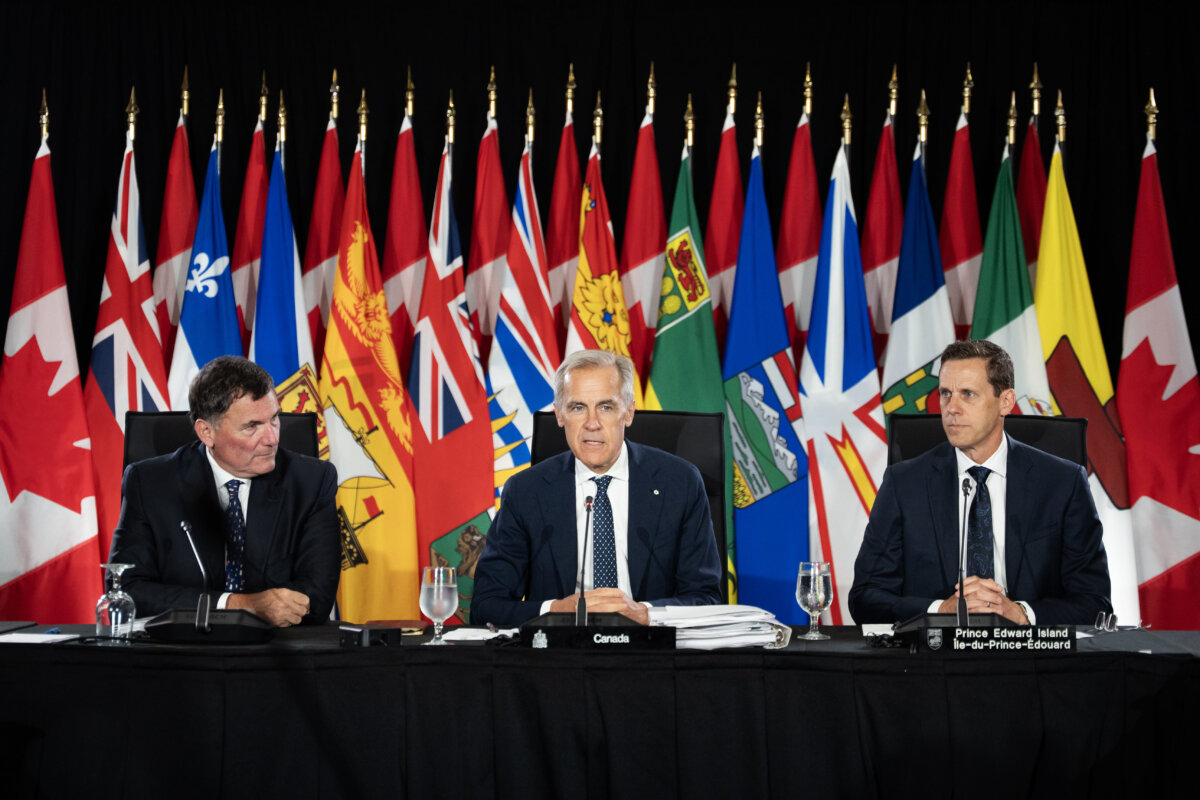
Carney made the remarks July 23 at a gathering of Canada’s 13 provincial and territorial premiers in Charlottetown, P.E.I., prior to closed-door meetings. He said Canada is united in the face of the 50 percent tariffs set to take effect Aug. 19 on various Canadian exports to the United States.
“On Monday, the U.S. administration announced its intention to impose the latest in a series of unilateral, unwarranted trade actions, and we’re clear: Canadian governments around this table will do whatever it takes to defend and support our families, our workers, and our businesses,” Carney said.
Carney said Canada is in a “stronger position” than 18 months ago, pointing to expanded trade relationships with various countries, reduction of interprovincial trade barriers, and progress on major infrastructure projects.
Emphasizing trade diversification, Carney cited Canada’s 16 free trade agreements with 51 countries that account for about two-thirds of the world’s GDP, giving the country access to 1.5 billion consumers. He said Ottawa intends to double that market access by the end of this year.
“We’re all working to diversify our partnerships abroad, doubling the scale of those markets to over 3 billion people around the world. And we’re building strength at home, building one Canadian economy,” Carney said.
Speaking to reporters following a meeting with the premiers, Carney said the Canadian government would do whatever was needed to help Canadians if the United States follows through with its threat of 50 percent tariffs on Aug. 19.
“Everything’s on the table if there’s no agreement, depending on the outcome of the negotiations, ” Carney told reporters when asked if Ottawa was willing to impose retaliatory tariffs on Washington.
Carney said his government is focused on building the economy and diversifying trade relations, assisting economic sectors affected by tariffs, and respond “if these tariffs or other measures come into force.”
“We don’t need to respond in advance. In fact, I think it would be counterproductive at this stage to respond in advance. But it’s important to know what your options are,” Carney added.
Carney also responded to the news that United States Trade Representative Jamieson Greer hopes to present Trump with options by the end of the year for “interim arrangements” with Canada and Mexico relating to the Canada–United States–Mexico Agreement (CUSMA), calling it a “sensible approach.”
Carney said these interim agreements would be “consistent with the structure” of CUSMA, with bilateral arrangements reflecting the different economic issues between the three countries.
The proclamations signed on July 20 by U.S. President Donald Trump impose 50 percent tariffs on roughly $28 billion worth of Canadian goods, including alcohol, automobiles, and dairy products, regardless of whether the products comply with the conditions of CUSMA.
Washington said the new measures are a response to “discriminatory” Canadian trade practices against U.S. exports, especially American automobiles, alcohol, and dairy products.
Conservative Leader Pierre Poilievre has called Trump’s latest tariffs “unjustified,” and said the Carney government must do more to mount an effective response and give Canada “unbreakable leverage abroad.”
“That means unblocking pipelines, LNG plants, port expansions and other privately-funded infrastructure to reach world markets. It means unblocking our resources and committing to a Strategic Energy and Minerals Reserve that is available to allies who have agreed to provide tariff-free market access,” Poilievre wrote in a July 21 statement posted to social media.
Poilievre has argued that Canada must respond to U.S. tariffs by reducing regulations that he says obstruct development, including the oil tanker ban on B.C.’s north coast, permitting and approval processes for resource and energy projects, and repeal of laws such as the federal impact assessment act.
 Friends Read Free
Copy
Facebook
Tweet
Friends Read Free
Copy
Facebook
Tweet