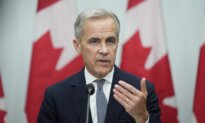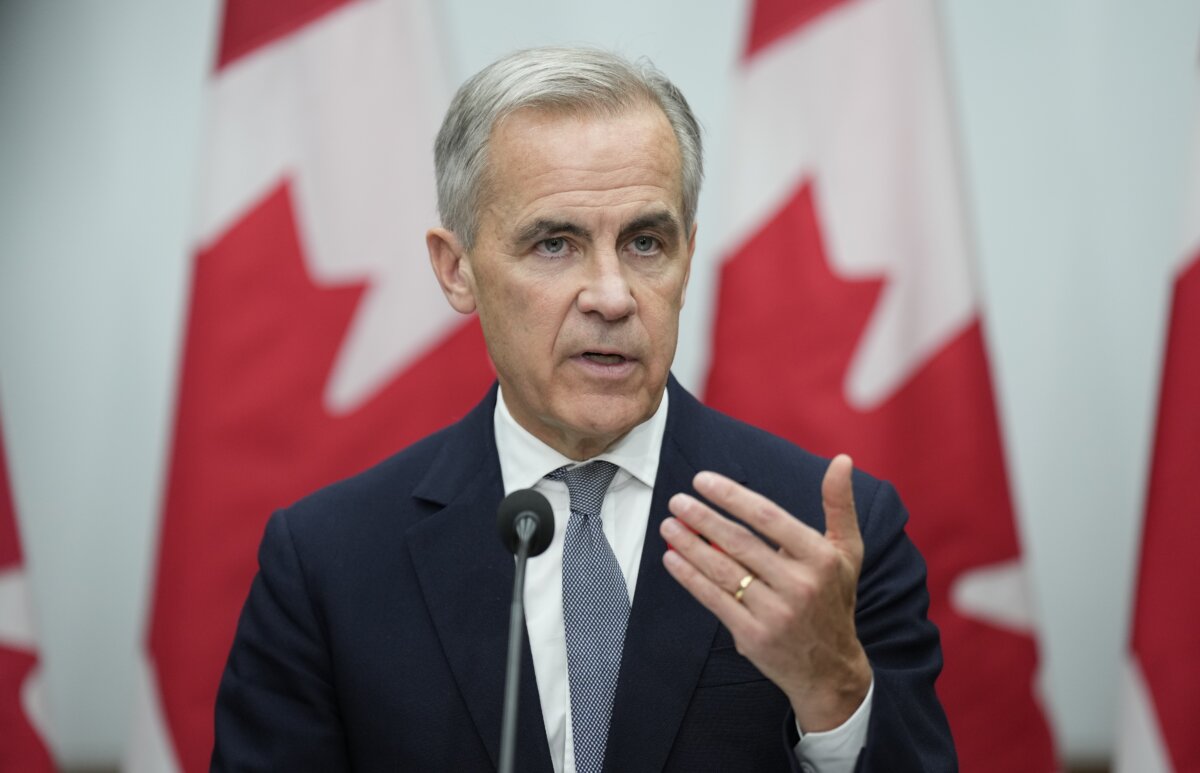

Prime Minister Mark Carney said he discussed the issue of foreign interference when he met Chinese leader Xi Jinping during their first formal meeting at the Asia-Pacific Economic Cooperation (APEC) forum in South Korea on Oct. 31.
“We had a discussion on foreign interference,” Carney told reporters during a press conference the next day before leaving the summit in Gyeongju.
The prime minister was asked by a reporter at the Nov. 1 press conference if he brought up the issue with Xi, as neither Ottawa’s nor Beijing’s readout of the Oct. 31 meeting mentioned human rights abuses such as the Uyghur detention camps, Canada’s national security concerns about China’s transnational repression, or the regime’s meddling in Canadian elections.
Carney said the two discussed a range of other topics, including mutual economic interests, but he noted that the Chinese leader is not on the same page with Canada on foreign interference.
“I don’t think they recognize the level of concerns we have about these issues,” the prime minister said. “But we manage these issues in Canada; we have a structure to manage them.”
Concerns have been high in Ottawa about foreign interference and transnational repression being carried by the Chinese regime in recent years, with a public inquiry set up to look into the issue. The final report of the Foreign Interference Commission in January said that China is “the most active perpetrator of foreign interference targeting Canada’s democratic institutions.”
The Prime Minister’s Office’s readout of the Oct. 31 meeting made no mention of Beijing’s human rights violations or foreign interference on Canadian soil. The message centred on establishing bilateral trade relations, saying that both Carney and Xi had “directed their officials to move quickly to resolve outstanding trade issues and irritants”—with special mentions of sectors including agriculture and agri-food products such as canola, along with seafood and electric vehicles.
The current trade issues with China include Chinese tariffs placed on Canadian agriculture and seafood products in retaliation for Ottawa imposing duties on Chinese steel, aluminum, and electric vehicles.
‘Manage All of Our Threats’
Carney said at the Nov. 1 press conference that Canada’s strategy in working with China will be to “find common ground” where it can be found and, where there are “big differences” between the two nations, “our governments will respect those.”
Carney’s comments marked a shift from his previous remarks during the federal election campaign in April that China was the “biggest security threat” facing Canada. He had also said in March that potential trading partners in Asia that share Canadian values “don’t include China.”
The tone appears to have changed as Ottawa seeks to rebuild relations with Beijing and resolve trade issues amid trade tensions with the United States. After the meeting with Xi on Oct. 31, Carney said he was “very pleased with the outcome” and that he also received an invitation from the Chinese leader to visit China, which he accepted. No date was provided, but the prime minister said it would be “soon enough.”
Questioned if he still stood by his earlier comment that China presents the biggest threat to Canada’s national security, Carney didn’t answer directly, saying his government has to “manage all our threats.”
“There are a number of threats from countr[ies] mentioned, [such as] Russia. We have non-state actor threats, which are material,” he said, adding that his top-level security clearance allows him to be “better informed about some of the threats,” a reference to a criticism that the Liberals had levelled at Conservative Leader Pierre Poilievre during the previous election campaign when the Tories criticized the government on its handling China’s foreign interference.
The Liberals last year asked all party leaders to obtain the security clearance needed to read an unredacted version of intelligence documents on parliamentarians who may be acting inappropriately when it comes to foreign interference. Poilievre refused, saying he had security clearance but that getting that specific clearance would in effect gag him from criticizing the government.
The Oct. 31 engagement during the APEC summit was the first meeting between Canadian and Chinese leaders since former Prime Minister Justin Trudeau visited Beijing in December 2017. Aside from trade, relations between the two countries soured in late 2018 when the RCMP arrested Huawei executive Meng Wanzhou in Vancouver on a U.S. extradition request for fraud and conspiracy to commit fraud. In apparent retaliation, China detained Canadians Michael Kovrig and Michael Spavor for over 1,000 days.
‘Different Aspects of Disruption’
In 2022, the federal government released Canada’s Indo-Pacific strategy in which China was described as an “increasingly disruptive global power” and a key source of security threat whose interests and values increasingly don’t align with Canada’s.
In late October this year, the Carney government announced it would update the strategy, citing “the world has changed” and that efforts would focus on doubling non-U.S. exports in the next decade.
At the Nov. 1 press conference, Carney said there are “different aspects of disruption,” one of which is “economic disruption,” when asked if he still agrees with the previous statement.
“We see that in terms of Chinese competitiveness in certain areas, market dominance in other areas. I mean the issues with critical minerals, for example. Over capacity and certain steel would be another example of that, where those are disruptive facts that we are adjusting to,” he said.
On the same day as Carney’s meeting with Xi, federal Energy and Natural Resources Minister Tim Hodgson and his G7 counterparts announced a critical minerals pact during a meeting in Toronto, aimed at countering China’s market-distorting practices.
Carney suggested that he won’t revisit the restrictions the Trudeau government had imposed on Chinese investments in Canada, including the ban on Huawei Technologies in Canada’s 5G wireless networks on security grounds.
Carney added that the current expectation from the Chinese side is on areas where the two countries can cooperate, but he noted that there are “sensitive areas in terms of inbound investment.”
Carolina Avendano and Noé Chartier contributed to this report.
 Friends Read Free
Copy
Facebook
Tweet
Friends Read Free
Copy
Facebook
Tweet