
Prime Minister Mark Carney has promised his government will open its new major projects office by Sept. 1.
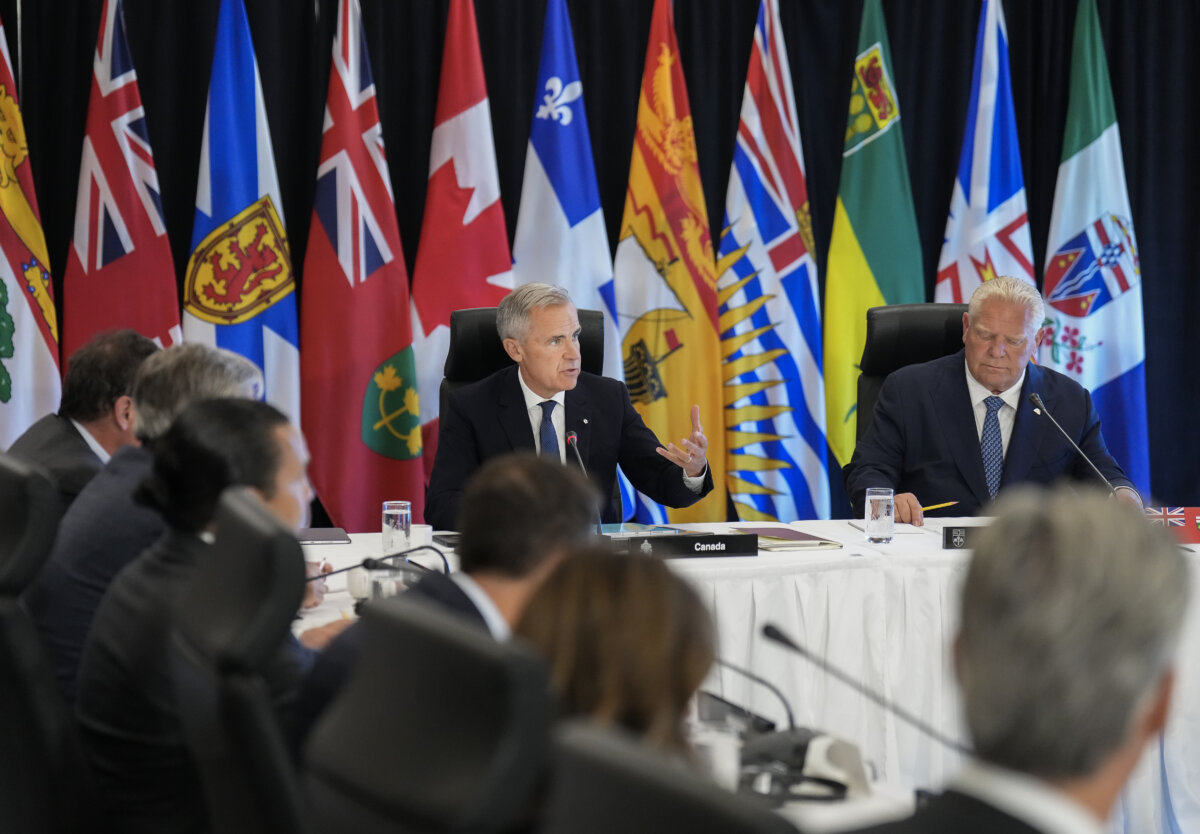
The announcement came while Carney met with the premiers on July 22 in Huntsville, Ont., to discuss ways to boost the Canadian economy amid trade uncertainty with the United States.
The major projects office will be a hub for initiatives considered under the recently passed One Canadian Economy Act, and aims for a two-year timeline for making approval decisions on nation-building projects, said Carney, adding his government is focused on moving from “why build?” to “how to build?”
Five criteria to guide such projects were outlined by Carney and the premiers during a meeting in Saskatoon last month. The criteria include the potential to boost Canada’s economy, independence, and security, the likelihood of success, prioritization by indigenous leaders, and potential for clean growth.
While announcing the upcoming launch of the major projects office, Carney also touched on the goal of reducing interprovincial trade barriers and working to create a more unified economy. The One Canadian Economy Act outlines the goal with a focus on reducing costs and delays.
Three premiers took a step toward breaking down those barriers during the July 22 meeting. Saskatchewan Premier Scott Moe, Alberta Premier Danielle Smith, and Ontario Premier Doug Ford signed a memorandum of understanding (MOU) with the goal of building new energy and trade infrastructure between their provinces.
For his part, Carney said the MOU and other measures by provinces to bolster Canada’s economy need to be in the service of the entire country.
“Yes, some provinces and some people in the private sector are looking at this, but really the question is, which projects are in the national interest,” Carney said after the meeting. Although trade tensions with the United States were discussed in the meeting, Carney said “a large part of our exchanges concentrated on what we can do, what we can control and how we can move forward.”
Carney gave examples of Canadian initiatives that might meet the criteria, such as an intertie project in northwest B.C. connecting provincial power grids, which he said also benefits the Yukon, Northwest Territories, and Alberta and “unlocks critical minerals and other investments.”
He said a port project proposed by B.C., Alberta, Saskatchewan, and Manitoba would create an economic corridor from Prince Rupert to Hudson’s Bay, while the Wind West project to construct offshore wind turbines would benefit Canada’s Atlantic provinces.
“It’s almost always the case that a project involves several provinces,” Carney said. “So it’s a process to unify our country.”
The One Canadian Economy Act has met with opposition from various indigenous leaders, with nine Ontario First Nations currently asking for a court-ordered injunction against the act, which they say allows projects to be approved “without meaningful or any engagement with First Nations.”
The Conservatives had also signalled reluctance regarding the act, and only agreed to vote for the bill last month after a number of amendments were made. The party said it decided to support the act, formerly known as Bill C-5, because it was an improvement from the status quo, but noted it would rather see various laws such as the West Coast tanker ban, industrial carbon tax, and Impact Assessment Act scrapped to boost Canada’s economy and resilience in the face of U.S. tariff threats.
“It’s baby steps when we needed a giant leap,” Conservative Leader Pierre Poilievre said in June in reference to the act.
“We would vote in favour of accelerating even one project, even though we think there are literally thousands of projects that need to be accelerated. So our test is not whether or not legislation is perfect—but whether it is better than the way things are.”
 Friends Read Free
Copy
Facebook
Tweet
Friends Read Free
Copy
Facebook
Tweet