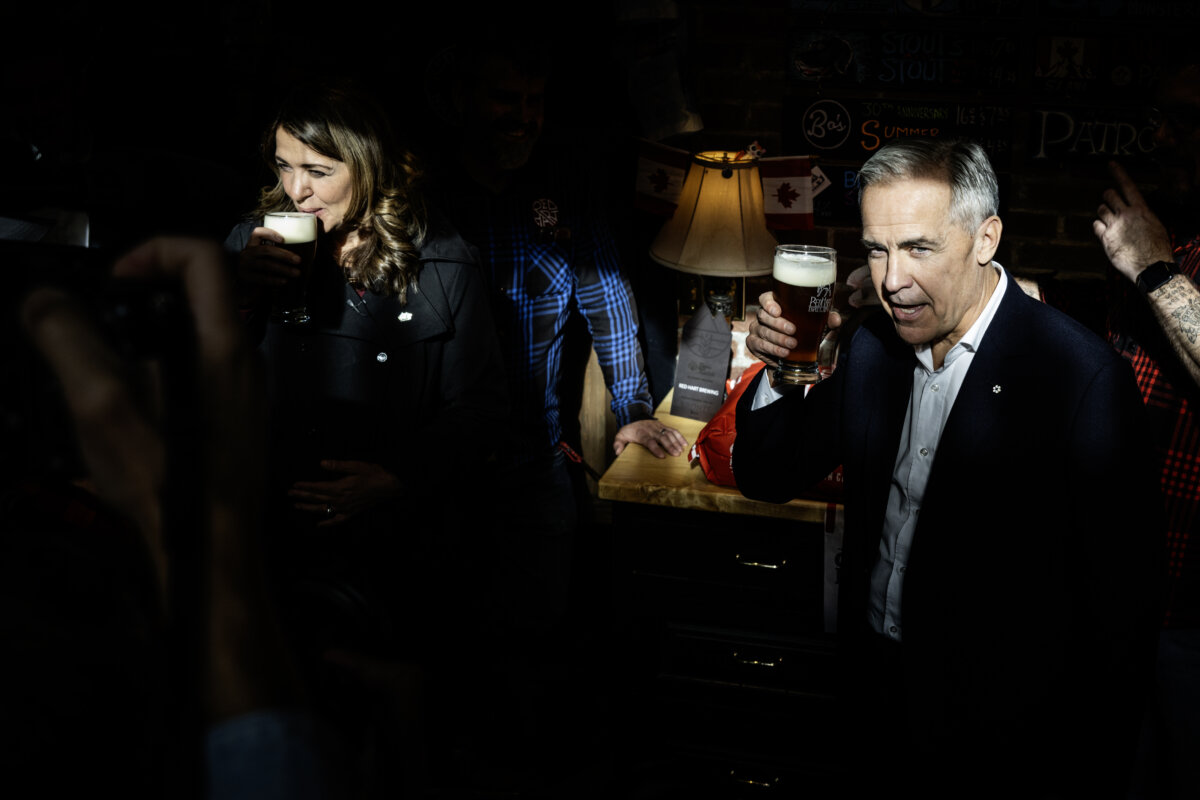

Prime Minister Mark Carney and Alberta Premier Danielle Smith joined a rally in Red Deer, Alta., to promote national unity ahead of Alberta’s Oct. 19 referendum.
Carney, who is attending various pro-Canada events in Alberta this week, opened the event by praising past and present elected officials at the rally, including former Harper government cabinet minister Monte Solberg who helped organize the event, former Progressive Conservative Alberta Premier Ed Stelmach, Calgary Mayor Jeromy Farkas, and Red Deer Mayor Cindy Jefferies, among others.
“I have learned a lot from those individuals. From Monty [Solberg], I’ve learned importance of decency, wry sense of humour, and an inquisitiveness about ideas,” Carney said.
“Premier Stelmach … : Great Canadian, great Albertan, focused government, small cabinet, importance of rural Canada, rural Alberta, infrastructure, and one of the … true pioneers of interprovincial trade.”
When he got to Premier Smith, Carney said what he has taken from her is the importance of “tough collaboration.”
“In our time working together, the premier has consistently put the most difficult issues on the table, with the intention of finding a common way forward,” he said. “And one of the other lessons I take from that … is when we try to do more, we can do more.”
Carney and Smith have jointly announced a proposed Alberta–B.C. oil pipeline, the Pacific Link, whose regulatory approval process will be expedited through the Major Projects Office. The Carney government has also eased a series of federal policies that Alberta has said stand in the way of resource development in the province, while the Smith government has agreed to increase its industrial carbon tax and pair the proposed oil pipeline with a major carbon capture project.
For her part, Smith recognized the various elected officials, as well as past and present Liberal MPs, at the rally, noting that it’s a “pretty exciting day” to join an event with Carney and “people who have a bunch of different backgrounds.”
“As you know, we don’t always agree on everything. We often disagree quite publicly on several things, but today we can all agree that on Question 10, that we are voting for Option one: To remain in Canada,” Smith said.
Smith noted that when she first met Carney, she was skeptical. “I put the same kind of proposal on the table about trying to address some of the bad laws as I had with his predecessor. I said, ‘We’re just looking for a compromise here,’ and he said, ‘Well, I don’t think I want a compromise. I think I want a win-win.’”
“That was the approach that he took into our negotiations and discussions, and I can tell you that’s exactly how I feel after 18 months,” Smith said.
“There were nine bad laws I identified. There are seven of them that have been dealt with in a very substantial way. Another one is in court today that I told you [Carney] I was going to beat you on, which is the plastics ban, so people can have straws again,” she added. The Supreme Court of Canada on Oct. 15 said that it would hear an appeal of the federal government’s ban on single-use plastics.
However, Smith repeated her opposition to Carney’s stance on the non-separation-related questions on the Oct. 19 referendum. These other nine questions seek input on whether the province should pursue greater control on immigration and judicial appointments, and pursue constitutional changes such as abolishing the unelected Senate.
While in Alberta this week, Carney urged Albertans to vote “No” on those questions, saying, “we can have diversity in this province, so we take care of each other, and build together.”
Smith, who rebuked Carney for this position the previous day, handed Carney an information pamphlet about her government’s position on the referendum questions at the Oct. 16 event, adding, “I have bad news for you, prime minister. All of the premiers are interested in talking about immigration and how we might be able to reform it.”
But she added that her point is that “it’s a conversation.”
“We meet. We find areas where we can agree. We work together on areas that we can agree. I think we are stronger together,” she said.
Besides Carney, Conservative Leader Pierre Poilievre is also in Alberta this week to urge residents of the province to vote to stay in Canada.
“To those people who are thinking about taking out their frustration on the current government by voting for separation in the referendum, I say this: Canada is more than a government. It is a people, a flag, a land, a history, and a promise,” Poilievre said at the Canada Strong and Free conference in Calgary on Oct. 16.
Canola
While speaking at the Oct. 16 Red Deer event, Carney repeated some of his previous points about the world being a more “dangerous and divided” place and that the country faces “real threats to our sovereignty,” while urging unity, and noting his government has taken initiatives to diversify trade.
One item he specifically highlighted while in Red Deer was canola, a major agricultural product in that region of Alberta. Earlier this year, Carney reached a trade agreement with China to allow up to 49,000 Chinese electric vehicles (EVs) into Canada annually at a reduced tariff rate of 6.1 percent, down from 100 percent, in exchange for China lowering its tariffs on Canadian canola seed from approximately 85 percent to 14.9 percent.
Smith said in 2025 that Beijing exploits divisions in Canada to achieve its objectives, pointing to how it targeted canola, a primarily Western-Canadian product, with tariffs, while demanding Ottawa remove its 100 percent tariffs on Chinese EVs, with the EV tariffs primarily benefiting auto-producing Ontario. Canada had imposed the levies on Chinese EVs in 2024 in lockstep with the United States.
“I can only interpret that as the Chinese understand the divisions in our country. They understand that if you’re going to retaliate and create maximum pressure, you do it by pitting one region against the other,” Smith said at a press conference in May 2025.
After China imposed anti-dumping tariffs on Canadian canola in 2025, Saskatchewan Premier Scott Moe and Manitoba Premier Wab Kinew, whose provinces are major canola producers, were among the most vocal in urging Ottawa to drop its tariffs on Chinese EVs. This was opposed by Ontario Premier Doug Ford, whose province is a major auto producer.
 Friends Read Free
Copy
Facebook
Tweet
Friends Read Free
Copy
Facebook
Tweet