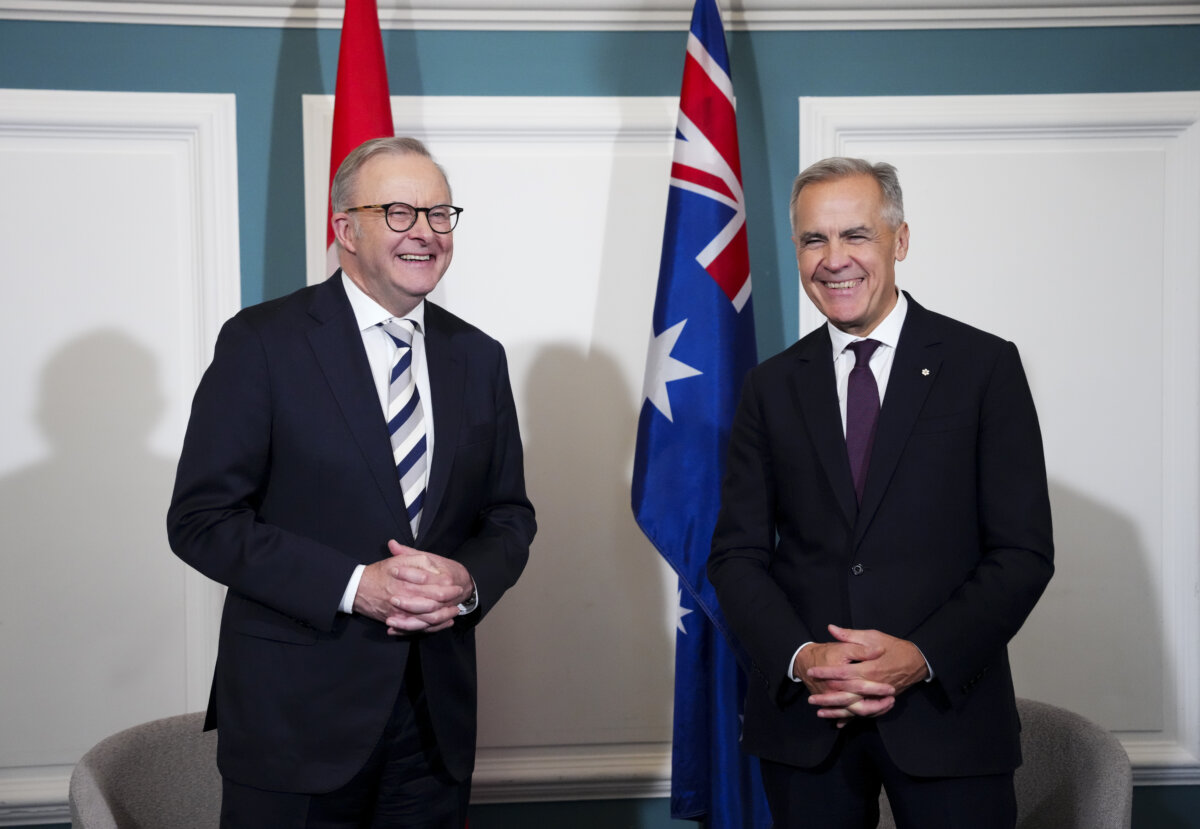

Prime Minister Mark Carney will address Australia’s Parliament during his visit to the country in March, the Australian prime minister says.
Prime Minister Anthony Albanese made the announcement during a Jan. 24 television interview with the Australian Broadcasting Corp.
Albanese did not say what type of talks the two countries would have during the spring visit. During the interview, he praised the foreign policy speech Carney delivered on Jan. 20 at the annual meeting of the World Economic Forum in Davos, Switzerland, and called Canada a “like-minded” country with values that closely align with Australia’s.
“I agree with him,” he said of Carney’s speech, which was later criticized by U.S. President Donald Trump.
Carney said in his speech that a “system of intensifying great power rivalry,” is replacing the international rules-based order and criticized the actions of those powers, without directly referring to the president or the United States.
“Great powers have begun using economic integration as weapons, tariffs as leverage, financial infrastructure as coercion, supply chains as vulnerabilities to be exploited,” Carney said during his speech. “You cannot live within the lie of mutual benefit through integration, when integration becomes the source of your subordination.”
Carney’s words closely aligned with a speech Albanese gave at the 80th session of the United Nations General Assembly at U.N. headquarters in New York last September, the Australian leader noted.
“That’s why I’ve engaged with the Canadian PM,” he told the Australian Broadcasting Corp, saying Australia is “very much engaged with our partners overseas.”
“We do have a shift in the way that international politics is being played with a greater engagement from middle powers,” he added. “We need greater cooperation as we see the world changing in its dynamic.”
While Albanese applauded Carney’s speech, it wasn’t well-received by Trump.
Trump made direct reference to both Canada and Carney when delivering his own speech in Davos.
He said the Canadian prime minister “wasn’t so grateful,” and that Canada “lives because of the United States.”
“Canada gets a lot of freebies from us, by the way, they should be grateful also, but they’re not,” Trump added during his Jan. 21 speech. “Canada lives because of the United States. Remember that, Mark, the next time you make your statements.”
Carney said in a Jan. 22 address to the nation during a Quebec cabinet retreat that Canada “does not live because of the United States. Canada thrives because we are Canadian.”
Trump hours later withdrew his invitation for Canada to join the U.S.-led Board of Peace, which includes representatives from 19 nations. The majority of the member nations are located in Asia; however, Hungary, Argentina, and Paraguay have also become members, and European leaders, such as Russian President Vladimir Putin, have been invited to participate as well.
Carney is the only world leader who was publicly informed by Trump that his invitation to join had been revoked.
Carney’s Davos remarks were also criticized by Conservative Leader Pierre Poilievre in a Jan. 22 statement. The Tory leader said Carney’s speech was “eloquently delivered” but added that the prime minister should focus his energies on domestic issues and addressing “unkept promises.”
Poilievre said Carney should expedite the construction of an oil pipeline from Alberta to the coast of British Columbia, strengthen and expand the Canadian Armed Forces, and revoke multiple federal regulations that he argues impede resource development and restrict Canada’s export capabilities. He also cited rising crime, high food inflation and housing costs, and foreign interference as urgent domestic issues that needed to be addressed.
“So far, Mr. Carney has been lucky that he’s been judged by his rhetoric and his stated intentions, by the number of his trips and meetings overseas. Because nearly a year into his term, the rhetoric has changed, but reality has not,” Poilievre said. “There is an illusion of purpose, but no results to back it up.”
Carney said his government has several items on the agenda for the new Parliamentary session beginning today, including pushing for deeper economic cooperation with the provinces and territories.
Reforming Canada’s criminal justice system, boosting border security, and making investments in defence and artificial intelligence, were also listed by Carney during his Jan. 22 speech.
 Friends Read Free
Copy
Facebook
Tweet
Friends Read Free
Copy
Facebook
Tweet