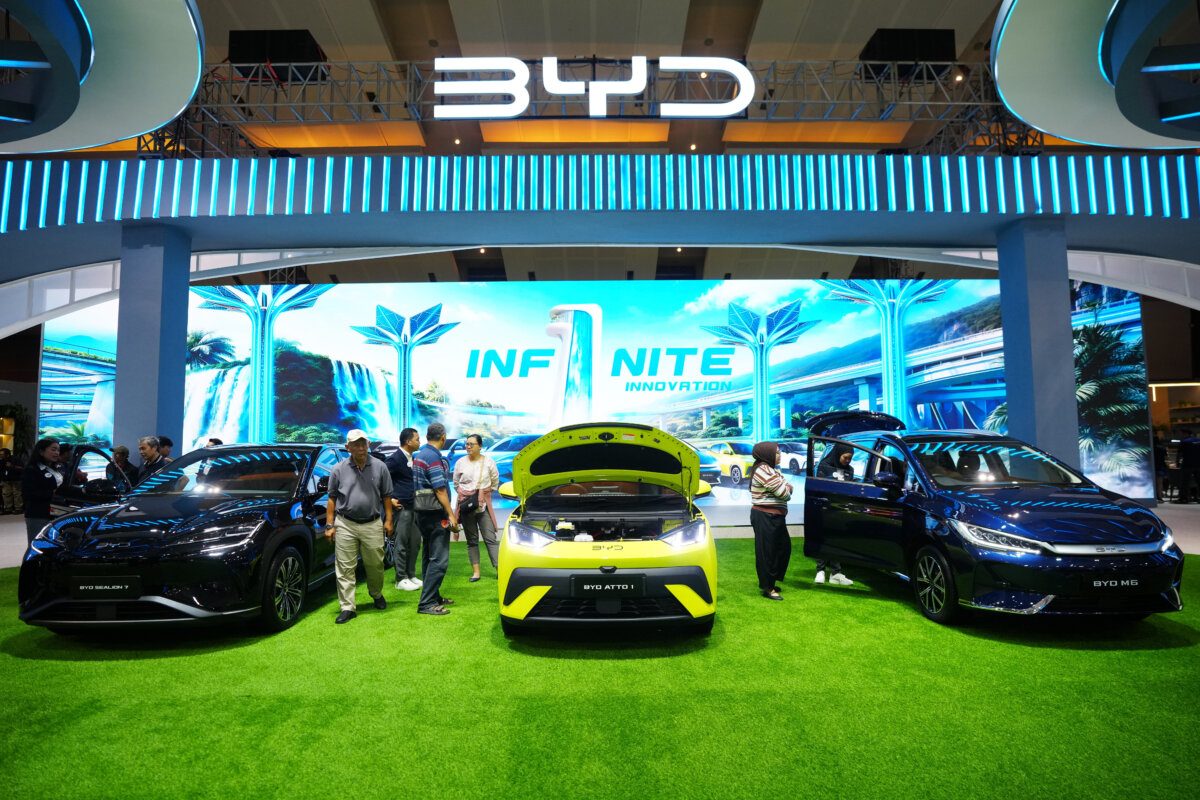

Several electric vehicles from Chinese manufacturer BYD are undergoing Transport Canada’s preliminary review process, according to a report by Chinese state media outlet Xinhua.
The March 27 report says BYD’s Seagull, Dolphin, Atto 3 and Seal models are on the regulator’s pre-approval list as the company works to obtain necessary certifications to sell its passenger vehicles in Canada.
Xinhua also reported that BYD Executive Vice President Li Ke has said the company is carrying out a feasibility study for building an auto manufacturing plant in Canada.
The developments follow an agreement-in-principle signed this past January. In the deal, Ottawa agreed to reduce the previous tariff rate on Chinese-branded EVs from 100 percent to a most-favoured-nation rate of 6.1 percent on up to 49,000 vehicles in the first year, from March 1, 2026, to Feb. 28, 2027. The quota volume will then grow annually at a rate of 6.5 percent, reaching just over 63,000 Chinese EVs per year in year 5, ending Feb. 28, 2031.
During the first six months of the initial quota year, Canada is allowing imports of up to 24,500 EVs originating from China, issuing import permits on a first-come, first served basis. During the second six months, starting Sept. 1, the quota will be another 24,500 EVs plus any unused volumes from the initial 6-month period.
In the deal signed in January, Beijing also agreed to lower tariffs on Canadian canola seed by March 1 and to remove retaliatory tariffs it had placed on Canadian canola meal, lobsters, peas, and crabs from March 1 to the end of this year.
The Xinhua report said that BYD is also the first Chinese automaker to register a passenger car factory in the Canadian regulator’s system. The report adds that automakers Geely and Chery are also eager to enter the Canadian market and that, in addition to these three leading Chinese automakers, 15 to 20 more Chinese carmakers are expected to follow suit and establish a presence in Canada.
Mixed Reactions to Chinese EV Deal
Ontario Premier Doug Ford criticized Ottawa and Beijing’s January deal relaxing tariffs on Chinese-branded EVs, calling the agreement “lopsided” and saying it “risks closing the door on Canadian automakers to the American market.”
“The federal government is inviting a flood of cheap made-in-China electric vehicles without any real guarantee of equal or immediate investments in Canada’s economy, auto sector or supply chain,” Ford said.
The January agreement was welcomed by Saskatchewan Premier Scott Moe, whose province was heavily affected by Beijing’s restrictions on agricultural products.
The federal government has said the recent agreement with China is aimed at addressing “several important tariff issues” and is not intended to pave the way toward a free-trade agreement.
Ontario remains the core of Canada’s auto manufacturing sector and is home to major labour organizations including Unifor. Based on Statistics Canada’s latest national new vehicle registration data, in 2024, EV adoption in Ontario sat at 8.1 percent, far below levels in Quebec (30.9 percent) and British Columbia (20.9 percent).
Several industry and policy experts also criticized the Chinese-brand EV agreement during May 4 testimony before the House Committee on Industry and Technology, saying it could expose Canada to unfair Chinese trade practices, undercut Canada’s auto sector, and leave Canada vulnerable to surveillance and data collection by the Chinese communist regime.
“The real question is not, ‘Don’t we want cheaper EVs?'” Michael Kovrig, head of the Global Network for Strategic Effects, told MPs during committee testimony. “It’s whether Canada wants to be a producer in the future auto economy or merely a consumer market for vehicles produced by China’s industrial system.”
President and CEO of the Canadian Vehicle Manufacturers’ Association Brian Kingston said the agreement does not protect against cybersecurity risks posed by the vehicles and could also threaten Canada’s access to the American market, noting that “there is no industry without U.S. access.”
U.S. Treasury Secretary Scott Bessent in January criticized Canada’s decision to allow the import of Chinese electric vehicles at reduced tariff rates, warning it could also result in “cheap goods” flowing into the United States.
Ottawa has said its cap of 49,000 imported units at reduced tariffs will protect the domestic industry. Kingston testified before the House Committee on International Trade on June 9 saying that this figure represents roughly 30 percent of the number of EVs sold in Canada last year.
China’s automobile exports reached 1.352 million units in the first two months of 2026, up 48.4 percent from a year earlier, according to statistics compiled by the China Association of Automobile Manufacturers.
Chinese EV exports totalled 583,000 in those two months, more than doubling the volume year-over-year.
Overseas markets have become a key part of the growth strategy for Chinese automakers, in part due to signs of relative saturation in China’s domestic market, according to Xinhua.
Correction: An earlier version of this article misstated Chinese electric vehicle company BYD’s plans for entering the Canadian market later this year. The Epoch Times regrets the error.
 Friends Read Free
Copy
Facebook
Tweet
Friends Read Free
Copy
Facebook
Tweet