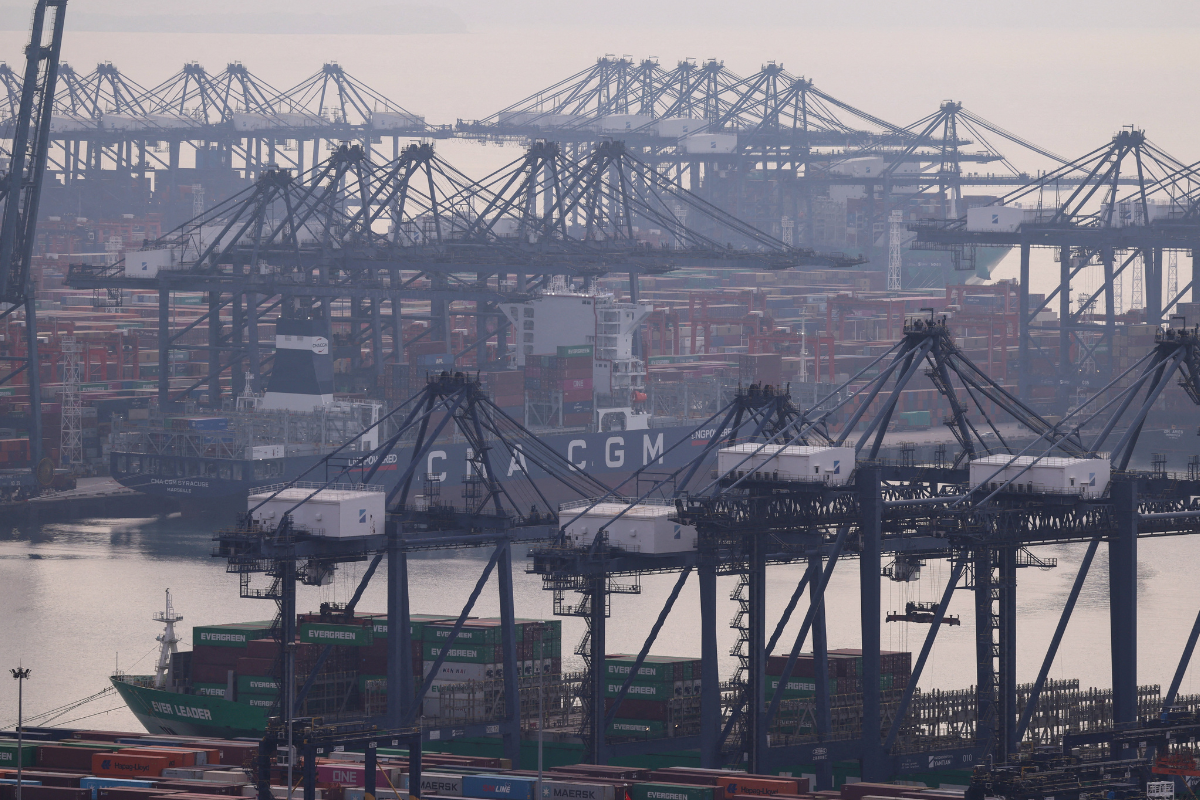

Beijing’s export controls are forcing businesses in Europe to move sourcing away from China, according to a survey conducted by the European Union Chamber of Commerce in China and published on Dec. 1.
The lobby group published the results of a flash survey completed by 131 of its members, in which 75 companies (57 percent) said they expected to be, or had been, impacted by Chinese export controls. Of those, more than one in three (36 percent) said they plan to work with suppliers to develop capacity outside of China.
However, uncertainty remains among a large proportion of the group’s members, with 43 percent saying that they have not yet made a decision about how to respond to the controls.
“China’s export controls have increased the uncertainty felt by European businesses operating in the country, with companies facing risks of production slowdowns or even stoppages,” European Chamber President Jens Eskelund said in a statement.
Eskelund said export controls had also prompted “strong responses” from Beijing’s trading partners, and thus “added more pressure to a global trade system that was already under a great deal of stress.”
Supply Chains, Delivery, Revenue Impacted
Many businesses said in the survey that export control measures affect China’s efficiency and reliability as an export hub.
Respondents noted that it would put strain on supply chains, with 60 percent saying that they expect “moderate” or “significant” disruptions to their supply chains once all of Beijing’s planned measures come into effect. Another 13 percent “expect to face production stoppages or slowdowns,” the European Chamber stated.
Delivery times will be impacted by the license approval process, with 6 percent saying it added less than a month to delivery times, 34 percent saying it added one to two months, and 40 percent saying it added more than two months. The remaining 21 percent said they had not yet applied for any export licenses.
The European Chamber said that “not a single respondent” to the survey said the process had added no additional time to delivery processes.
Export controls will also affect revenue, according to European businesses.
“While estimates of the impact of Chinese export controls on companies’ finances vary substantially, for those acutely impacted the picture is stark,” the lobbying group stated.
It said one company responding to the survey indicated that the measures “will result in estimated additional costs of 20 percent of its 2025 gross global revenue.” Another said it expects additional costs of upward of 250 million euros (about $290 million).
Expansion of Export Controls Delayed
Facing U.S.-led pressure over the Chinese communist regime’s non-market trade policies, Beijing has tightened its grip on rare earths in recent years, using these critical metals as leverage in trade negotiations with Western economies.
On Oct. 9, the Chinese Ministry of Commerce announced that it was expanding Beijing’s export controls to include certain rare-earth technology and equipment, as well as certain lithium-ion batteries, cathodes, anode materials, and artificial diamonds.
However, following a meeting between U.S. President Donald Trump and Chinese leader Xi Jinping on the sidelines of the Asia-Pacific Economic Cooperation (APEC) summit in South Korea, Beijing announced that it would suspend the restrictions for one year.
The suspension of Beijing’s controls also extends beyond U.S. markets to include the EU.
EU Trade Commissioner Maros Sefcovic said on Nov. 1 that Chinese officials at the Ministry of Commerce informed their European counterparts that the pause also applies to the EU.
Treasury Secretary Scott Bessent told the Financial Times in an interview published on Oct. 31 that Beijing’s move has jolted the United States and its allies to fast-track efforts to secure new sources within the next two years.
“China has alerted everyone to the danger. They’ve made a real mistake,” he told the newspaper.
“It’s one thing to put the gun on the table. It’s another thing to fire shots in the air.”
Dorothy Li and Tom Ozimek contributed to this report.
 Friends Read Free
Copy
Facebook
Tweet
Friends Read Free
Copy
Facebook
Tweet