
The One Canadian Economy Act passed the committee stage and was sent back to the House of Commons following Conservative and Bloc Québécois MPs raising concerns about whether the bill gives government sweeping authority to exempt projects from existing laws without reasonable limits.
The transport committee met on the afternoon of June 18 until just after midnight to quickly review Bill C-5, which the Liberal government is seeking to approve before July 1.
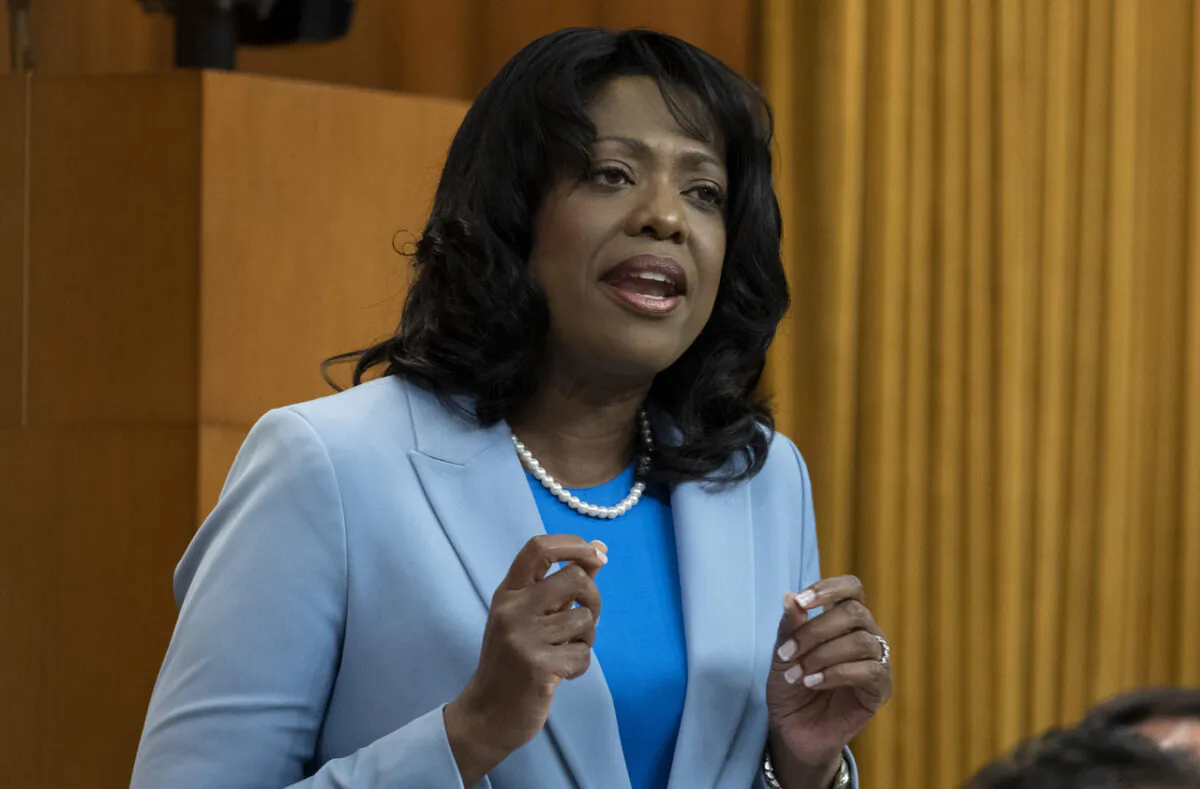
During the committee meeting, Conservative MP Leslyn Lewis compared Bill C-5, which would allow projects in the national interest to be exempt from certain legislation, to a section of the Canadian Charter that allows for the temporary suspension of certain civil liberties.
The Charter’s “reasonable limits” clause offers protection to Canadian citizens, Lewis said on June 18. “Where are the reasonable limits of this legislation?” she said. “Where are the brakes in this legislation so that federal governments don’t become bullies and sweep into municipal and provincial jurisdiction?”
Bill C-5 intends to remove federal impediments to interprovincial trade barriers by allowing goods and services that meet comparable provincial or territorial rules to be treated as compliant with federal trade requirements, which would the government says would reduce delays and costs for businesses.
Intergovernmental Affairs Minister Dominic LeBlanc answered Lewis’s question by saying that since the legislation is intended to get large projects built, it’s not surprising that a number of laws need to be evaluated by government.
Lewis questioned what reasonable limits applied to government’s “sweeping powers,” and why those limits are not contained in the bill.
LeBlanc responded that decisions would be exercised in consultation with provincial, territorial, and indigenous leaders, serving as a “limitation in and of itself.”
Transport and Internal Trade Minister Chrystia Freeland asked whether Lewis was concerned that “as a result of this legislation, we will build too much,” which Lewis described as a “very pejorative way of characterizing my concern” and “making a joke out of it.”
Freeland replied that she was “in no way making a joke” and was confident that the legislation would not infringe on Canadians’ rights, adding the Conservatives have supported it because of a national consensus that “we have such a thicket of processes and rules and regulations at all levels of government.”
The Conservative caucus this week voted with the Liberals to fast-track the legislation through the House of Commons. Conservatives say they support efforts to build the economy, with Conservative MP Philip Lawrence calling the bill a “small step in the right direction” toward meeting what is needed.
‘Disguised Version of Emergencies Act’
During the Transport Committee meeting, Bloc Québécois MP Xavier Barsalou-Duval asked whether Bill C-5 was a “disguised version of the Emergency Measures Act.” LeBlanc responded that he did not share “that interpretation of the situation,” as the Emergencies Act only applies when certain legal conditions are met.
“I participated in deciding to invoke the Emergencies Act the last time, and I’m proud of the decision we made,” LeBlanc said.
The federal government invoked the act in February 2022 in response to the Freedom Convoy protest, which saw people and trucks converge in downtown Ottawa for weeks to protest COVID-19 vaccine mandates and other pandemic restrictions.
The Public Order Emergency Commission found that Ottawa was justified in invoking the act, while a federal court hearing a challenge by some of the protesters ruled that the government infringed on Canadians’ constitutional rights.
LeBlanc said Bill C-5 was a response to an “urgent” threat from U.S. President Donald Trump’s tariffs, which is why Ottawa is trying to diversify its international trade and bring down interprovincial trade barriers.
“But are you not taking this notion of urgent or emergency situation a bit too far?” Barsalou-Duval asked. “We don’t want the Emergency Measures Act to be invoked left, right, and centre.”
“That’s not what we’re doing,” LeBlanc said. “We cannot compare this legislation to a White House presidential order. That’s an inaccurate comparison.”
 Friends Read Free
Copy
Facebook
Tweet
Friends Read Free
Copy
Facebook
Tweet