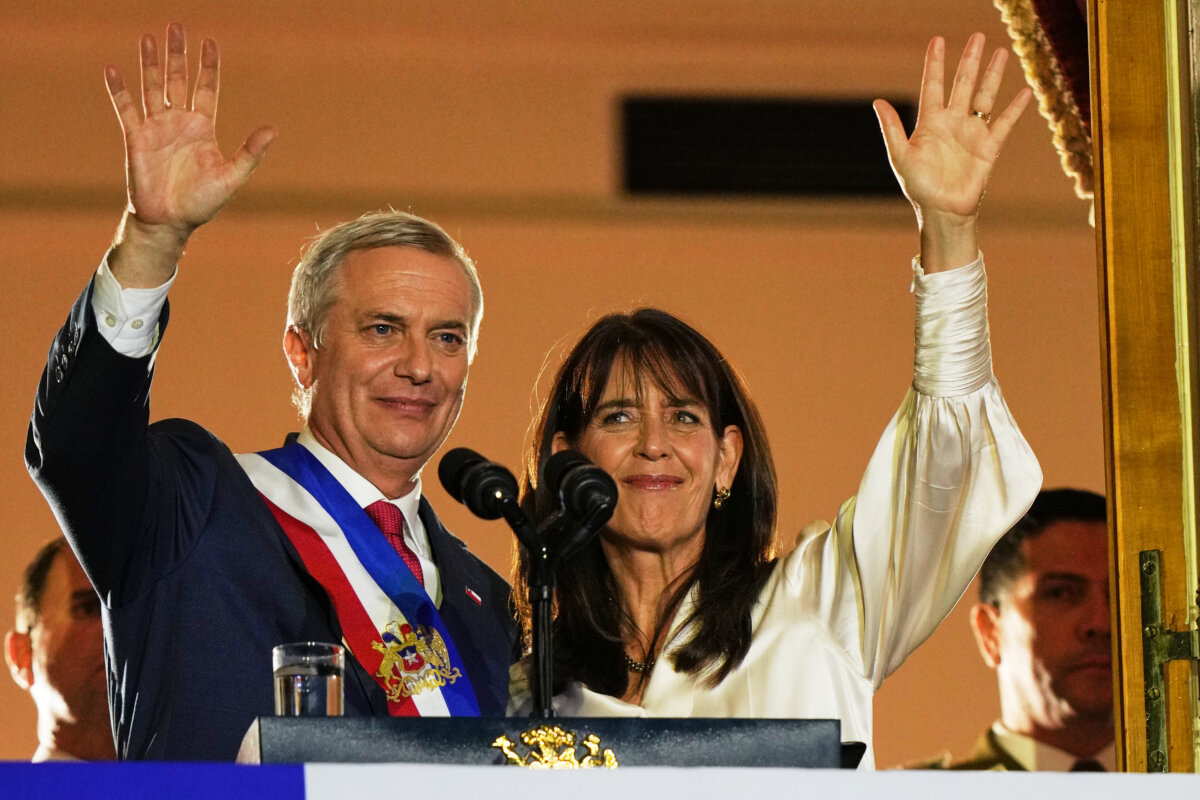
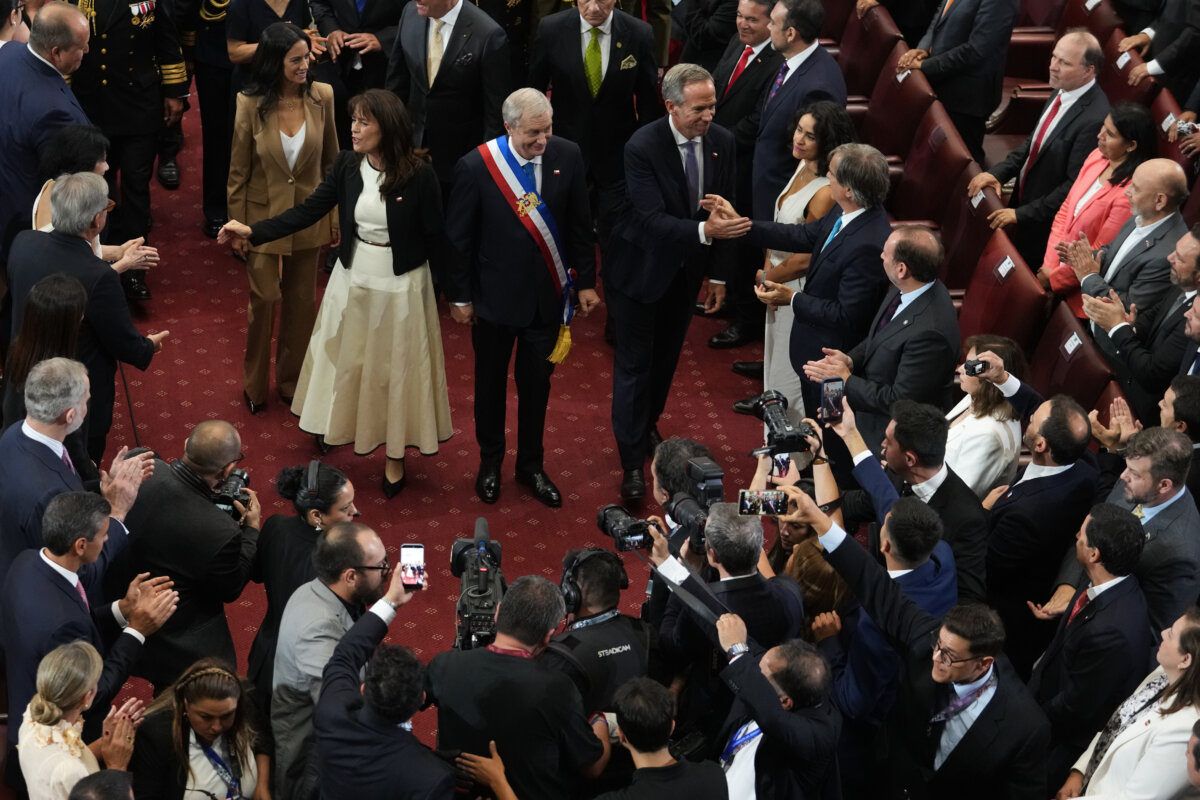
Conservative José Antonio Kast was sworn in as Chile’s president on March 11, following his landslide election victory against a communist candidate in December.
Kast, who leads the Republican Party of Chile, took the oath of office at the National Congress in the coastal city of Valparaíso. The ceremony was attended by dozens of heads of state and high-profile individuals.
Argentine President Javier Milei, Panamanian President José Raúl Mulino, Ecuadorian President Daniel Noboa, and King of Spain Felipe VI were among the guests, alongside Venezuelan Nobel Peace Prize laureate María Corina Machado.
The United States was represented at the ceremony by a delegation led by Deputy Secretary of State Christopher Landau.
Notable absences among Latin American leaders included Brazilian President Luiz Inácio Lula da Silva and Salvadoran President Nayib Bukele.
In his first speech as president on the night of March 11, Kast said Chile has real adversaries, including “those who have sown terror in neighborhoods.”
A lawyer by profession, Kast defeated communist candidate Jeannette Jara in a runoff, with pledges to crack down on crime and curb illegal immigration to the South American country.
Illegal Immigration
In his speech, delivered from the balcony at the La Moneda Palace in the capital, Santiago, Kast repeated his campaign pledge: “Those who have entered by violating our borders to commit crimes, exploit others, or turn our land into a no-man’s-land are also adversaries of Chile.”
The 60-year-old president, a practicing Catholic and father of nine, said his government “will not negotiate” with such criminals, whom he vowed to bring to justice.
Kast’s parents immigrated to Chile from Germany in the early 1950s. His father, a former German military officer who fought in World War II, founded a sausage factory in Buin, Chile.
Supporters of the new leader gathered both in Santiago and Valparaíso, carrying flags and banners reading “Long live Chile” and “President of change.”
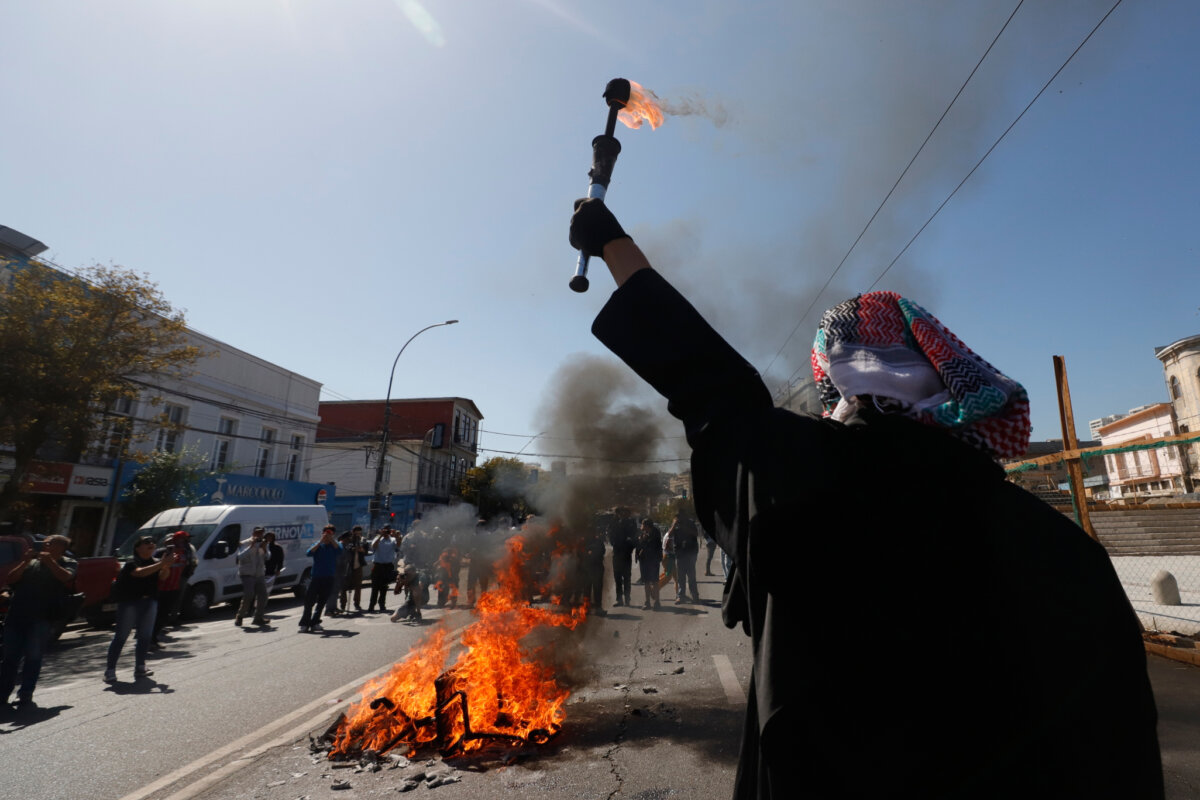
Meanwhile, a group of protesters marched against Kast and what they termed American “imperialism.” Police closed a number of subway stations in downtown Santiago as a security precaution.
Social Conservatism
Kast’s social conservatism includes opposition to same-sex marriage and abortion. He has previously expressed nostalgia for the 17-year military dictatorship of Gen. Augusto Pinochet, now deceased, who led a coup against a communist government in 1973 amid an economic crisis during which inflation soared as high as 600 percent.
“If [Pinochet] were alive he would vote for me,” Kast told local newspaper La Tercera in 2017, when campaigning unsuccessfully to be president. “If I had met him now, we would have had a cup of tea at La Moneda.”
Chile is the latest Latin American country to have swung away from socialism by voting out incumbent left-leaning governments, following Argentina and Bolivia.
Kast has praised the leadership of U.S. President Donald Trump, making clear his support for the military operation to capture Venezuelan socialist leader Nicolás Maduro to face charges of narcoterrorism.
Endorsed by Trump
The Chilean leader has expressed admiration for former Brazilian President Jair Bolsonaro, an ally of Trump, and pledged to deport tens of thousands of illegal immigrants.
Following Kast’s victory, in which he received about 60 percent of the vote, U.S. Secretary of State Marco Rubio offered his congratulations, indicating alignment between the two governments on policy.
“The United States congratulates President-Elect José Antonio Kast of Chile on his electoral victory,” Rubio said in a statement. “Under his leadership, we are confident Chile will advance shared priorities to include strengthening public security, ending illegal immigration, and revitalizing our commercial relationship.
“The United States looks forward to working closely with his administration to deepen our partnership and promote shared prosperity in our hemisphere.”
In his election campaign, Kast said he plans to construct hundreds of miles of ditches and walls along Chile’s northern border with Bolivia to prevent people from entering the country illegally, with particular attention paid to those moving from Venezuela.
The administration of outgoing President Gabriel Boric drew criticism from the United States, particularly over a project to install an underwater cable to connect Chile with China, deepening diplomatic tensions between Washington and Santiago.
Boric, who narrowly defeated Kast for the presidency in 2021, was a vocal critic of Trump, characterizing his leadership style as that of a “new emperor.”
Trump invited Kast to last weekend’s Shield of the Americas summit in Miami—which brought together conservative leaders in the region, including Bukele and Milei—where he offered his support to the incoming president.
“Congratulations,” Trump told Kast. “That’s an endorsement. I love it when I give endorsements of people and they win.”
The Associated Press and Reuters contributed to this report.
 Friends Read Free
Copy
Facebook
Tweet
Friends Read Free
Copy
Facebook
Tweet