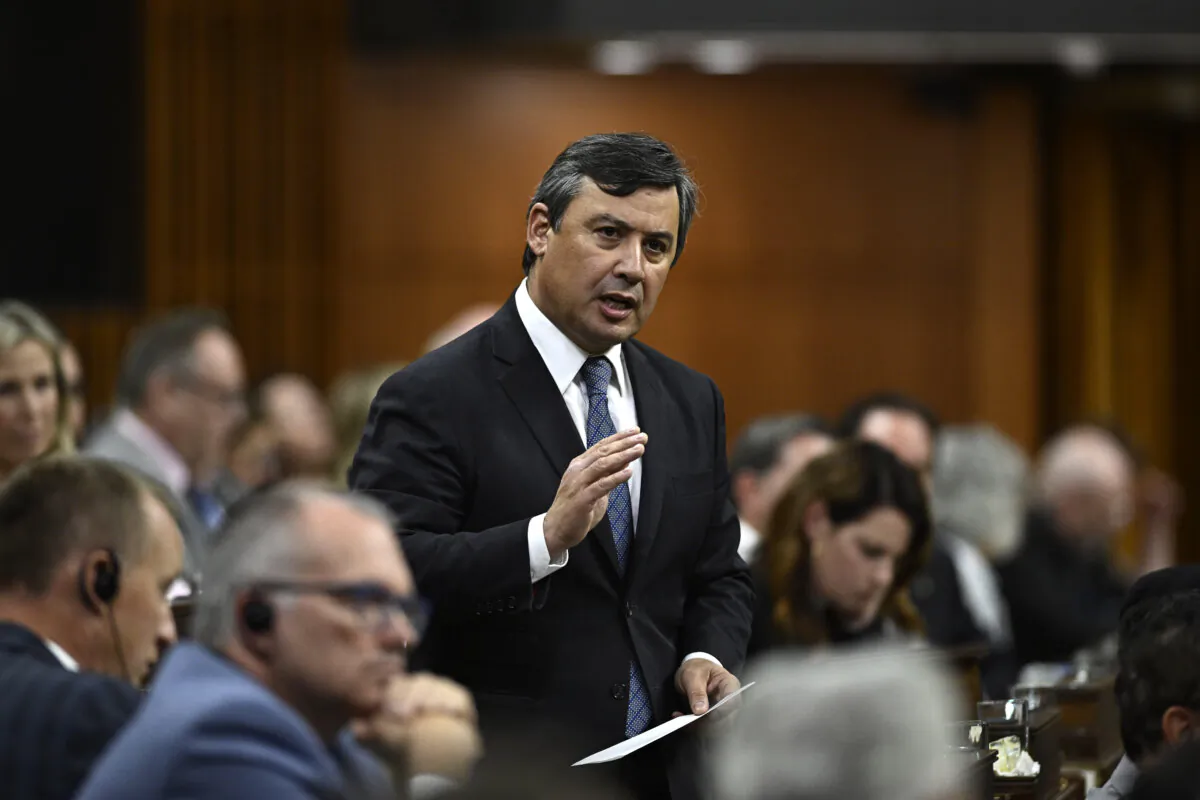

Conservative MP Michael Chong is visiting Taiwan and meeting with President Lai Ching-te this week in defiance of a recent warning from the Chinese ambassador to Canada against sending parliamentarians to Taiwan.
The Chinese Communist Party (CCP) views self-ruled Taiwan as a breakaway province, despite never having governed the island nation, and seeks to place it under Beijing’s rule. Taiwan, meanwhile, is pushing back against Beijing’s international pressure campaign to sideline the island.
Chong, who is the Conservative Party’s foreign affairs critic, is visiting Taiwan from May 18 to May 21 and is set to meet with Lai, Taiwanese minister and trade representative Jen-Ni Yang, and deputy minister of foreign affairs Chen Ming-chi. He is also expected to meet with officials at the Canadian Trade Office in Taipei.
“Canada is a sovereign and independent country,” Chong said in a May 17 statement. “We do not take direction from a foreign government about where Canadian MPs can travel internationally, and where Royal Canadian Navy warships can transit in international waters.”
China’s ambassador to Canada, Wang Di, said in an interview with The Globe and Mail in late April that it would be “hurtful” to Canada-China ties if Canadian parliamentarians conduct “any official engagement” with Taiwan. He also said that sending navy ships through the Taiwan Strait is “harassment, and even provocation.”
Canadian navy ships have travelled through the Taiwan Strait about a dozen times in the last decade, often accompanying U.S. Navy vessels, with the last occurrence in September 2025. China has criticized the transit of vessels through the strait, calling the move a “provocation,” while Taiwan has said it affirms the strait as international waters and supports freedom of navigation.
Chong’s visit serves two purposes, he said, including to “show solidarity with a democracy at the front lines of intimidation” by the CCP, and to “assert Canadian sovereignty” in the face of the Chinese ambassador’s warning.
“To remain silent and comply in the face of intimidation is to accommodate this behaviour, further embolden authoritarianism, and further weaken democracy,” Chong said in his statement, adding that it is important for democracies to “speak up and take a stand” in the face of intimidation from authoritarian states.
He noted that proclaiming sovereignty is not sufficient, and that sovereignty “must be exercised.”
The Chinese ambassador’s comments came as the Carney government has pursued closer ties with Beijing. Prime Minister Mark Carney declared during his visit to China in January that Ottawa’s relations with Beijing had entered “a new era” and the two countries were in a “strategic partnership,” and he signed several agreements with Beijing.
Reacting to the ambassador’s remarks, Chong said on May 4 that Carney “needs to make clear that these comments are unacceptable.” Deputy Tory Leader Melissa Lantsman echoed Chong’s comments, saying Canada “does not take its instructions from foreign ambassadors — the prime minister should make that clear.”
Bloc Québécois Leader Yves-François Blanchet reacted to the ambassador’s comments, saying Carney showed “imprudence” when he got closer to the Chinese regime months ago. He said China “believes it is entitled to intimidate Canada’s elected officials.”
Liberal MP Judy Sgro, chair of the Canada-Taiwan Friendship Group in Parliament, also commented on Canada-Taiwan ties following the ambassador’s remarks, saying the friendship between Canada and Taiwan is “priceless.”
Canada-Taiwan Relations
Controversy over Canada-Taiwan relations has arisen in recent months, with Taiwan’s ambassador to Canada saying Ottawa may be delaying the signing of a trade agreement with Taiwan as it seeks closer ties with Beijing.
Harry Tseng told CBC’s Radio-Canada in February that Taiwan has been left with the impression that Canada is seeking to improve its relations with China at the expense of its relationship with Taiwan, saying the trade cooperation agreement between Ottawa and Taipei has been ready to be finalized since April 2025.
He said there are no negotiations left between the two nations and the agreement just awaits a final signature.
Carney said in February that Canada has trade relations with Taiwan but his government is “focusing on strengthening our trade relations with China.”
Just weeks before the Taiwanese ambassador’s remarks, two Liberal MPs visiting Taiwan as part of a parliamentary delegation were advised by Ottawa to return home early as Carney was about to depart for China.
Liberal MPs Helena Jaczek and Marie-France Lalonde were part of the delegation that also included three Conservative MPs. Parliamentarians regularly make trips to Taiwan sponsored by the Taiwanese government.
The Liberal MPs said in a statement in January that it was important to “avoid confusion with Canada’s foreign policy, given the overlap with the Prime Minister’s engagement in Beijing.” However, the move was criticized by Chong, who said the federal government was “kowtowing to Beijing.”
Taiwan has remained independent since 1949 and was once recognized as the official seat of the Chinese government. Meanwhile, China has escalated its aggression toward Taiwan in recent years, launching major military drills to encircle Taiwan in late December 2025. Canada has said it opposes “any unilateral attempts to change the status quo across the Taiwan Strait.”
Countries wishing to have diplomatic relations with Beijing are required not to recognize Taiwan as a sovereign entity. Canada switched its recognition of the proper seat of the Chinese government from Taipei to Beijing under Prime Minister Pierre Trudeau in 1970. Only 12 countries still formally recognize Taiwan, including Guatemala, Paraguay, and the Vatican.
Noé Chartier contributed to this report.
 Friends Read Free
Copy
Facebook
Tweet
Friends Read Free
Copy
Facebook
Tweet