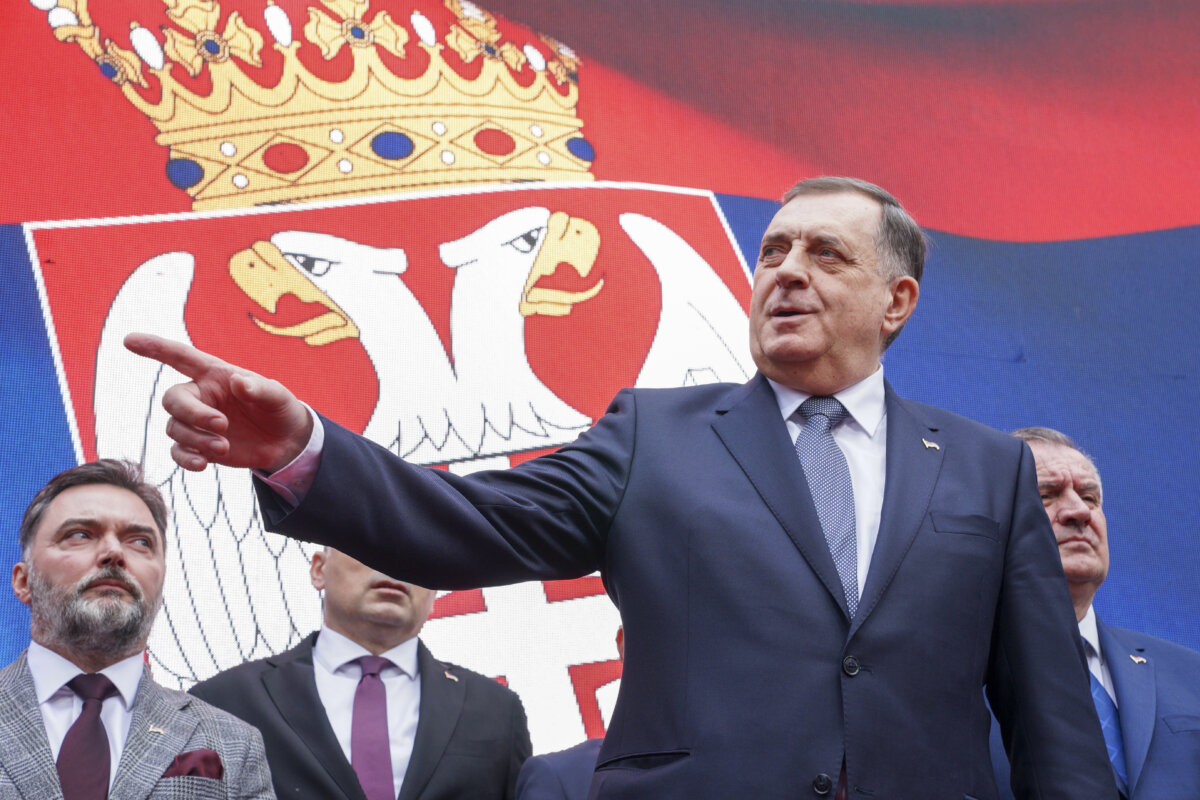
An appeals court in Bosnia-Herzegovina confirmed on Friday the sentence of a lower court that the Bosnian Serb president, Milorad Dodik, should go to jail for one year and be banned from politics for six years.
Dodik has repeatedly called for the Serb-run half of Bosnia-Herzegovina, known as Republika Srpska, to break away and join neighboring Serbia.
In February, he was handed the sentence for defying the Constitutional Court and the country’s high representative, Christian Schmidt.
In November 1995, the Dayton Agreement was signed in Ohio, bringing to an end more than three years of civil war in Bosnia-Herzegovina, which killed 100,000 people, and creating a federal state with a Muslim-Croat federation and an ethnic Serb republic.
Dodik rejected the court’s ruling and said on X it was “a political decision” orchestrated by the country’s Muslim, or Bosniak, community in collaboration with the European Union.
He said, “The prosecutor is Muslim, the first judge is Muslim, the second judge who ruled is Muslim, in the appeals chamber there are two Muslims, and you could not expect anything else.”
Dodik Turns to Russia for Support
Dodik said, “I expect complete support from Serbia, we will turn to Russia for support, we will write a letter to the new U.S. administration.”
The EU issued a statement in which it said the verdict must be respected.
Dodik, who represented the Serb nationalist SNSD party, was elected president of the Republika Srpska in 2022 and has frequently voiced his wish for the region to merge with Serbia to the east.
Dodik’s lawyer, Goran Bubic, said his legal team would appeal the ruling to the Constitutional Court, Bosnia’s highest court, and seek a temporary delay of the implementation of the verdict pending that decision.
Under the Dayton Accords, the Republika Srpska and the Bosniak-Croat Federation were granted wide-ranging autonomy, but the country has a single army, judiciary, and tax administration.
Bosnia-Herzegovina also has a rotating three-member presidency, made up of Bosniak, Bosnian Croats, and Bosnian Serbs.
Under the Dayton Accords, an Office of the High Representative (OHR) was set up with wide-ranging powers of oversight and the right to impose legislation and remove officials.
The current high representative, Schmidt, is a former German government minister who has clashed frequently with Dodik and declared some of his decisions in the Republika Srpska illegal.
Dodik ordered the Bosnian Serb parliament to ban the federal Bosnian state’s prosecutor, court, and intelligence agency.
The country’s Constitutional Court then temporarily suspended the regional parliament’s legislation as endangering the constitutional and legal order and sovereignty of the country.
In a lengthy statement on X, Dodik said: “I do not recognize the criminal act imposed by Christian Schmidt that anyone who does not respect him will receive a prison sentence.
“And that is the essence of everything. If we recognize that a man without any legitimacy can do this, then we are in trouble.”
Hungary Backs Dodik
Hungarian Foreign Minister Peter Szijjarto wrote on X on Friday: “The political witch-hunt in Bosnia and Herzegovina continues. Milorad Dodik was democratically elected by the people as President of Republika Srpska.
“Milorad Dodik is a friend of Hungary, and Hungary stands by its friends.”
Between 1945 and 1992, Bosnia-Herzegovina was part of Yugoslavia, but after Slovenia and Croatia declared independence, Bosnia followed suit, and a civil war broke out, with the Bosnian Serbs being backed by the Serbian-dominated Yugoslav army.
During the war, the Bosnian Serbs were accused of “ethnic cleansing” against the Croat and Muslim communities, culminating in the massacre at Srebrenica in July 1995, the 30th anniversary of which was marked last month.
Bosnian Serb leader Radovan Karadzic and his military commander, Gen. Ratko Mladic, were later indicted by a war crimes tribunal in The Hague, Netherlands.
Karadzic was jailed for 40 years in 2016, and Mladic was jailed for life in 2017.
The EU issued a statement in which it said: “The EU takes note of the criminal conviction in appeal of Milorad Dodik by the Court of Bosnia and Herzegovina.
“The verdict is binding and must be respected. The EU calls on all parties to acknowledge the independence and impartiality of the court, and to respect and uphold its verdict.”
Neither the U.S. State Department nor the Kremlin has yet commented on Friday’s developments.
The Associated Press and Reuters contributed to this report.
 Friends Read Free
Copy
Facebook
Tweet
Friends Read Free
Copy
Facebook
Tweet