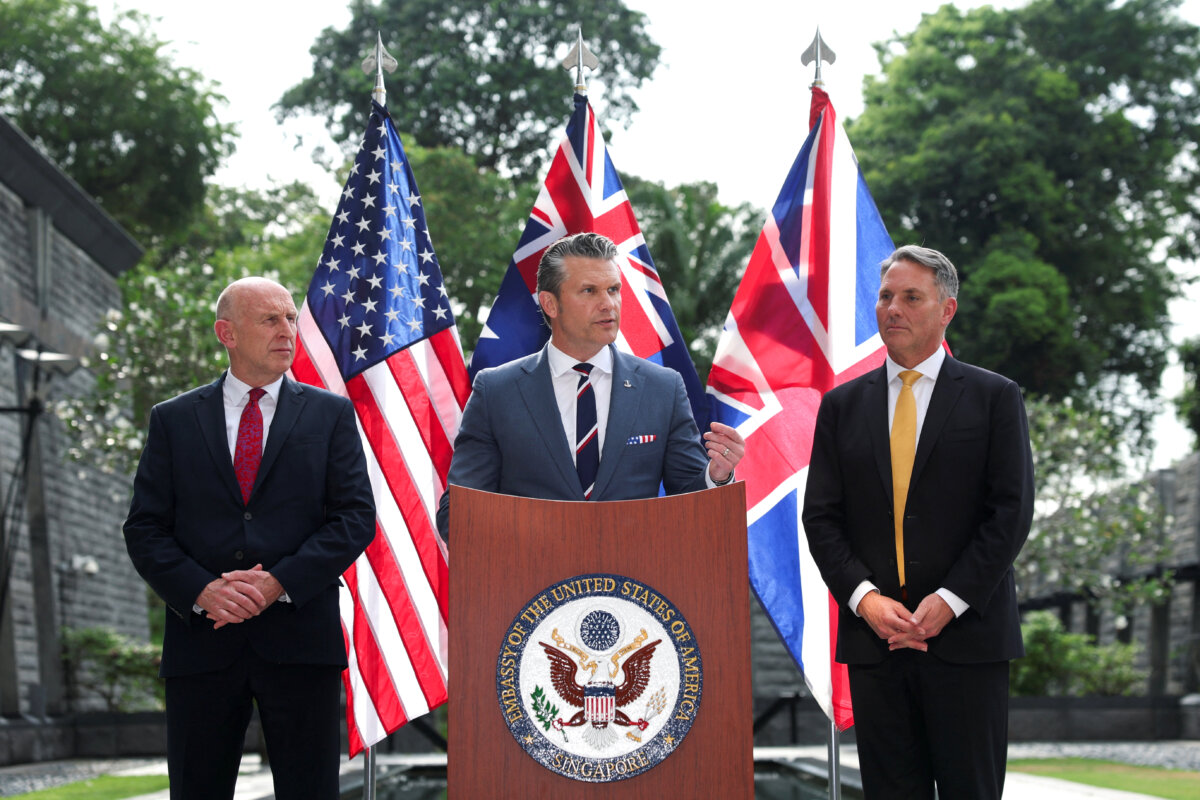

Officials from the Department of Defence are yet to calculate the expected savings from the AUKUS submarine program being rejigged so that Australia buys used, and not new submarines from the United States.
The revelations emerged during a lengthy exchange between opposition defence spokesperson James Paterson and officials during an estimates hearing on June 2.
Originally slated to cost $368 billion (US$264 billion) when it was signed in 2021, Pillar 1 of AUKUS would involve Australia buying eight nuclear-powered, conventionally armed submarines, three to be built in the United States and five in Australia, along with maintenance.
For the 2026 to 2036 decade alone, Australian federal spending on AUKUS-related efforts is projected to range from $71 billion to $96 billion.
On the weekend, Defence Minister Richard Marles, along with his U.S. and UK counterparts, announced that the first three submarines would now be second-hand—or, as the Department of Defence calls it, “in-service.”
Marles also stated the move would save on costs.
Senator Paterson pressed Department Secretary Megahn Quinn—appointed last month—for how much Australia could expect to save as a result.
“How much will Australia save by acquiring three used Virginia-class submarines, instead of two used submarines and one new submarine?” asked Paterson.
Quinn said she could not commit a figure, or reveal how the decision was made.
“There’s not a specific number, but we are absolutely expecting a reduction in sustainment costs, training costs, and we’ll be working through with partners in terms of the transition costs when we receive the three in-service submarines,” Quinn replied.
Paterson tried to redirect his questions to Steven Groves, the chief finance officer for the Defence Department, but Quinn insisted that, as the senior officer at the table, only she would answer them.
Senator then pressed further: “The deputy prime minister has made a public statement that the savings will be ‘significant.’ What constitutes a significant saving?”
“Almost everything in the Department of Defence is significant in some way,” Quinn replied. “But we do understand that having the simplicity of the program and having three like-for-like boats out of the same block will simplify and reduce costs.”
Paterson continued trying to get a figure based on the “percentage of GDP.”
In response, Quinn took the question on dollar amount on notice—meaning the Department will respond later in writing.
Which AUKUS Partner Suggested Submarine Switch?
The secretary was just as unforthcoming about which AUKUS partner had suggested the substitution.
Senator Paterson suggested the move was not initiated by Australia.
“This has been a continuous discussion, so it’s not that someone decided one day to announce change,” Quinn responded. “There’s been a long discussion about in-service or new build.”
“Someone had to initiate that proposal in those discussions,” Paterson asked. “Was it the United States or was it Australia?”
Discussions had been “ongoing,” Quinn said.
“Someone has to raise it first, right?” Paterson insisted. “It’s not raised by osmosis; one party has to be the first one to do it, which one was it?”
At that point the minister’s representative, Senator Jenny McAllister, intervened.
“You are entitled to ask any question, but you’re not really entitled to insist that Ms. Quinn answer in the terms that you prefer,” she told Paterson.
“You are insisting there’s a binary, Ms. Quinn says to you that there’s been a back and forth, which covers a whole range of different dynamics that exist within the evolution of this project. You have asked her about three times now, and she has given you an answer.”
“It’s not an answer which engages with my question,” Paterson pointed out, before the committee went into recess for the dinner break.
Leader of the Opposition Angus Taylor used his budget reply speech to, among other things, emphasise that the Coalition backed AUKUS, pledging a commitment to lift defence spending to at least 3 percent of GDP.
“That is what is needed to bolster our ranks of war fighters in this country, to harden our bases, to deliver AUKUS to build offensive and defensive drones and missiles at speed and scale in an age where such weapons are essential to deter a larger adversary,” he said.
 Friends Read Free
Copy
Facebook
Tweet
Friends Read Free
Copy
Facebook
Tweet