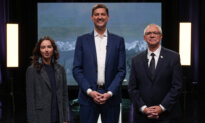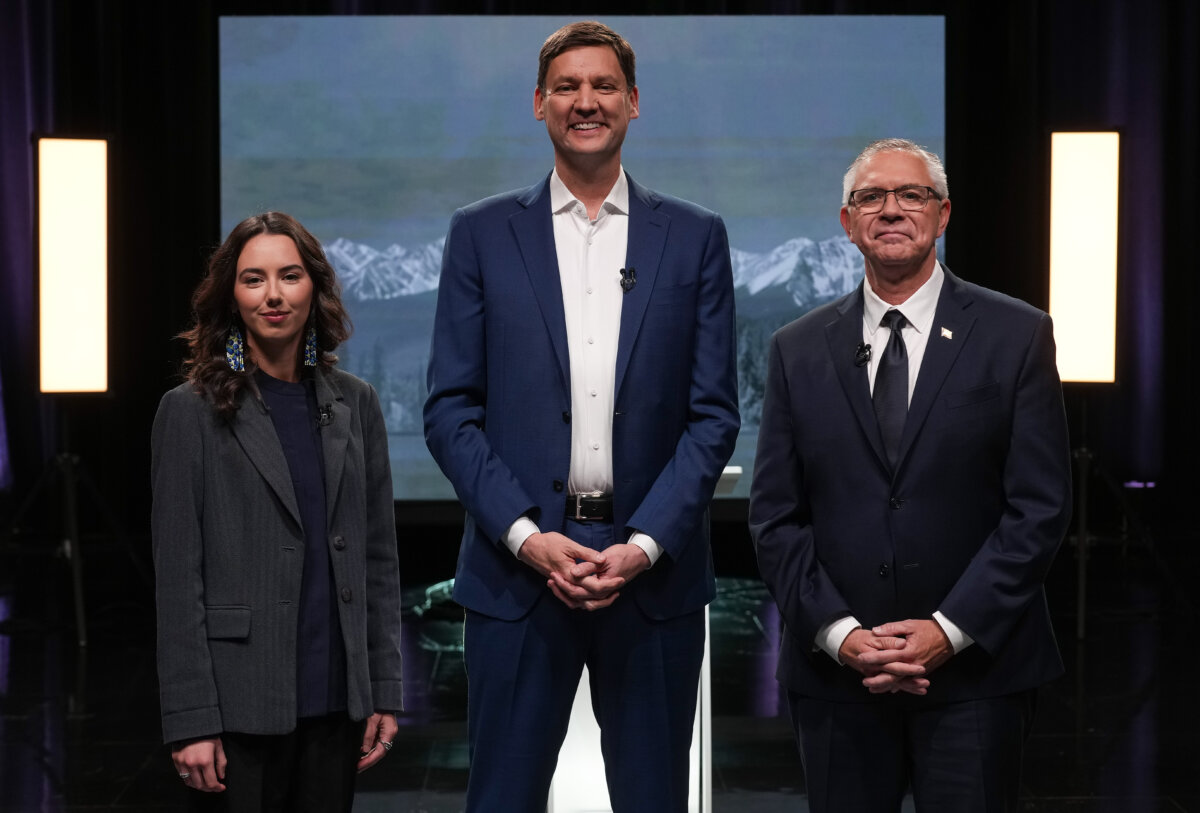
B.C. NDP Leader David Eby defended his record and his decision to call an early election during the B.C. party leaders’ debate, while interim B.C. Conservative Leader Lorne Doerkson challenged him on his government’s deficit and tax policies.
The Oct. 14 event was the only televised leadership debate between Eby, Doerkson, and B.C. Green Party leader Emily Lowan ahead of the Oct. 24 election.
At the outset of the debate, Eby was asked why he called a snap election two years into his four-year mandate, at an estimated cost of $90 million. Eby said his party’s narrow majority left the legislature effectively tied after the appointment of a speaker, “so every vote is potentially a vote to bring down the government.”
“When you’re unable to deliver the agenda that we need at this time … because our preoccupation was just with the government surviving another day, isn’t good enough,” Eby said.
Doerkson was asked about his leadership experience, given that he has only been in charge of the party for the 24 days since Kerry-Lynne Findlay resigned amid turmoil within the party. Doerkson said it was “a bit of a surprise to myself as well,” and that Eby had “called a snap election because he saw opportunity for himself, and I see opportunity for British Columbians.”
Lowan said she was the only leader of the three who rents her home and has worked a minimum wage job over the last decade. That, she said, makes her the “only leader on this stage that feels the decisions being made in the legislature, especially as it relates to the cost of living crisis and the climate crisis.”
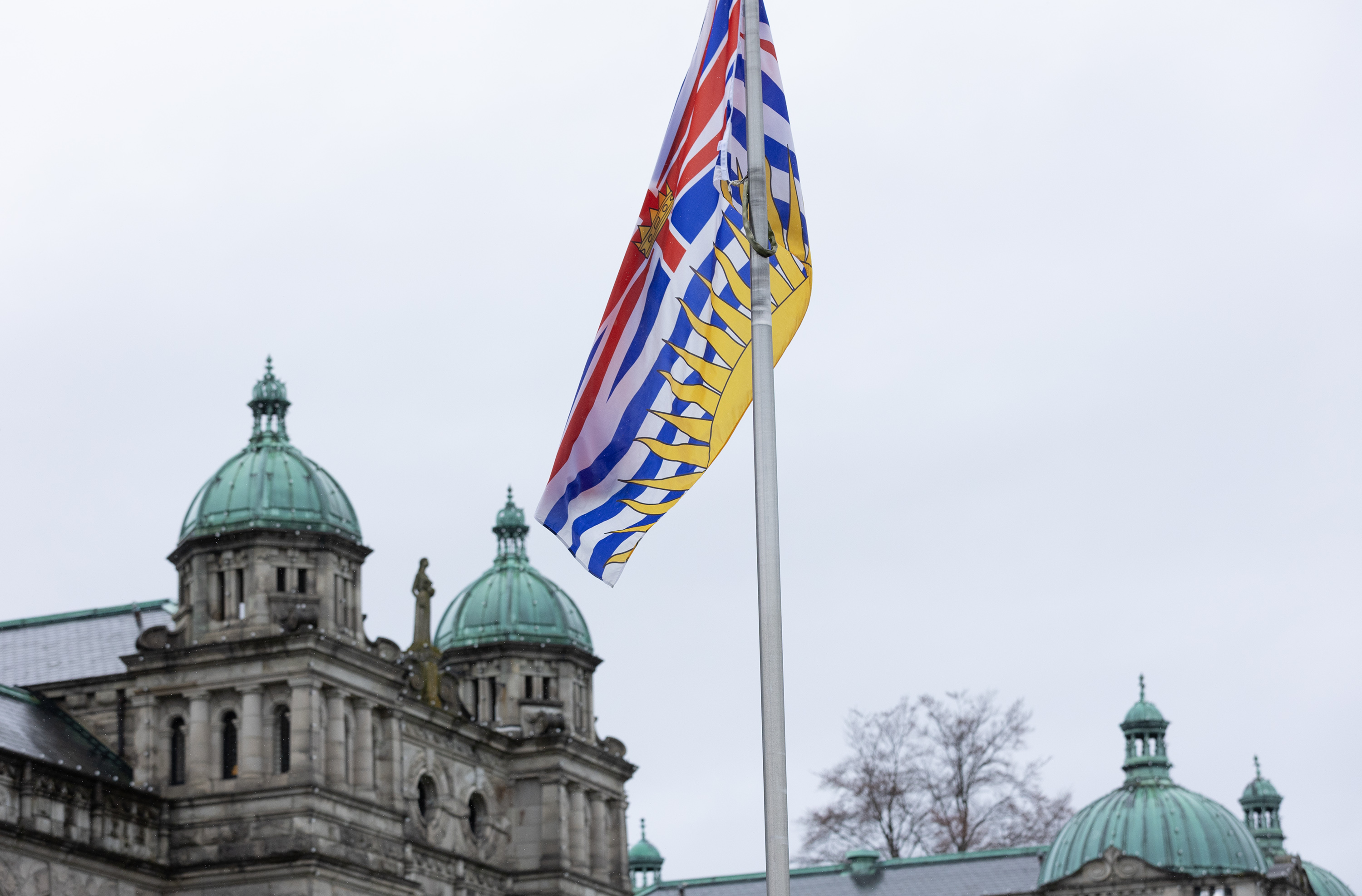 A B.C. provincial flag hangs in front of the legislature building in Victoria on April 14, 2026. (The Canadian Press/Chad Hipolito)
Candidate and Staff Comments
Moderator Shachi Kurl, president of the Angus Reid Institute, asked Doerkson about comments made earlier this year on social media by the Conservatives’ campaign director, Katy Merrifield, about Islam.
Doerkson was asked what kind of behaviour is unacceptable within his party, given Merrifield’s posts. Merrifield had made the comments after reading the accounts of young women in the United Kingdom who suffered sexual abuse from predominantly Pakistani men.
“This is a woman who survived sexual violence, and she acted out in a moment of trauma. She removed the post, and from there, I think she has been very apologetic,” Doerkson said, adding that he had given Merrifield “a moment to reflect on that.” He said Merrifield will remain his campaign manager.
Eby accused Doerkson of minimizing Merrifield’s comment, while also accusing an incumbent Conservative MLA of making comments about another incumbent MLA who is in a same-sex relationship.
“Just three weeks ago, she said, ‘If you’re concerned about hate against Muslims, then you have a suicidal empathy, and that is the problem of the West.’ Her Twitter feed at points reads like the worst corners of the dark web,” Eby said.
Doerkson countered by accusing the B.C. NDP of having an anti-Semitism problem, citing the 2024 departure of former Post-Secondary Education Minister Selina Robinson, who is Jewish. He also faulted an NDP candidate for “denouncing police,” and said that NDP candidate and Attorney General Niki Sharma has made comments “with racism” on her social media. In a 2018 social media post about that year’s municipal election results, Sharma wrote, “The unbearable whiteness of local elections results.”
“You had a woman leave your caucus because they either didn’t feel safe or didn’t feel supported,” Doerkson said.
Eby said he ousted Robinson for comments she made about Palestine. Robinson said in 2024 that Palestine was “a crappy piece of land with nothing on it” until Israel was founded.
Lowan said the exchange felt like “déjà vu of the 2024 race,” with a divided Conservative Party and an interim leader. “And we see the same failing status quo, a managed decline under David Eby, and I think British Columbians are finally ready to see this province move forward,” she said.
 Signage seen at the Elections BC office in Victoria on Sept. 25, 2024. (The Canadian Press/Chad Hipolito)
Finances, Healthcare
Eby was asked about B.C.’s finances, including a record $13.8 billion deficit despite a $6 billion surplus four years ago. Eby aaccused the government that preceded the NDP’s election in 2017 tof reducing funding for healthcare and schooling.
“The so-called ‘balanced budgets’ that the previous government delivered were balanced on the backs of British Columbians. We will never do that,” Eby said.
Eby has pledged to increase taxes on people making more than $190,405 if re-elected, and to make a new tax bracket for people making more than $1 million, which the party says would bring in an extra $1 billion a year.
Doerkson said he would fully fund healthcare in the province while cutting red tape and bureaucracy and supporting the forestry and liquiefied natural gas industries. “There is an opportunity like never before to grow income in this province. I will fully fund healthcare … but we will be looking for savings wherever we can,” he said.
The B.C. Conservatives have promised a $1,000 tax cut for British Columbians by raising the basic personal exemption from from $13,216 to $32,000.
Doerkson said that Eby could not “continue to attack the residents of British Columbia through taxation,” and Eby countered that B.C.has the lowest income tax for people who earn under $150,000 of any province.
Lowan said that Eby was “taxing work and not wealth,” and was “unwilling to stand up to the ultra wealthy and ask them to pay their fair share.” Lowan said her party would impose a one-time tax on British Columbians with fortunes exceeding $50 million, along with a “marginal annual tax,” which she said would bring in $5.4 billion a year.
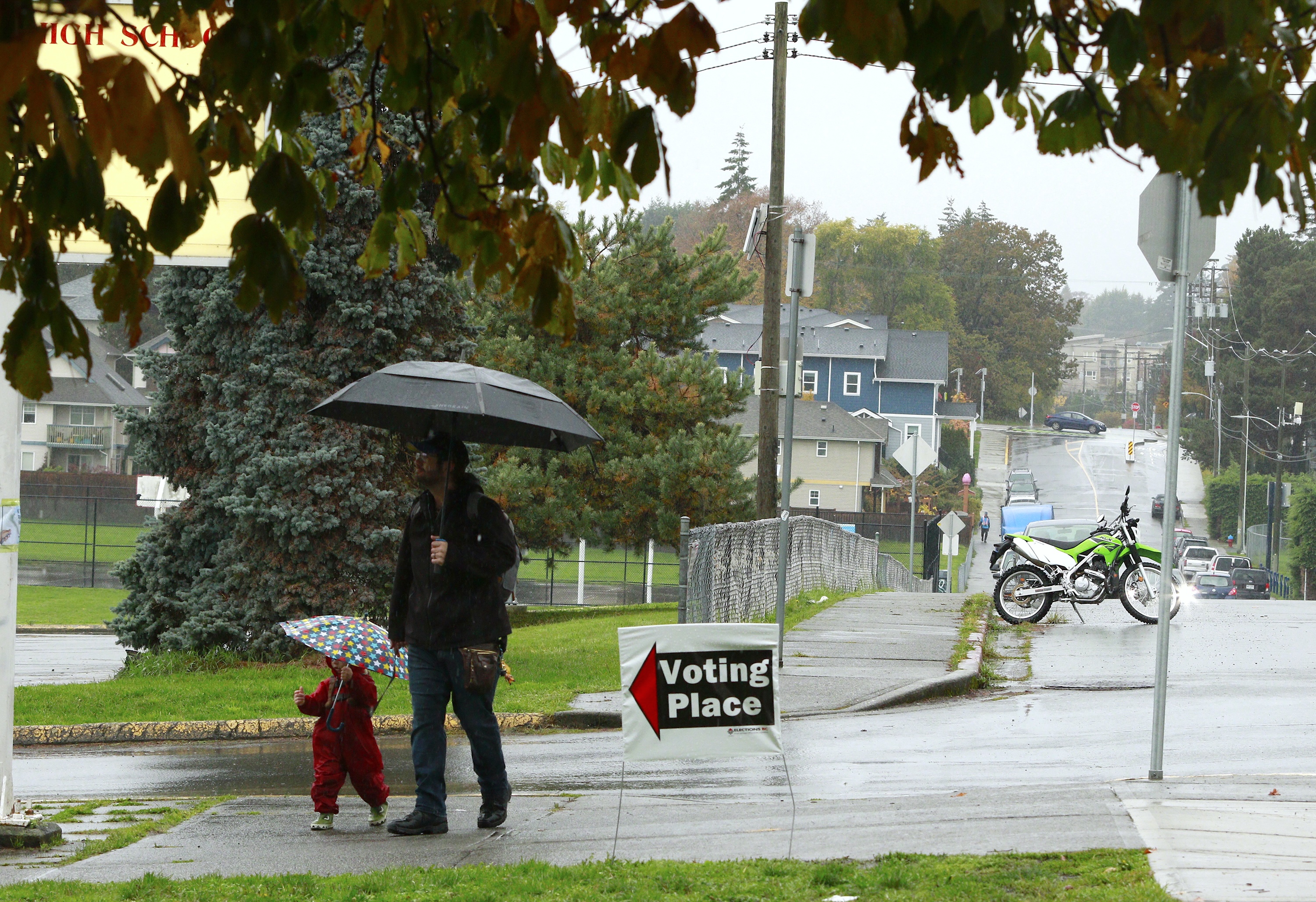 Rain falls as a man and child make their way to a school serving as a voting station in Esquimalt, B.C., on Oct. 19, 2024. (The Canadian Press/Chad Hipolito)
Housing, DRIPA, and Public Safety
On the subject of housing, Doerkson said the government needs to eliminate the “bureaucratic nightmare” homebuilders face. He said he knows of a builder in Comox, B.C., who has been waiting a year for a permit to build a home. Doerkson has also criticized the NDP’s proposal for a new tax on vacant condos, saying more taxes aren’t the solution to the housing crisis.
Eby said rents have been decreasing for 24 months straight “because we have built so much rental housing.” He added that the B.C. Conservatives’ promise to repeal municipal housing rules would increase red tape for new projects and subject many proposals to long public hearing timelines.
The leaders were asked about the Declaration on the Rights of Indigenous People Act (DRIPA), which established the United Nations Declaration on the Rights of Indigenous Peoples as B.C.’s framework for reconciliation in 2019. The legislation has drawn increased attention recently amid court rulings affecting private property ownership and other land right issues.
The B.C. Conservatives have said they will repeal DRIPA, which Doerkson said has adversely affected property rights of British Columbians.
“There has to be a better path forward, and that is through respect and relations, and certainly partnerships with First Nations in this province,” Doerkson said. “We have to ensure private property rights for owners. We have to ensure that tenures that exist on the landscape are also protected in some way. And if we share that wealth, that’s fantastic. But DRIPA is not solving the issue with British Columbia,” Doerkson said.
Eby said the province has experienced a “couple of challenging court decisions” due to DRIPA, such as the Gitxaała and Cowichan Tribes ruling by the B.C. Supreme Court.
He said the province needs to continue its teamwork with indigenous peoples, which he said is the reason B.C. leads Canada in the number of projects approved by the federal Major Projects Office.
“But another thing is true too. When you have your private property, you need to know what you have, and you need to know what you can do with it,” Eby said, adding that his government would protect private property rights.
Eby also accused Doerkson’s “colleagues” of “attacking residential school survivors.” Doerkson called the remark offensive, adding, “We’re here to talk about DRIPA.”
Lowan said while her party “takes the advice” of First Nations, the uncertainty around DRIPA had come from “a premier who can’t seem to make up his mind,” and a “Conservative Party that is constantly pushing misinformation and blatant fearmongering.”
Doerkson criticized the state of public safety in the province, and that “random attacks” take place against residents. “We have to bolster our police force,” he said.
Eby said his government has taken action against “violent repeat offenders” and has moved to address the extortion issues in Surrey.
Debate organizers also played videos of CentreBC and OneBC leaders, in that order. The oragnizers of the live debate said the leaders of the two parties didn’t meet the requirements to be included.
CentreBC Leader Elenore Sturko called her party “socially progressive, environmentally pragmatic, and fiscally responsible,” and said it will “support strong ideas and bring accountability back to the legislature.”
OneBC Leader Dallas Brodie said her party would push for a 25 percent income tax cut for both individuals and corporations, as well as a 2 percent cut in the PST. She added, “We will stop the greed and corruption of the reconciliation industry in British Columbia.”
Advance polling in the B.C. election runs from Oct. 16 to 21, and election day is Oct. 24.
 Friends Read Free
Copy
Facebook
Tweet
Friends Read Free
Copy
Facebook
Tweet