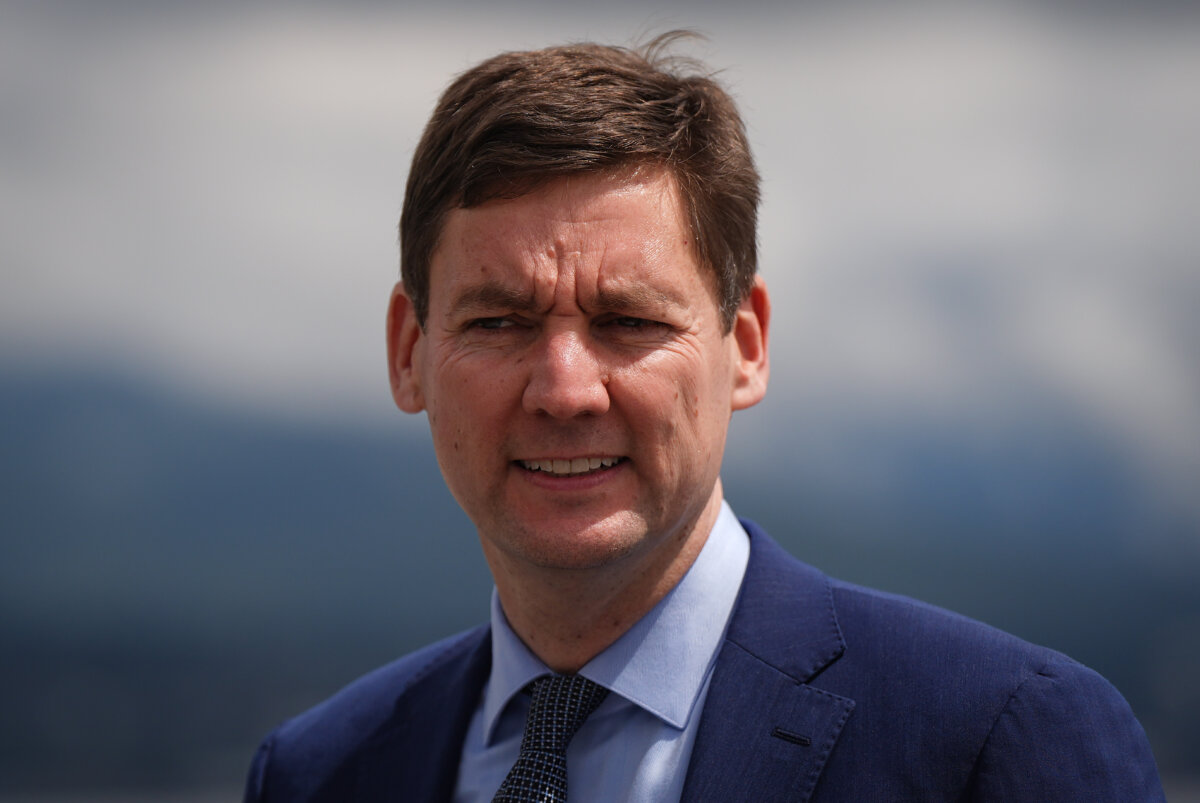

B.C. Premier David Eby continues to express skepticism about the need for a new pipeline in his province, suggesting that an energy company would have already signed up for the project if it was economically feasible.
“The reality is that there’s a reason why there’s no proponent,” Eby told CTV’s Power Play in a June 22 interview. “There’s a reason why there’s not a big private company that’s advocating for this. It’s because the economics aren’t there, and so it will require federal subsidy.”
Eby has said in recent weeks that if a new pipeline from Alberta to B.C.’s northern coast was viable, there would already be companies interested in building it.
Alberta Premier Danielle Smith said earlier this month that persuading Eby to support a new pipeline is one of her top priorities. But Eby said his stance hasn’t changed and he is “skeptical” Smith will be able to convince him to change his mind.
“Count me as skeptical, and count me as opposed to the idea of tens of billions of dollars of additional federal subsidy when we have a pipeline that is not currently at capacity in our province operating right now,” he said, referring to the Trans Mountain pipeline, while noting that he is not in favour of any new pipeline that Ottawa would need to fund.
Instead, Eby said he wants the Trans Mountain pipeline carrying crude and refined products from Edmonton to the B.C. coast to reach its full capacity before embarking on construction of a new pipeline.
If Smith can find a way for a pipeline project to move ahead without “significant federal subsidy,” then “more power to her,” Eby added. “If the premier of Alberta is able to deliver it, then let’s have that conversation. But I don’t see that.”
Nation-Building Projects
A pipeline could be one of the so-called “nation-building” projects that Ottawa decides to pursue now that the Liberals’ Bill C-5, also known as the Building Canada Act, has passed through the House of Commons.
MPs voted 306 to 31 in favour of the legislation on June 20, shortly before the House adjourned for its annual summer recess.
If the legislation is approved by the Senate and goes on to receive royal assent from the governor general, the government will be granted extensive new powers to expedite major projects like mines, ports, and pipelines.
The Liberal government has yet to prioritize any particular project, as one of its “nation-building” initiatives, although Prime Minister Mark Carney has said he is not opposed to the idea of a new pipeline.
Carney has said, however, that a pipeline alone is not enough to make Canada an “energy superpower.” He has floated a number of different energy project ideas with a focus on nuclear, hydro, and carbon capture and storage.
Carney has also said a pipeline project would need to achieve “consensus” to move forward, noting that his government would not impose any project upon a province that does not support it.
Canada’s western provinces already have a consensus of sorts to work together on a “port-to-port” energy corridor running from Manitoba to Prince Rupert, a port city on B.C.’s northwest coast, Eby said. The provinces signed a memorandum of understanding at last month’s Western Premiers’ Conference to connect ports on the northwest coast with Hudson’s Bay and called on Ottawa to support the project.
The corridor will be used “for energy products, for electricity, for additional rail capacity” and other resource-related projects, Eby said.
“If Premier Smith is able to come up with this (pipeline) project, that’s what the corridor will be for,” he said, but noted he would rather concentrate on projects that can be accomplished in the immediate future.
“Let’s talk about the projects that are actually here, that are going to be delivered in the here and now, that will have that impact of increasing GDP,” Eby said, noting that oil is not at the top of British Columbia’s priority list.
Instead, he wants to focus on the areas of energy production that were discussed during his recent trade mission to Asia.
The 10-day trade mission earlier this month saw Eby visit Japan, Malaysia, and South Korea where there is a growing demand for energy. He said it is time to tap into the growing interest in liquefied natural gas which can be transported over long distances when pipelines are not feasible. Eby said the countries are also interested in hydrogen, which can be used in fuel cells to generate electricity, and ammonia, which is gaining traction as a potential carbon-free energy source.
All three countries are “anxious about energy security,” he said.
“There’s huge work that we can do with massive private project proponents, huge investment in both of our provinces,” he said, referring to both B.C. and Alberta. “I think this is where our attention should be, and I’m going to do my best not to have our provinces divided when we need to be coming together.”
 Friends Read Free
Copy
Facebook
Tweet
Friends Read Free
Copy
Facebook
Tweet