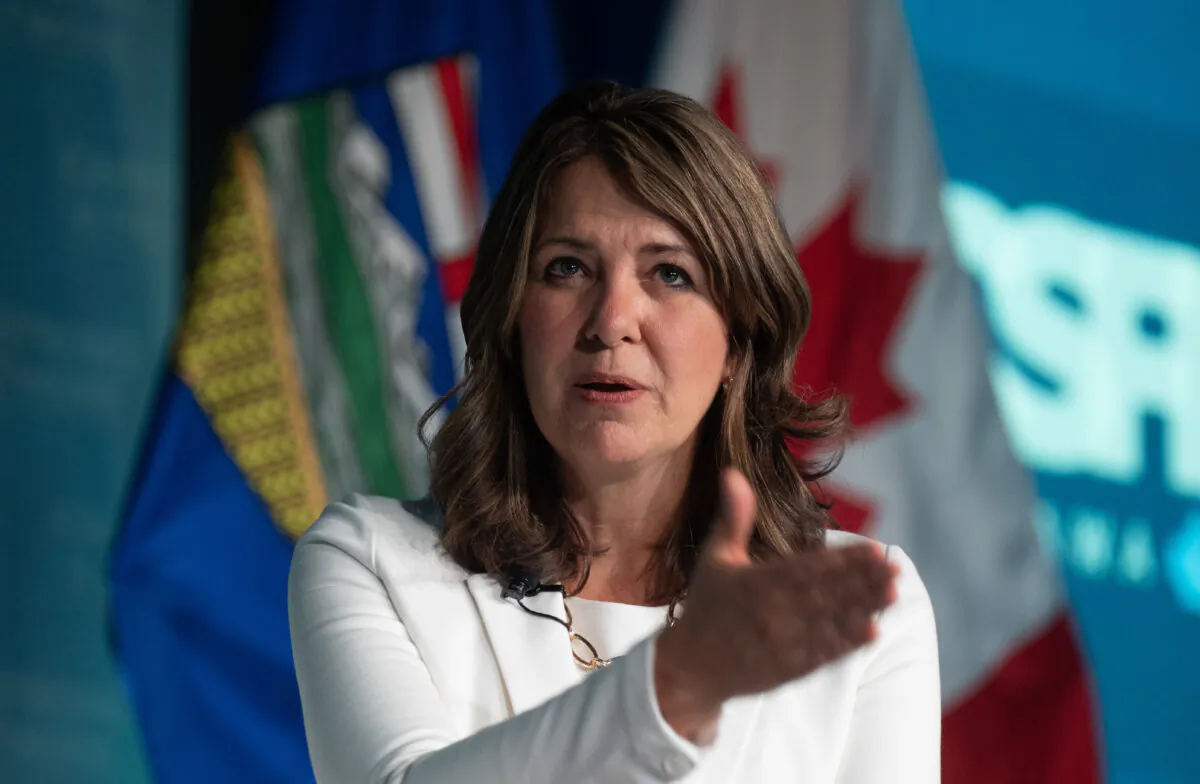

Persuading British Columbia Premier David Eby to support the construction of a pipeline to transport oil from Alberta through his province to the coast is a top priority, Alberta Premier Danielle Smith says.
Eby said last week he would not back a new pipeline, saying the Trans Mountain pipeline carrying crude and refined products from Edmonton to the B.C. coast is already operational and should be used to its maximum potential. He told reporters during a June 3 press conference that Smith’s vision for a north coast pipeline is “many, many years off.”
The absence of support from B.C. could significantly impede Smith’s efforts to advance the pipeline in light of recent comments made by Prime Minister Mark Carney. He told reporters last week his government would not impose any project on a province that does not endorse it, adding that a pipeline will need to achieve “consensus” to move forward.
Smith told CTV’s Question Period host Vassy Kapelos this weekend that she is not giving up on her pipeline goal, a project says is beneficial for Canada.
“I’m going to convince David Eby of it, because I know that this is good for the country,” Smith said. “I know that he’s on Team Canada, and I can’t imagine, in the end, that if we meet the issues that have been raised by British Columbia, that he would go off Team Canada. That doesn’t seem to me to be the type of person that David Eby is.”
Smith said there are issues and concerns to tackle, including the pipeline’s route and the support from indigenous communities. But she said she remains confident such challenges can be resolved, noting that the $22 billion in gross domestic product (GDP) the pipeline could generate is a powerful incentive at a time when the country needs funds to build new schools, hospitals, and roads.
“That’s the kind of national interest that we’ve got to be thinking about and I’m going to tell you, there isn’t going to be a single other project on the national projects list that comes close to that scale,” Smith said. “So I think that that’s what we have to be talking about, since we all win, let’s figure out a way to address the objections.”
British Columbia has a history of pipeline opposition. The federal government purchased the Trans Mountain pipeline expansion project in 2018 for $4.5 billion after energy conglomerate Kinder Morgan abandoned it, citing B.C. opposition.
Eby suggested last month he would consider a pipeline if Smith was able to convince the federal government to approve one, but added that his focus was on decarbonizing his province’s economy.
Carney said in an interview last month he would support a new pipeline but only if there is a “consensus” for their development among all provinces it would run through.
Carney has said there are opportunities for an oil pipeline to bring “decarbonized oil” to markets in Asia and Europe, but has also said that a pipeline alone is not enough to make Canada an “energy superpower.” He has also said he is focused on a number of different energy projects such as nuclear, hydro, and carbon capture and storage.
Carbon Capture
Smith noted during her June 8 interview that a new pipeline could play a major role in de-carbonization, saying that some of the revenue the government receives from the pipeline could be used for the Pathways Alliance project, a proposal for a carbon capture and storage network in northeast Alberta.
The goal of the project is to reduce emissions from oil sands facilities by capturing and storing carbon dioxide that would otherwise be released into the atmosphere. The project is being spearheaded by the Pathways Alliance, a consortium of six oil sands companies.
When asked why government revenues should be allocated to a project that profits oil companies instead of designating all pipeline revenues for health care and education, Smith said it could be a win-win scenario for both the country and the energy industry.
“You can’t spend money if you don’t create it,” she said. “And the energy companies create a lot of money for us. We get about $17 billion worth of revenue from those companies. So we want to be able to see the ability for them to create more of that.”
Smith said the province has consistently maintained a funding agreement with energy companies operating within its borders, enabling them to recoup 12 percent of the costs associated with the construction of their oil sands projects through a government rebate.
“That’s very much in keeping with the kind of supports that we’ve given in the past,” she added. “I think the advantage this time is that they can now see the potential for new markets. And if you can have $20 billion worth of sales year after year after year for 20 or 30 years, that’s a pretty good value proposition.”
 Friends Read Free
Copy
Facebook
Tweet
Friends Read Free
Copy
Facebook
Tweet