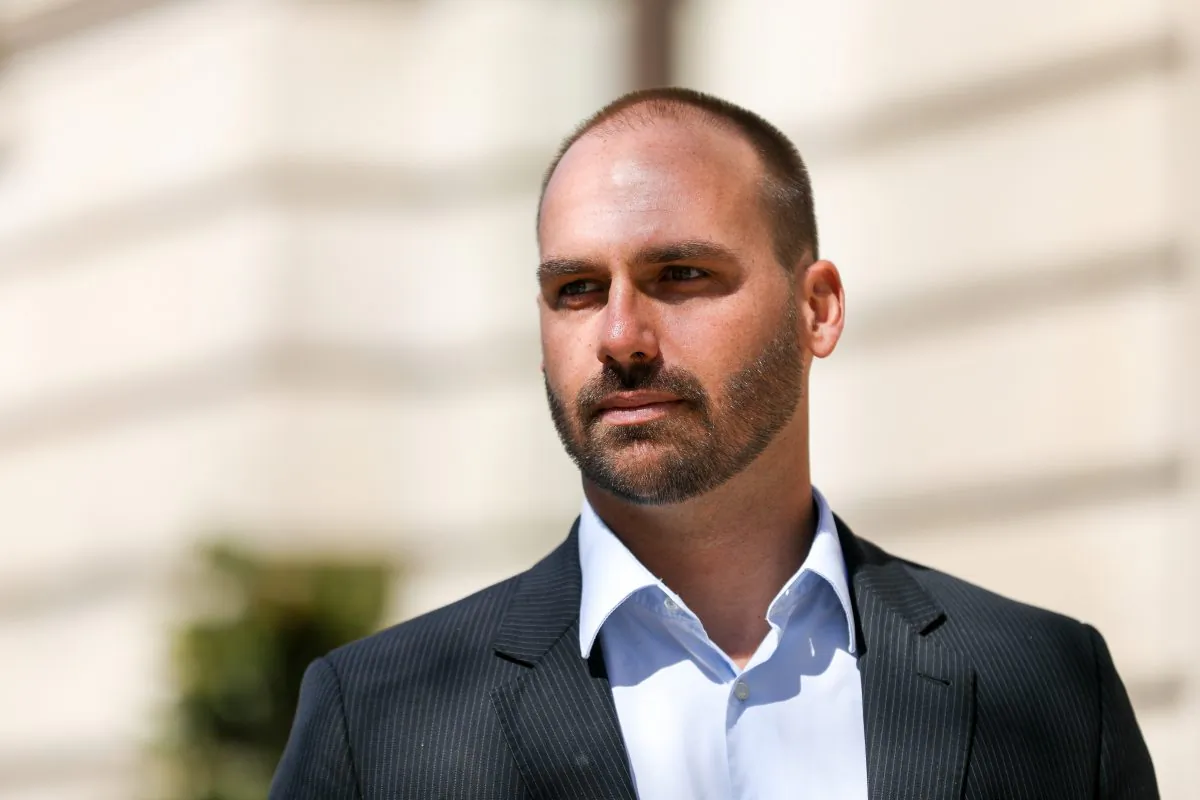

NEW YORK—A new round of U.S. sanctions related to Brazilian authorities was imposed on Sept. 22—the same day lawmaker Eduardo Bolsonaro, son of former President Jair Bolsonaro, was charged with coercion. The indictment is part of related legal cases U.S. President Donald Trump previously called a “witch hunt.”
Eduardo Bolsonaro spoke to The Epoch Times as talks between Brazilian President Luiz Inácio Lula da Silva and Trump are now expected within days, following a brief encounter at the United Nations General Assembly on Sept. 23.
The younger Bolsonaro said that without international pressure—coming mainly from the United States—Brazil would be sliding into authoritarianism.
“I can’t come back to my country, because they will arrest me. My bank accounts and those of my wife are frozen. They fabricate new investigations against me all the time, and now they even threaten to strip me of my mandate,” said Eduardo Bolsonaro, residing in the U.S. since Feb. 27.
He is a congressman serving his third term in Brazil’s Chamber of Deputies, the lower house of the National Congress. He was the most voted congressman in Brazil’s history in the 2018 elections.
“It is clear: Brazil is heading down the same path as Venezuela,” he said.
Trump accused the Brazilian government of political persecution towards conservative opposition voices and imposed on the country tariffs of up to 50 percent—among the highest in the world.
On Sept. 11, a panel of the Brazilian Supreme Court sentenced Jair Bolsonaro to 27 years in prison after convicting him of attempting to overthrow the government following his loss in the country’s 2022 election.
The court found him guilty on five counts: attempted coup, participation in an armed criminal organization, attempted violent abolition of the democratic rule of law, violence-related damage, and serious threats against state assets and protected heritage.
Lula wrote in a Sept. 14 op-ed published on The New York Times: “The judgment was the result of proceedings carried out in accordance with Brazil’s 1988 Constitution, enacted after two decades of struggle against a military dictatorship. It followed months of investigations that uncovered plans to assassinate me, the vice president and a Supreme Court justice. Authorities also discovered a draft decree that would have effectively annulled the 2022 election results.”
Meanwhile, Eduardo Bolsonaro said that “Lula, Alexandre de Moraes, and their accomplices in the Brazilian regime cling to fabricated narratives,” referring to Brazilian Supreme Court Justice Alexandre de Moraes, who presided over the trial.
“They want people to believe that 1,500 unarmed citizens—many of them elderly women in their 70s—gathered on a Sunday during Brasília’s holiday recess, were capable of staging a coup d’état, precisely at a time when President Bolsonaro was in the United States,” he said, referring to the Jan. 8, 2023 riots, when a mob vandalized Brazil’s Congress, Supreme Court, and Presidential Palace buildings after the 2022 presidential elections that Jair Bolsonaro lost by a thin margin.
The Jan. 8 riots were classified by the Brazilian Supreme Court as the consummation of the alleged coup attempt, which, the Court ruled, also involved plots to assassinate authorities.
Eduardo Bolsonaro said this narrative is “absurd, insanity that collapses under a minute of honest scrutiny.”
“Bolsonaro, while still president, even appointed the military commanders who had been nominated by Lula, something no coup plotter would ever do,” the younger Bolsonaro said. “The events of January 8, 2023, were a protest that spiraled out of control, much like January 6, 2021, in the United States. But today they are being weaponized by the left to disqualify Bolsonaro from the 2026 elections.” He was referring to the Jan. 6, 2021, Capitol breach in the United States.
The former Brazilian president now faces house arrest and can’t run in the 2026 ballot.
Eduardo Bolsonaro denies the allegations of coercion. His recent indictment refers to his advocacy work abroad, as he seeks to raise awareness about an alleged lack of due legal process in his father’s trial and on other cases related to Jan. 8, as well as online censorship by Brazilian authorities involving U.S. social media companies and U.S. residents.
“How could I possibly be accused of coercion if I hold no power whatsoever to place anyone on [Office of Foreign Assets Control’s] sanctions list, which is governed by the Magnitsky Act? This is a legitimate instrument of U.S. law, not a personal tool of mine,” he said.
The Office of Foreign Asset Control (OFAC) is a branch of the U.S. Department of the Treasury that tracks financial sanctions. The Global Magnitsky Act is a 2016 piece of legislation that allows the president of the United States to sanction individuals for substantial corruption or human rights violations.
De Moraes, the main Brazilian Supreme Court justice responsible for former president Jair Bolsonaro’s trial and targeting big tech for online speech, was sanctioned by the Treasury through this program on July 30, 2025. His wife and an entity called the Lex Institute, a company linked to his family, were sanctioned on Sept. 22, the same day Eduardo Bolsonaro was charged.
“I have never acted to interfere in any judicial proceedings. What I do, within the prerogatives of my office as a Congressman, is defend amnesty [a pardon that comes from Congress] for those politically persecuted by the human rights violator Alexandre de Moraes,” the younger Bolsonaro said.
“Denouncing human rights violations is not a crime; it is a duty,” he continued.
He has called for “broad, general, and unrestricted amnesty,” dating back to controversial investigations started in 2019 by the Supreme Court that intermingle with the coup d’état ruling. He alleged that “otherwise, the Supreme Court will continue fabricating cases to convict conservatives and render them ineligible.”
Eduardo Bolsonaro said U.S. sanctions have had an impact locally, mentioning a recent vote in the Brazilian parliament to expedite a bill that would reduce the sentences of Jan. 8 offenders.
“Today, after the American sanctions … we passed the urgency motion [in Congress] with 311 votes, more than enough to amend Brazil’s Constitution,” he said. “Without international pressure, Brazil would already be a Venezuela, with only false opposition and the true right barred from next year’s elections.”
The Epoch Times reached out to the Brazilian Supreme Court and to the Brazilian Attorney General’s Office for comment and did not receive immediate replies.
Emel Akan contributed to this report.
 Friends Read Free
Copy
Facebook
Tweet
Friends Read Free
Copy
Facebook
Tweet