The ethics commissioner is defending the conflict-of-interest screen put in place to shield Prime Minister Mark Carney, as the House of Commons reconvenes for the fall sitting.
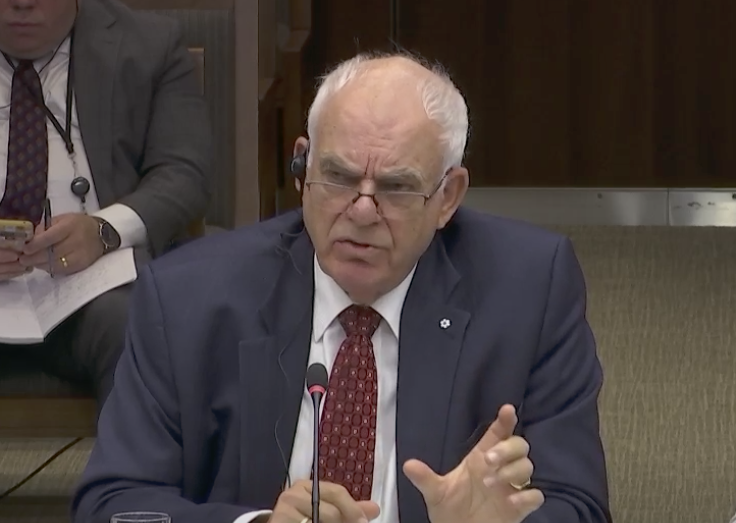
Commissioner Konrad von Finckenstein attended the House ethics committee on Sept. 15 to provide a briefing and take questions from MPs.
Opposition MPs were mostly focused on seeking details regarding the measures put in place to ensure that Carney does not benefit financially or otherwise from his political decisions.
Von Finckenstein was asked whether there could be an issue with the conflict-of-interest screen being managed by Carney’s top two political appointees.
The commissioner said the screen relies “on the integrity of the senior people in government acting in accordance with the law.”
“Because their interest is the same as the prime minister, whom they serve,” he added, they don’t want to see Carney “run afoul of conflict of interest. That causes both political and legal problems.”
Carney’s chief of staff Marc-André Blanchard and Clerk of the Privy Council Michael Sabia are in charge of managing the ethics screen.
Tory MP Michael Cooper remarked that the two serve at the pleasure of the prime minister. “In the face of that, what assurance do Canadians have that the screen is actually being enforced properly?” he asked.
Von Finckenstein said that all of the staff working under Carney have been instructed on how to deal with the potential conflicts of interest. “We have given them lessons on what [to do], how to do, etc. When in doubt, they will consult with us,” he said.
MPs are subject to the Conflict of Interest Code for MPs while public office holders are subject to the Conflict of Interest Act. Officials are required to divest their controlled assets or put them in a blind trust.
The ethics commissioner keeps a public registry of declarations by MPs, ministers, and officials. Other information submitted to the commissioner’s office by individuals subject to regulations is also kept confidential.
Carney’s office previously said he has worked with the ethics commissioner to “exceed” the conflict-of-interest rules. “All of his investments were placed in the blind trust and all investment decisions are taken independently from him,” said a spokesperson from the Prime Minister’s Office in July.
Blind Trust
Before entering politics in January, Carney served on the board of several companies and organizations, including as board chair of Brookfield Asset Management. Before becoming prime minister, Carney pledged to put his assets in a blind trust, but after being sworn-in to office he refused to disclose the nature of those assets.
Carney said he was working with von Finckenstein to set up the appropriate conflict-of-interest screen. “Let’s say that there’s a decision that will have a major impact on Brookfield. Then of course, I will recuse myself,” Carney said in March.
Details of the screen were released by the ethics commissioner in July. Carney’s declaration said he and von Finckenstein had agreed the screen would be aimed at “preventing any opportunity” to further his interests or to “improperly further those of Brookfield Asset Management, Brookfield Corporation, and Stripe Inc.”
It also encompasses any company owned or controlled by the three companies on the date that the blind trust was established.
The content of the blind trust disclosed includes a number of shares and stock options in payment processor Stripe, Brookfield, and others. It also lists shares in over 500 companies held in an investment account managed by a third party.
Amid Ottawa’s push to build major projects deemed to be in the national interest, Bloc Québécois MP Luc Thériault raised concerns during the committee meeting about companies like Brookfield potentially benefitting from federal decisions.
Thériault said that Bill C-5, also known as the One Canadian Economy Act, could lead to the construction of railways, natural gas pipelines, nuclear facilities, and ports, all of which could have an impact on Carney’s assets.
“He probably knows that Brookfield will benefit from it, and I think that this shows a structural deficiency that is unacceptable,” said Thériault.
Von Finckenstein said the potential projects mentioned by Thériault “doesn’t show who will be doing the work, who will be receiving government support, who will be choosing companies, what the impact will be for companies.”
“So we need to look at Brookfield, yes, but we are not at the moment of making a decision regarding who is going to benefit from all of this,” said the commissioner.
The Canadian Press contributed to this report.
 Friends Read Free
Copy
Facebook
Tweet
Friends Read Free
Copy
Facebook
Tweet