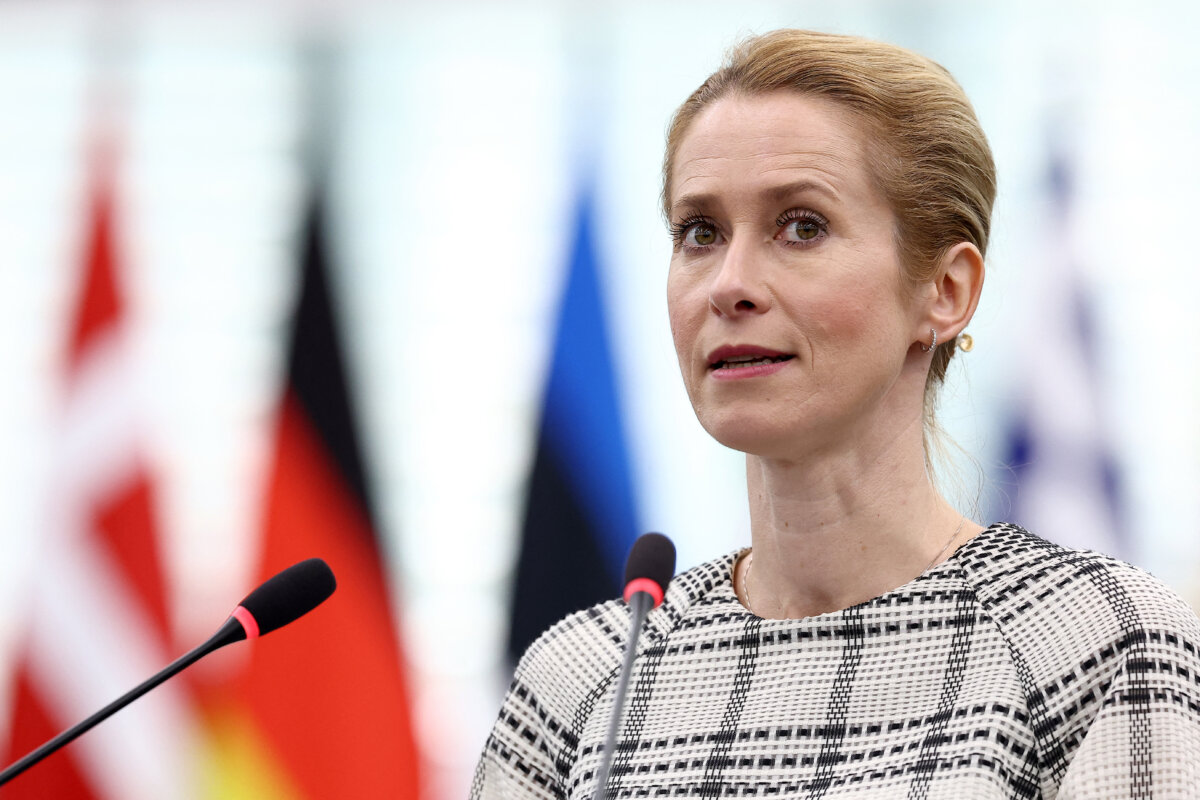

The European Union has reached an agreement on an 18th sanctions package targeting Russia’s energy industry and shadow fleet, EU foreign policy chief Kaja Kallas announced on Friday.
“The EU just approved one of its strongest sanctions package[s] against Russia to date,” Kallas said on X.
“We will keep raising the costs, so stopping the aggression becomes the only path forward for Moscow,” she added in a follow-up post.
Kallas stated that the package would target 105 additional shadow fleet ships, their enablers, and limit Russian banks’ access to funding.
The sanctions package comes amid mounting pressure from Washington, after U.S. President Donald Trump on July 14 threatened to impose 100 percent tariffs on the buyers of Russian exports if Moscow does not reach a peace deal with Ukraine within 50 days.
The raft of new measures is aimed at Russia’s oil and energy industry, and will lower the G7’s price cap for crude oil from $60 to $47.60 per barrel, according to Estonian Foreign Minister Margus Tsahkna.
The new cap is dynamic, meaning it will set the price of Russian oil exported to third countries at 15 percent lower than the average market price of Russian crude oil, in line with market fluctuations.
An import ban has also been introduced for refined petroleum products made from Russian crude oil in third countries, as part of a further effort to throttle Moscow’s economy.
However, Russia has so far managed to sell most of its oil above the previous price cap, as the current mechanism makes it unclear who is supposed to police its implementation.
“Neither the price cap for Russian oil nor adding shadow fleet tankers on a sanction list managed to disrupt Russian oil exports so far, so the market remains skeptical of the impact of the latest sanctions,” UBS analyst Giovanni Staunovo recently said.
Thanking those involved in bringing the package to fruition, Ukrainian President Volodymyr Zelenskyy said in an X post that the decision was “essential and timely” because Moscow has “intensified the brutality of the strikes” on Ukrainian cities and villages.
Zelenskyy also highlighted the EU’s decision to ban all transactions related to the Nord Stream gas pipelines, describing the construction of the network as part of Russian President Vladimir Putin’s “preparation for the full-scale war.”
Moscow responded to the new raft of sanctions by suggesting that they would not have a significant impact on Russia.
Putin’s press secretary, Dmitry Peskov, said, “We have acquired some immunity from sanctions, we have adapted to life under the conditions of sanctions,” Russian state news agency TASS reported.
He also told state-owned outlet RIA that the Kremlin has repeatedly said such actions are illegal.
The European Union has imposed multiple rounds of sanctions on Moscow since it invaded Ukraine in February 2022.
Slovak Prime Minister Robert Fico and Hungarian Prime Minister Viktor Orban previously signaled that they would block future EU sanctions against Moscow, as both nations rely on Russian gas and oil supplies.
Nevertheless, the 19th round of EU sanctions is already underway, according to the Estonian Ministry of Foreign Affairs.
The new European sanctions came on the heels of a threat by U.S. President Donald Trump for harsher measures from across the Atlantic.
Trump has expressed frustration with Moscow’s apparent reluctance to come to the table to bring the war in Ukraine to an end, with him explicitly criticizing Putin on July 8, saying that “he’s very nice all the time, but it turns out to be meaningless.”
This has led Trump to say he is considering throwing his support behind a bill sponsored by Sen. Lindsey Graham (R-S.C.) that would impose sweeping sanctions on Russia, including 500 percent tariffs on countries still buying Russian oil, gas, uranium, and other exports. The bill is currently working its way through the U.S. Senate and could be debated later this month, according to Senate Majority Leader John Thune (R-S.D.).
Trump has also stated that his threat of 100 percent tariffs could be implemented alongside the Senate package, in what he referred to as “secondary tariffs.”
Secondary tariffs are a newer form of economic action that entail a duty imposed on goods coming from third-party countries that trade with countries sanctioned by the United States.
Friday also saw Britain announce new sanctions on more than 20 Russian spies, hackers, and agencies over what it called a “sustained campaign of malicious cyber activity” involving attacks on governments and institutions across Europe.
Reuters contributed to this report.
 Friends Read Free
Copy
Facebook
Tweet
Friends Read Free
Copy
Facebook
Tweet