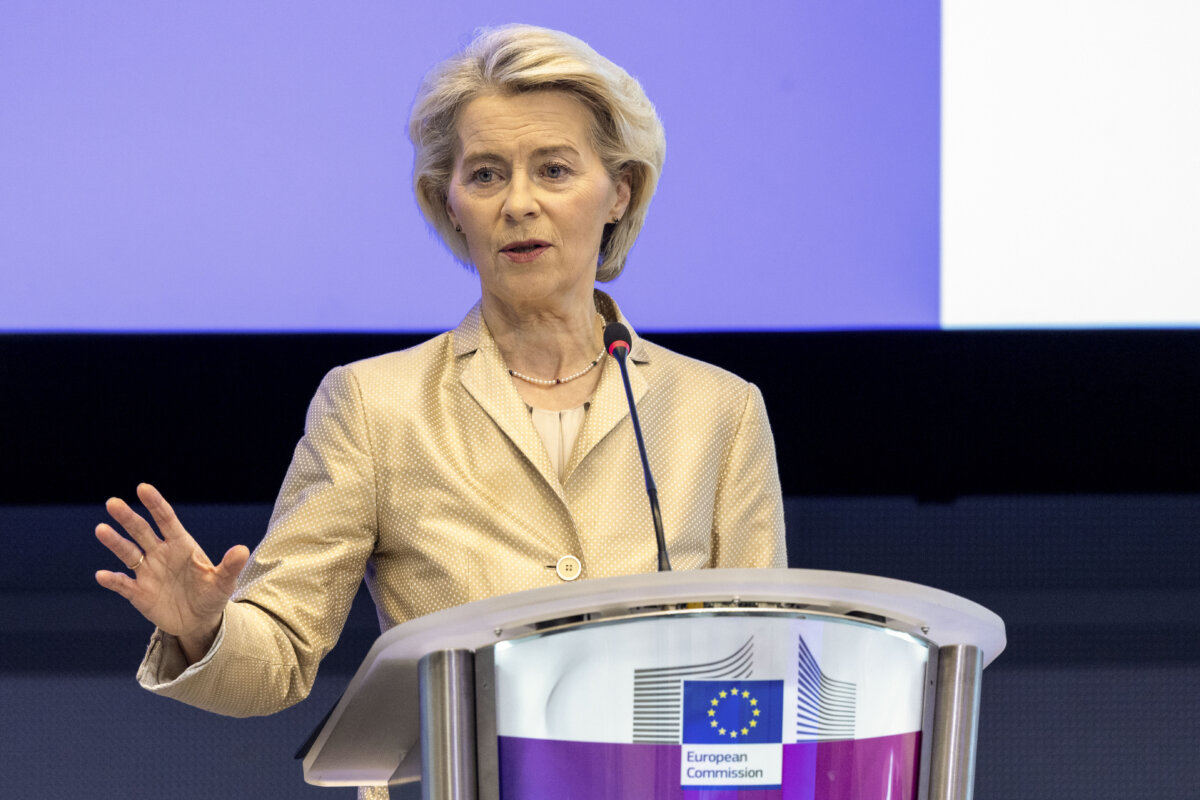

European Commission President Ursula von der Leyen labeled Russian threats toward the Baltic countries “unacceptable” on May 20, telling Moscow that threats toward those member states would be considered a threat against the bloc as a whole.
Her remarks came amid ongoing issues involving drones in the skies of Latvia, Lithuania, and Estonia, and claims from the Kremlin that the trio of former Soviet states are allowing Ukrainian unmanned aerial vehicles to use their airspace and even be launched from their territory.
“Russia’s public threats against our Baltic States are completely unacceptable,” von der Leyen said in a May 20 post on X.
“Let there be no doubt. A threat against one Member State is a threat against our entire Union,” she continued, saying that Russia and Belarus “bear direct responsibility for drones endangering the lives and security of people on our Eastern flank.”
Von der Leyen said the bloc will respond with “unity and strength,” and will continue “reinforcing the security of our Eastern flank.”
The Conference of Presidents of the European Parliament likewise condemned what they called Russia’s “unfounded allegations” and expressed “full solidarity” with the Baltic nations.
The body, which is responsible for organizing the parliament’s business and legislative planning, issued a statement on May 21 saying that Moscow’s accusations “form part of a broader pattern of intimidation, disinformation and provocation directed against EU Member States.”
It called on the EU to continue supporting Estonia, Latvia, and Lithuania, “in close coordination with NATO,” and strengthen airspace surveillance and counter-drone capabilities to prevent and respond to further incursions.
The previous day, NATO Secretary General Mark Rutte took aim at Russia over its claims about the Baltic states, which are members of both the defensive alliance and the EU.
He labeled Moscow’s allegation that the Baltic countries are opening their airspace to Ukrainian drones to attack Russia as “ridiculous” while taking questions from journalists in Brussels on May 20.
Rutte added that Russia knew that the claims were false, saying that if “drones come from Ukraine, they are not there because Ukraine wanted to send a drone to Latvia, Lithuania, or Estonia. They are there because of the reckless, illegal full-scale attack of Russia.”
He further said that the alliance had shown a “calm, decisive and proportionate response” to the Ukrainian drone that was downed by a Romanian fighter jet in Estonian airspace on May 19.
The same day the secretary-general made these remarks, the airport in Lithuania’s capital city of Vilnius suspended flights due to a drone warning, the country’s national crisis management center said.
Rutte’s comments came in response to allegations made on May 19 by Russia’s Foreign Intelligence Service (SVR).
The agency said Kyiv was preparing to launch an unmanned aerial vehicle strike from Latvian territory and from other Baltic states.
“According to the information received, Kyiv does not intend to limit itself to using the air corridors provided to the Ukrainian Armed Forces by the Baltic states. Drones are also planned to be launched from these countries,” the SVR said in a May 19 statement.
“The hope is that this tactic will significantly reduce flight times to targets and increase the effectiveness of terrorist attacks.”
Latvia and Ukraine have denied these claims.
More Incursions
Lithuania and Latvia both detected drones in their airspace on May 21 and urged some citizens to seek shelter while NATO fighter jets scrambled to intercept the devices, as the spate of incursions continues.
In Lithuania, military jets were searching for drones, the country’s military said, while air raid warnings were issued for Utena county, bordering Russian ally Belarus.
In a separate, earlier incident, Latvia’s armed forces reported a drone had entered the country’s airspace. They later said the threat had ended, without providing further details.
 Friends Read Free
Copy
Facebook
Tweet
Friends Read Free
Copy
Facebook
Tweet