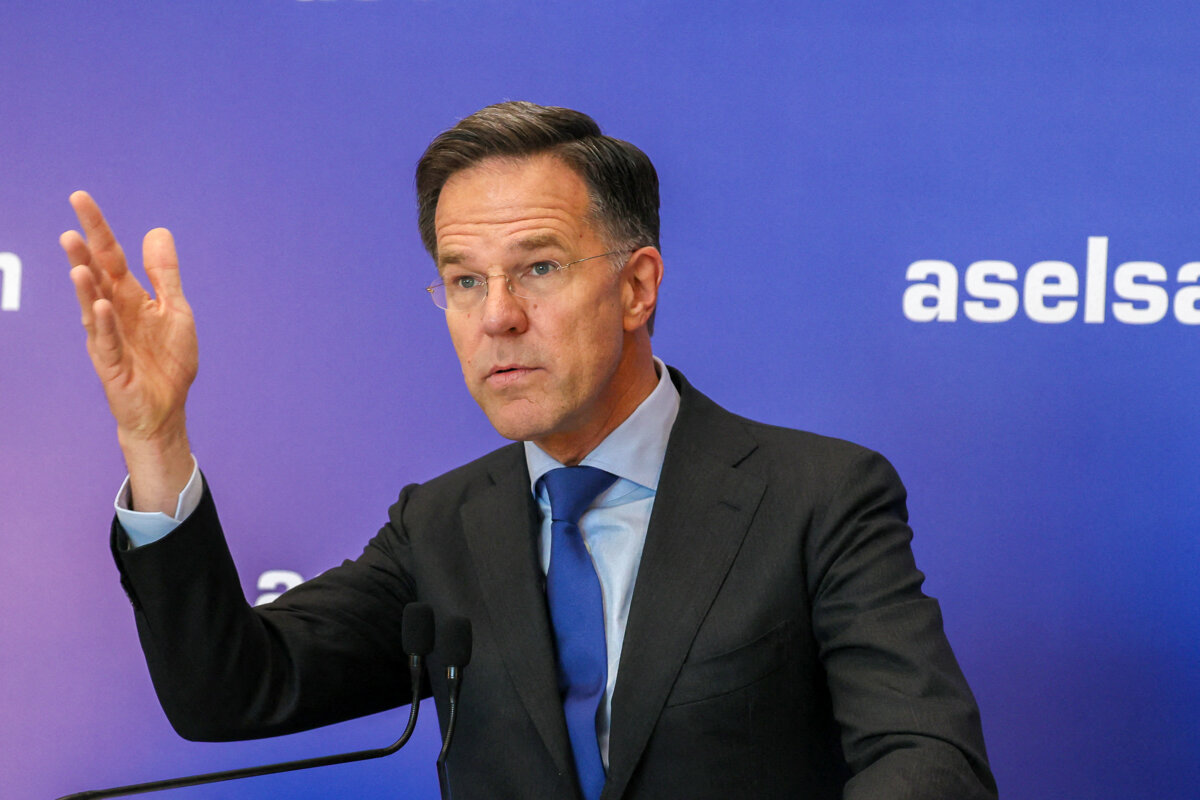

Moscow’s allegation that Baltic countries are opening their airspace for Ukrainian drones to attack Russia was branded “ridiculous” by NATO Secretary-General Mark Rutte on May 20.
He said that Russia knew that the claims were false, as he was taking questions from reporters in Brussels.
“If drones come from Ukraine, they are not there because Ukraine wanted to send a drone to Latvia, Lithuania, or Estonia. They are there because of the reckless, illegal full-scale attack of Russia,” Rutte said, adding that the alliance had shown a “calm, decisive and proportionate response” to the Ukrainian drone that was downed by a Romanian fighter jet in Estonian airspace on May 19.
The same day the secretary-general made these remarks, the airport in Lithuania’s capital city of Vilnius suspended flights due to a drone warning, the country’s national crisis management center said.
Train traffic in and around the capital was also suspended, with schools told to bring children to shelters during the incident, which lasted for nearly an hour.
A warning was also issued in the Vilnius parliament building, where lawmakers and government ministers were present.
Rutte’s comments came in response to allegations made on May 19 by Russia’s Foreign Intelligence Service (SVR).
The agency said Kyiv was preparing to launch an unmanned aerial vehicle (UAV) strike from Latvian territory, as well as from other Baltic states.
“According to the information received, Kyiv does not intend to limit itself to using the air corridors provided to the Ukrainian Armed Forces by the Baltic states. Drones are also planned to be launched from these countries,” the SVR said in a May 19 statement.
“The hope is that this tactic will significantly reduce flight times to targets and increase the effectiveness of terrorist attacks.”
The SVR said Latvia had agreed to the operation despite fears of becoming a target of a retaliatory strike from Moscow, adding that Ukraine had managed to convince the Latvian government that the precise launch sites of the drones would be “impossible to determine.”
The Russian intelligence agency also said that Ukraine’s Unmanned Systems Force personnel had already been deployed to Latvia and were stationed at the Latvian military bases of Adazi, Selija, Lielvarde, Daugavpils, and Jekabpils, adding that Riga’s membership of NATO will not protect them from “just retribution.”
Prior to Rutte’s dismissal, Latvia and Ukraine also denied these claims.
Also on May 20, Polish Prime Minister Donald Tusk warned that Russia’s war in Ukraine may lead to a situation in which NATO has to react strongly.
“This war, Russia’s attack on Ukraine, makes the threat to other borders truly real. When I spoke about this a few days ago, it stirred emotions among some commentators in Poland,” Tusk said at a press conference in Warsaw alongside new Hungarian Prime Minister Peter Magyar, according to Polish outlet Do Rzeczy.
“I want to reiterate this emphatically once again. Fortunately, today I am no longer alone. The Russian-Ukrainian war and Russia’s aggressive policy toward Ukraine and its neighbors may soon lead to a situation in which a decisive response will be necessary.”
Tusk also stressed that the entire NATO, including the United States, will take very seriously any threats or provocations that may arise.
The Polish leader’s comments come a day after a senior Russian diplomat said that the chances of a clash between Russia and NATO are increasing, with a risk of “potentially catastrophic” consequences.
In an interview with Russian state-run news agency TASS published on May 19, Deputy Foreign Minister Sergey Ryabkov highlighted what he called an “escalatory narrative” from Europe about “the looming threat of a high-intensity war” with Russia.
“As a result of this escalation of tensions, including blatantly provocative moves in the nuclear sphere, strategic risks are increasing, as is the danger of a head-on clash between NATO and our country, with potentially catastrophic consequences as a result,” Ryabkov said.
Victoria Friedman and Reuters contributed to this report.
 Friends Read Free
Copy
Facebook
Tweet
Friends Read Free
Copy
Facebook
Tweet