

European Commission President Ursula von der Leyen says she is pursuing a pathway for Canada to obtain associate member status within the European Union.
The move to strengthen ties comes amid an ongoing trade dispute between Canada and the United States.
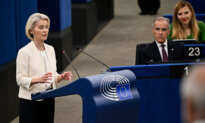
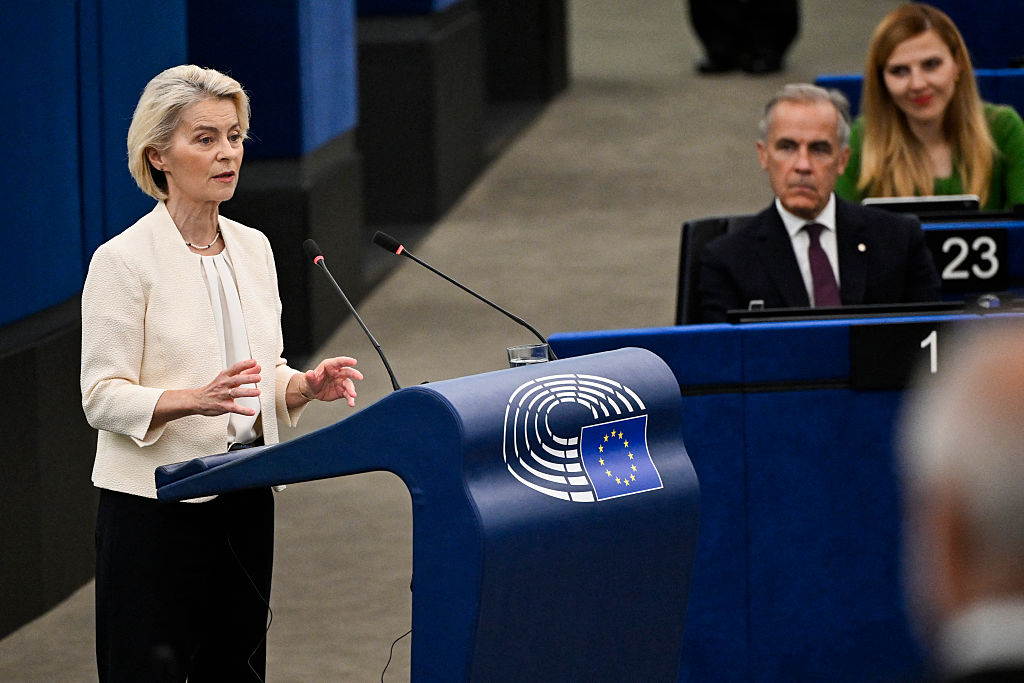
Canadian Prime Minister Mark Carney was in the front row at the European Parliament in Strasbourg, France on Sept. 16 as von der Leyen presented plans for stronger co-operation between Europe and Canada during her state of the union address.
“I would like to work with you on opening the door for Canada to be the first associate member of the European Union,” von der Leyen said.
Carney could be seen beaming in his seat before walking to the front to embrace von der Leyen during a prolonged standing ovation. He waved to the chamber before returning to his chair.
Von der Leyen said Europe wants to bring the relationship with Canada to the “highest level possible” by moving beyond the Comprehensive Economic and Trade Agreement (CETA). CETA was negotiated by former Prime Minister Stephen Harper and it went into effect after his tenure in 2017.
“Our cultural, historical, and personal links run deep in the fabric of our societies and thanks to CETA, our trade and goods has grown by 75 percent in less than a decade,” von der Leyen said.
She said Canada and the EU see the world “with the same eyes” on issues like AI, climate change, and geopolitics.
The EU chief said they would form a new tech alliance with Canada and integrate their defense industrial bases. The EU also seeks to cooperate with Ottawa on the Arctic, energy, critical minerals, quantum, AI, cybersecurity, and economic security.
Canada this year became the first non-European country to join the EU’s 150-billion-euro ($173-billion) SAFE defense program, giving Canadian companies access to joint procurement as Europe seeks to increase its defense readiness.
Von der Leyen emphasized that EU partnerships with Canada are aimed at building common strength and are “not against anyone else.”
“These partnerships are a strategic choice for Europe. But they also respond to the fracture in the international rules-based system,” she said.
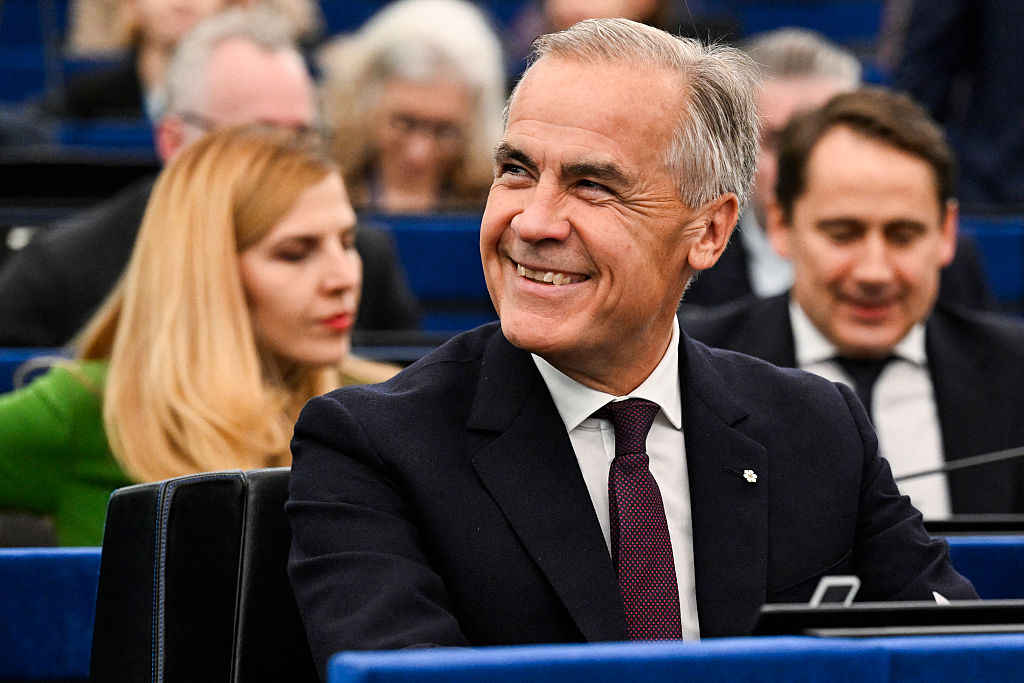 Canadian Prime Minister Mark Carney smiles as he listens to the European Commission president deliver a speech during her annual State of the Union address at a plenary session of the European Parliament in Strasbourg, France, on Sept. 16, 2026. (Jean-Christophe Verhaegen/AFP via Getty Images)
Carney’s office on Wednesday welcomed von der Leyen’s proposal, saying Canada is deepening ties with the EU “to strengthen our sovereignty” and supported a move beyond their existing free trade agreement, known as CETA.
Carney also posted briefly about his meetings with von der Leyen and European Parliament President Roberta Metsola, calling Canada and the EU “natural partners, united by shared values.”
“With President von der Leyen and President Metsola, we focused on what comes next: a closer partnership that strengthens our mutual sovereignty in order to create more opportunities and prosperity for our people,” Carney wrote on social media.
Carney was asked about the two sides reportedly pursuing associate membership earlier this week after the Wall Street Journal reported on the proposal based on unnamed sources. Carney didn’t refer to the term “associate member” in his response, instead saying that Canada isn’t pursuing “membership” in the bloc. He added that Canada wants to have a “unique alliance” with the EU.
The Conservatives voiced concern after the report initially came out, raising questions about implications to Canadian sovereignty.
“Will European border policies apply in Canada, further overwhelming our immigration system while our youth can’t find homes?” Poilievre said. “Will Canadian waitresses struggling with rent have to pay tax dollars to the bloated EU bureaucracy?”
Carney has yet to comment on a potential associate membership but stressed that both regions “share the same values.”
“We’re stronger together, and this is at a time when the world’s more dangerous and divided, and friends need to stick together at these times,” he said.
Carney told Bloomberg on Monday that he believes that a “mutually advantageous agreement” is possible between Canada and the United States. Trade talks broke down on Aug. 21, with each side blaming the other for making last-minute demands that the other wasn’t willing to accept. They subsequently imposed new tariffs on each other’s products.
“We’re ready to sit down and negotiate that and move it forward,” Carney said.
President Donald Trump has said a deal with Canada could come “fairly soon,” but it would depend on Ottawa’s willingness to address U.S. concerns about agricultural trade.
Carney Reception
The European Parliament rolled out the red carpet for Carney upon his arrival at the chambers and he was formally welcomed by Metsola and von der Leyen.
He also received applause as he entered the chamber as well as a standing ovation following Metsola’s formal introduction of him.
Von der Leyen referred to him as “dear Mark” during her address and described the invitation he received to attend as a “symbol of the enduring friendship between our people.”
She characterized her associate member proposal as a way to “urgently re-imagine” the partnership between Canada and the EU during a time of change and turmoil.
“This is not a partnership against anyone else but for our common strength,” she said. “In short, we want to bring the relationship with Canada to the highest level possible.”
Carney stayed in the chamber to listen to speeches from other political party leaders following von der Leyen’s address.
He was seated beside Ireland minister of state for European affairs Thomas Byrne, who also referenced Canada in his remarks.
“Your presence here today is a visible reflection of the deep bond shared by the European Union and Canada,” Byrne said. “Thank you, President von de Leyen. Your proposal significantly advances the relationships between the European Union and our great friend, Canada.”
The Associated Press contributed to this report.
 Friends Read Free
Copy
Facebook
Tweet
Friends Read Free
Copy
Facebook
Tweet