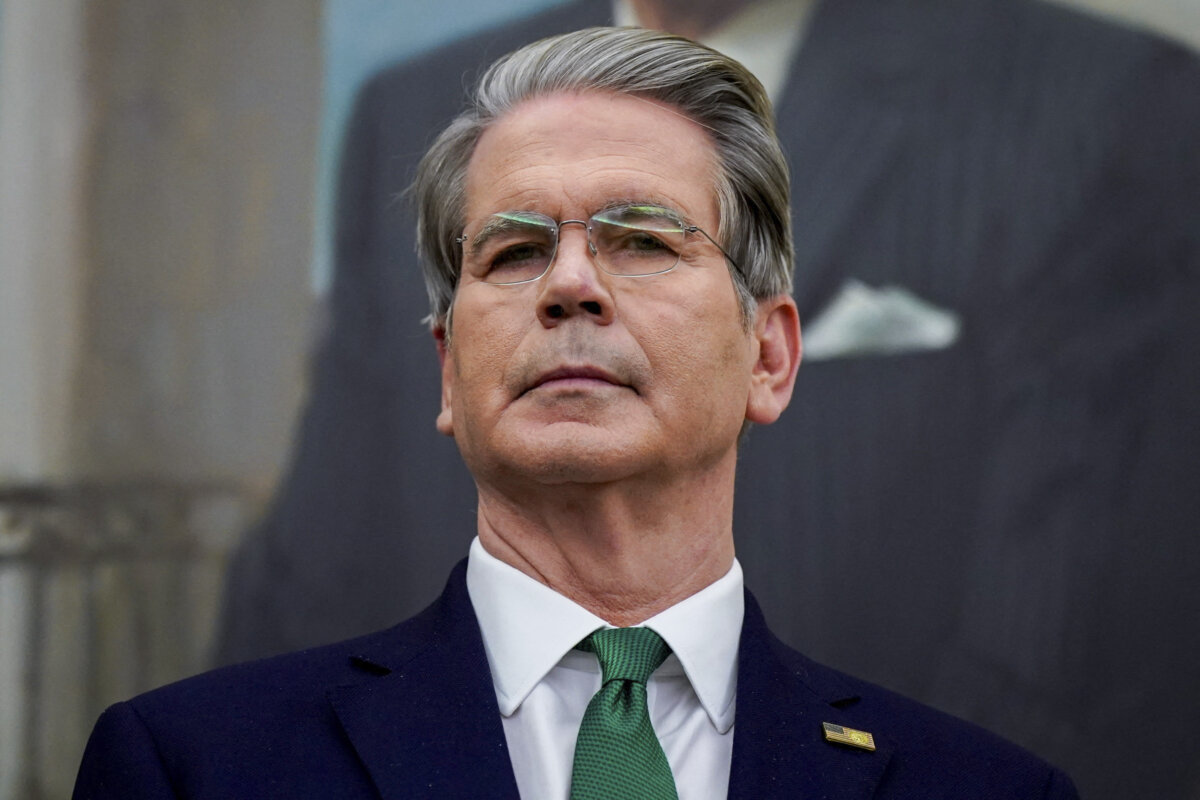

Treasury Secretary Scott Bessent on Jan. 20 rejected as “a completely false narrative” speculation that European governments could retaliate against President Donald Trump’s push to take control of Greenland by selling U.S. Treasury holdings.
Bessent, speaking to reporters on the sidelines of the World Economic Forum annual meeting in Davos, Switzerland, dismissed questions about whether the Treasury Department and the White House had contingency plans if European capitals pursued what a reporter described as a “nuclear option” of dumping U.S. government debt.
“Well, I just want to say this is a false narrative, … there is no talk in European governments,” Bessent said, pushing back on what he characterized as media-driven “hysteria” around what the reporter said were rumored closed-door discussions in the European Union and Britain about retaliatory financial measures to Trump’s efforts to acquire Greenland that would entail selling U.S. Treasury holdings, with the knock-on effect of making U.S. government borrowing more expensive.
“The media has latched on to this,” Bessent said.
“I think it is a completely false narrative.
“It defies any logic. And I could not disagree more strongly on that.”
Bessent said that market fundamentals and the structure of global finance make a coordinated sell-off of U.S. Treasuries by European governments implausible, describing the U.S. Treasury market—worth some $30 trillion—as the world’s key anchor for liquidity and pricing.
“It is the basis for all financial transactions, and I am sure that the European governments will continue holding it,” Bessent said, urging cool heads to prevail and “not listen to the media who are hysterical.”
The United States depends on foreign capital to finance its external deficits, with Europe being its biggest creditor, holding an estimated $8 trillion in U.S. bonds and equities—nearly twice as much as the rest of the world combined.
Retaliation Talk
Media speculation about European financial retaliation came after Trump escalated pressure on European allies over Greenland, pairing his renewed push to acquire the Arctic island with fresh tariff threats.
In response, EU leaders held an emergency meeting and said their nations were prepared to “defend ourselves against any form of coercion,” while denouncing Trump’s tariff threats as undermining transatlantic relations and risking a “dangerous downward spiral.”
While the U.S. Treasury market is deep and liquid, it is vulnerable to foreign outflows, analysts have said.
“This not only illustrates the deep interdependence between the US and Europe but also shows that, at least theoretically, Europe also has leverage on the US,” Carsten Brzeski, ING Global Head of Macro, and Bert Colijin, ING Chief Economist, Netherlands, wrote in a note on Jan. 19.
Still, the ING analysts said there is little that European governments can do to force private-sector investors to sell dollar assets.
“Whether in practice, Europe would really engage in a ‘Sell America Inc’ season is a completely different question,” they wrote.
“There is very little the EU could do to force European private sector investors to sell USD assets; it could only try to incentivise investments in EUR assets.”
Bessent, when pressed by reporters in Davos on Jan. 19 on whether Washington should be concerned about any European retaliatory financial measures, urged allies to avoid escalation and said the best course was to stay calm and let diplomacy work.
“What I am urging everyone here to do is sit back, take a deep breath, and let things play out,” Bessent said.
“The worst thing countries can do is escalate against the United States.
“I am confident that the leaders will not escalate and that this will work out in a manner that ends up in a very good place for all.”
On Jan. 20, the U.S. dollar retreated for a second day in Asian trading amid Trump’s tariff threats and retaliatory talk from European capitals.
 Friends Read Free
Copy
Facebook
Tweet
Friends Read Free
Copy
Facebook
Tweet