
The European Union formally approved a 90 billion euro ($105 billion) loan to Ukraine and a new package of sanctions against Moscow on April 23, after months of delay due to issues surrounding the Druzhba pipeline, which carries Russian oil to central Europe.
The loan is set to cover two-thirds of Ukraine’s budgetary needs for the next two years.
“Today the Council approved the final element needed to allow for the disbursement of the 90 billion euro loan for Ukraine,” Cypriot Finance Minister Makis Keravnos said in an April 23 statement.
“Loan disbursements will start flowing as soon as possible, providing vital support for Ukraine’s most pressing budgetary needs. The EU remains steadfast in its support for Ukraine’s sovereignty and territorial integrity.”
Cyprus currently holds the rotating presidency of the European Council, which changes every six months.
Economists had warned that Kyiv would start to run out of money by June without the EU loan, requiring the government to make deep cuts to public services.
Hungary had maintained a veto over the loan and sanctions package, after Russian oil flows stopped in January, with the government in Budapest accusing Ukraine of deliberately holding up oil supplies.
Kyiv always denied the allegations, maintaining that it had been working to repair the damage as quickly as possible and that the damage was caused by a Russian drone strike.
April 22 saw Hungary, which will soon be under a new government following an election earlier this month, lift its veto, after flows resumed through the Druzhba earlier that day.
On April 23, it was confirmed that the first flows of oil via the 2,485-mile-long pipeline had arrived in Hungary and Slovakia, which had also expressed concerns about the slow speed of repairs but stopped short of actively vetoing the loan.
“Crude oil deliveries via the Druzhba pipeline system have thus resumed to Hungary and Slovakia after a hiatus of nearly three months,” Hungarian oil group MOL announced in a statement.
The news of the release of funds came ahead of an informal summit of EU leaders in Cyprus on April 23 to 24, which Ukrainian President Volodymyr Zelenskyy will attend.
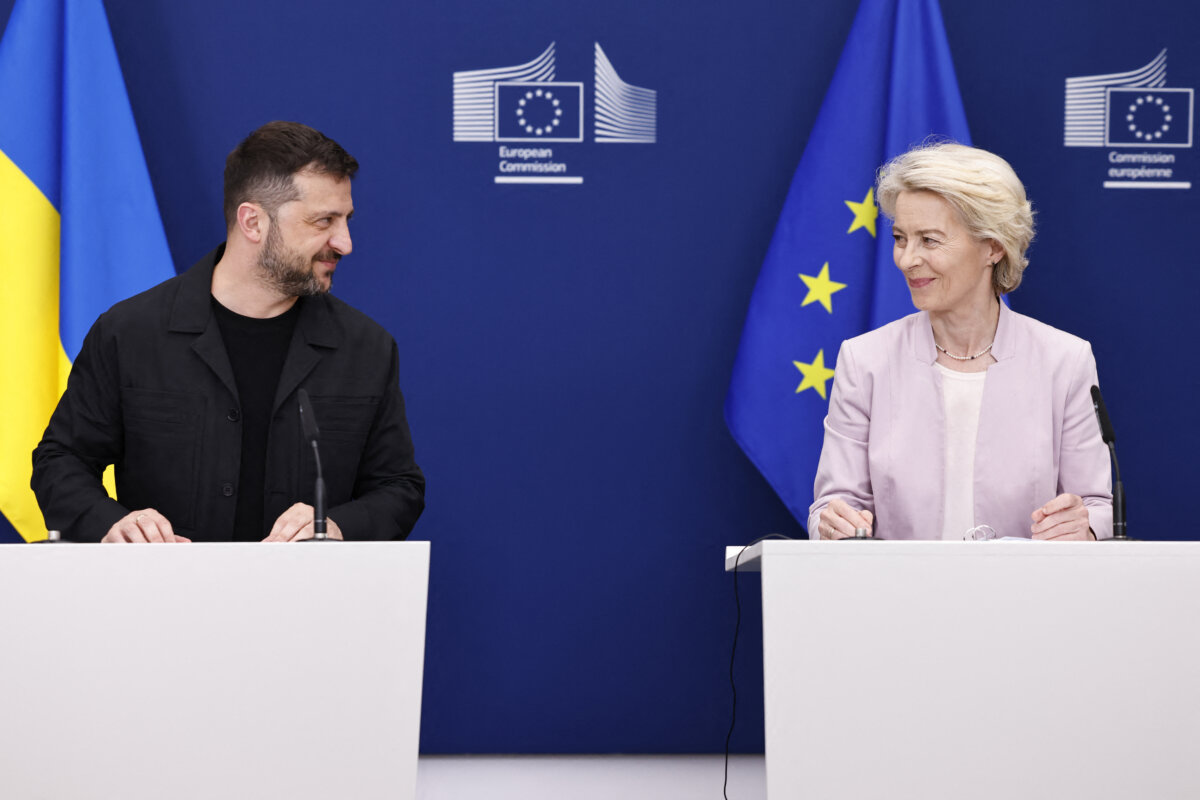
European Commission President Ursula von der Leyen welcomed the move, saying, “We are on our way to Cyprus with good news,” in an April 23 post on X.
“I welcome the agreement from the Member States on the 90 billion euro loan to Ukraine for 2026-27 and on the 20th sanctions package,” she wrote.
“While Russia doubles down on its aggression, we are doubling down on our support to the brave Ukrainian nation, enabling Ukraine to defend itself and putting pressure on Russia’s war economy. Now we will move to swiftly implement on both fronts.”
Zelenskyy also welcomed the loan.
“[It will] strengthen our army, make Ukraine more resilient, and enable us to fulfill our social obligations to Ukrainians, as set out in law,” he said in an April 23 post on X.
“It matters that Ukraine is securing this level of financial certainty—after more than four years of full-scale war.
“During meetings in Cyprus, we will also discuss with partners further sanctions pressure on Russia over this war. The 20th package has been unblocked, and it must be followed by other sanctions steps.
“And we will continue exploring a new format of cooperation with our partners—Drone Deals—which has already proven effective in the Middle East and the Gulf.”
 Friends Read Free
Copy
Facebook
Tweet
Friends Read Free
Copy
Facebook
Tweet