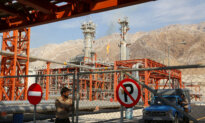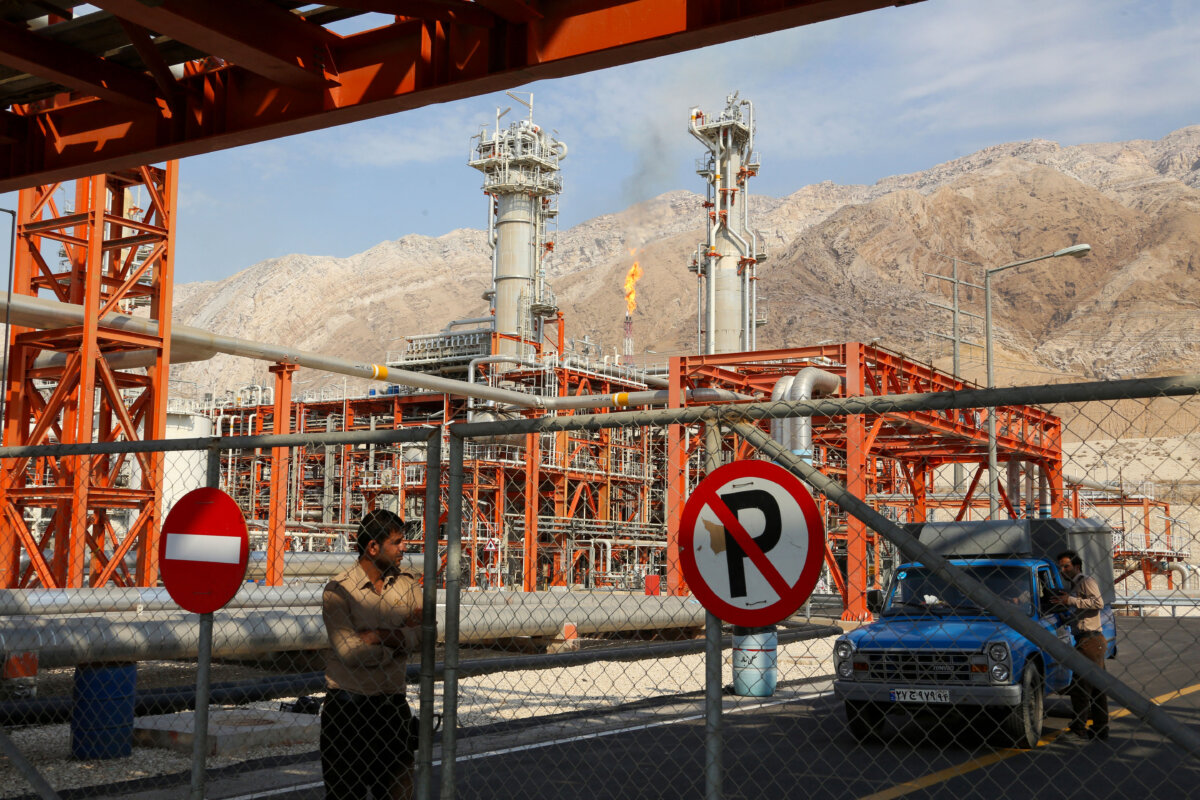

European gas prices surged on March 19, jumping as much as 40 percent before paring gains, after strikes on Iran’s giant South Pars gas field.
Dutch TTF natural gas futures, considered the European benchmark, later eased back from their highs to around 20 percent on the day after briefly surging close to 40 percent intraday.
On March 18, explosions were reported at Iran’s South Pars gas field, which is shared by Iran and Qatar.
Iran International, a London-based, privately owned Persian-language news outlet not affiliated with the Iranian state, posted a video on X of the strike on March 18.
After the explosion, Iran’s Islamic Revolutionary Guard Corps (IRGC) warned that everyone should stay away from oil facilities in Saudi Arabia, the UAE, and Qatar, in a statement to the Tasnim News Agency.
The Tasnim News Agency is a semi-official Iranian news agency affiliated with the IRGC.
President Donald Trump said in a March 18 post on Truth Social that Israel had hit South Pars.
“Israel, out of anger for what has taken place in the Middle East, has violently lashed out at a major facility known as South Pars Gas Field in Iran,” he said.
“A relatively small section of the whole has been hit,” he added.
He said that the United States “knew nothing about this particular attack, and the country of Qatar was in no way, shape, or form, involved with it, nor did it have any idea that it was going to happen.”
“Unfortunately, Iran did not know this, or any of the pertinent facts pertaining to the South Pars attack, and unjustifiably and unfairly attacked a portion of Qatar’s LNG Gas facility,” he added.
QatarEnergy said in a March 18 post on X that Iranian missile attacks struck Ras Laffan Industrial City, causing “extensive damage” and fires at the facility.
In a follow-up statement early on March 19, the state-owned energy giant further confirmed additional strikes in the early hours of Thursday that targeted several of its liquefied natural gas facilities, resulting in “sizeable fires and extensive further damage,” including to the Pearl gas-to-liquids plant.
Explosions were seen near a Saudi Aramco oil facility in Riyadh on Wednesday, as Iran launched ballistic missiles at Saudi Arabia, reported Reuters.
The disruption comes as Europe shuts off Russian gas.
European Commissioner for Energy and Housing Dan Jorgensen said in a March 19 post on X that “as of today, the EU begins closing the tap on Russian gas for good.”
“Imports under short- or long-term liquified natural gas (LNG) and pipeline gas contracts concluded, or amended, after 17 June 2025 are now prohibited,” he said.
In a report on March 19, S&P Global said the European gas market is heading into the summer season with “an almost unprecedented challenge; record low inventories and significant disruptions to supply.”
It said that European gas stocks stood at 28.93 percent fullness on March 16, according to the latest Gas Infrastructure Europe data. German gas storage was lower at 21.93 percent full on March 16.
The UK has significantly less natural gas storage capacity compared to other European countries, according to a report by Energy UK, the trade association for the energy industry.
At full capacity, it has enough gas for only 19 days, compared to nearly 120 days in Germany and France.
Using its Global Energy CERA data, S&P said that Qatar, the world’s second-largest LNG exporter after the US, shipped 82.44 million metric tons of LNG in 2025, with 8.9 percent of this total directed towards European terminals
Qatar also exported a quarter of the 67.7 million mt of LNG delivered to Asian markets in 2025, the second-largest share after Australia.
Though Europe was not the primary market for Qatari LNG, it said that “this loss is expected to divert Europe-bound volumes to Asia, heightening competition for floating cargoes.”
 Friends Read Free
Copy
Facebook
Tweet
Friends Read Free
Copy
Facebook
Tweet