
European leaders have said that the European Union risks falling further behind the United States and China unless it rapidly cuts red tape and simplifies regulation.
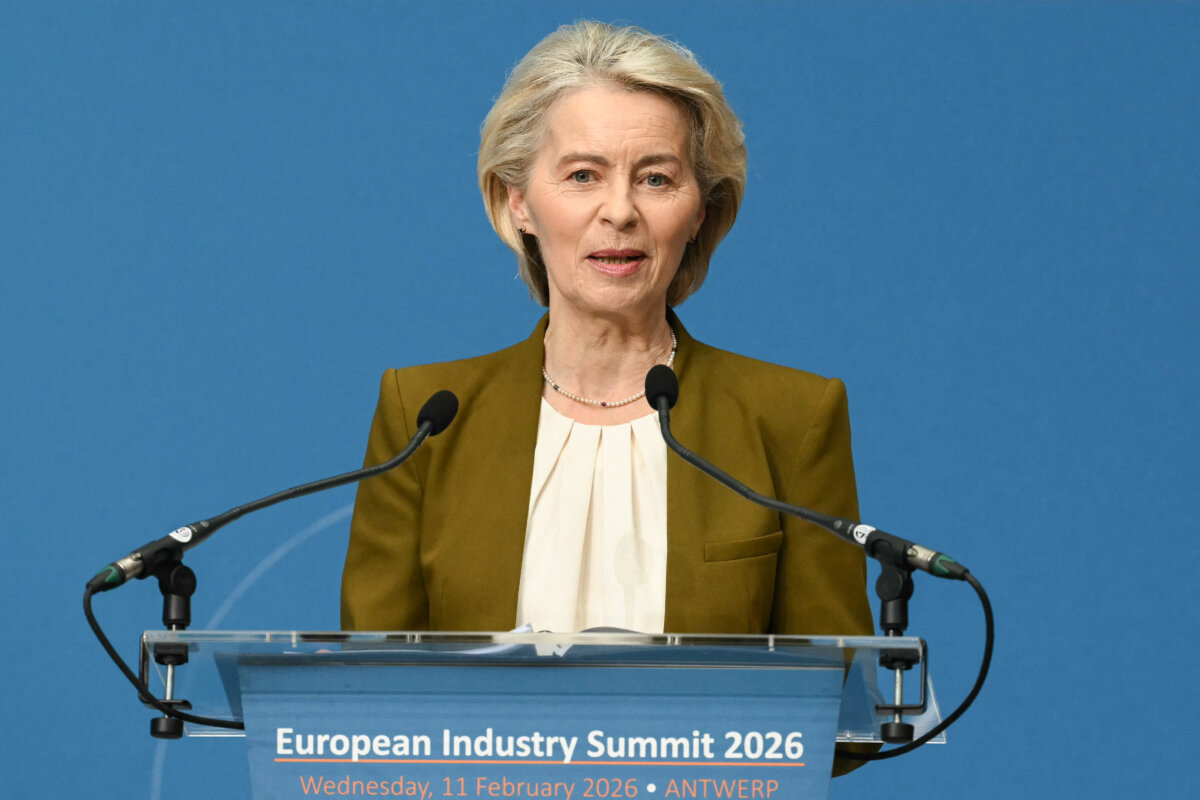
The comments came as EU political and business leaders met at the European Industry Summit on Feb. 11 in Antwerp, Belgium, to discuss how to strengthen the bloc’s economic competitiveness.
German Chancellor Friedrich Merz said on Feb. 11 that it is “high time for Europe to act, to act swiftly and to act decisively.”
“EU’s growth gap with the [United States] is widening,” he said. “And China is catching up.”
“Only three numbers: Over the past 20 years, China has grown by around 8 percent a year, the [United States] by 2 [percent], and the EU in average only by 1 percent,” Merz said. “So, we must close up this gap. We must close it now.”
He called for a “regulatory clean slate” at the event.
“We must deregulate every sector,” Merz said. “And I call for a regulatory clean slate: Minor corrections to laws are not sufficient. We need to systematically review the whole set of existing EU legislation.”
In her opening speech at the event, European Commission President Ursula von der Leyen said it was “time for a deep regulatory housecleaning—at all levels.”
“Today, it can take longer to permit a new factory than to build it,” she said.
Von der Leyen talked about “gold-plating” the practice of over-implementing EU rules at the national level by adding extra obligations that are not required under EU law.
“A truck in Belgium can weigh up to 44 [metric tons],” she said. “But if this truck drives to France and crosses the border with France, a border that does not exist anymore, it can only carry up to 40 [metric tons].
“In June 2023, we proposed legislation to harmonize this. Almost two years later, this is still under discussion by the co-legislators.”
Von der Leyen said shipping waste from one member state to another should be efficient, easy, and quick, but that differing national practices make it extremely complex.
“Some member states, for instance, only accept correspondence by fax,” she said. “It can take several months for traders to get [a] green light from the authorities, depending on the different rules of different member states.”
Von der Leyen said China now exports “almost twice as much clean tech as [Europe does].”
She said Europe should continue its decarbonization plan, saying that a 100 billion euro Industrial Decarbonization Bank will finance the “decarbonization of how you fire furnaces, melt metals, or mix chemicals.”
French President Emmanuel Macron told reporters on Feb. 12, “We share a sense of urgency that our Europe needs to act.” He was speaking at the Alden Biesen Castle in Belgium, where he met with the bloc’s 27 heads of state and government to discuss ways to regain competitiveness.
“We need to act fast, and we need concrete decisions by June,” he said. “If, in certain areas, we are not advancing as 27, we have the right to opt for reinforced cooperation [among fewer EU members] to go faster.”
At the meeting, Belgian Prime Minister Bart De Wever said: “The main issue for European industry right now is energy costs.
“We are not competitive, and we risk losing the petrochemical industry, the steel industry, metals, and of course, this is the base of all prosperity.”
De Wever recently criticized Europe’s green transition, warning that current EU climate and energy policies are accelerating deindustrialization.
Speaking on Jan. 29 at an event on the future of Europe hosted by Belgian newspapers De Tijd and L’Echo, De Wever said Europe had made a series of “dogmatic choices” on energy and climate that have weakened its industrial base.
“Let’s be very realistic, ladies and gentlemen, the decarbonization of Europe will be a synonym of the deindustrialization of Europe, and it’s already happening,” said De Wever, leader of the conservative Flemish nationalist party New Flemish Alliance.
“We were addicted to cheap fossil fuels flowing in from Russia.
“China is profiteering from the war. They’re getting the cheap oil, the cheap gas. America is no longer supporting Ukraine. They’re selling us the arms, and we are stuck with bills, crazy energy prices.”
Reuters contributed to this report.
 Friends Read Free
Copy
Facebook
Tweet
Friends Read Free
Copy
Facebook
Tweet