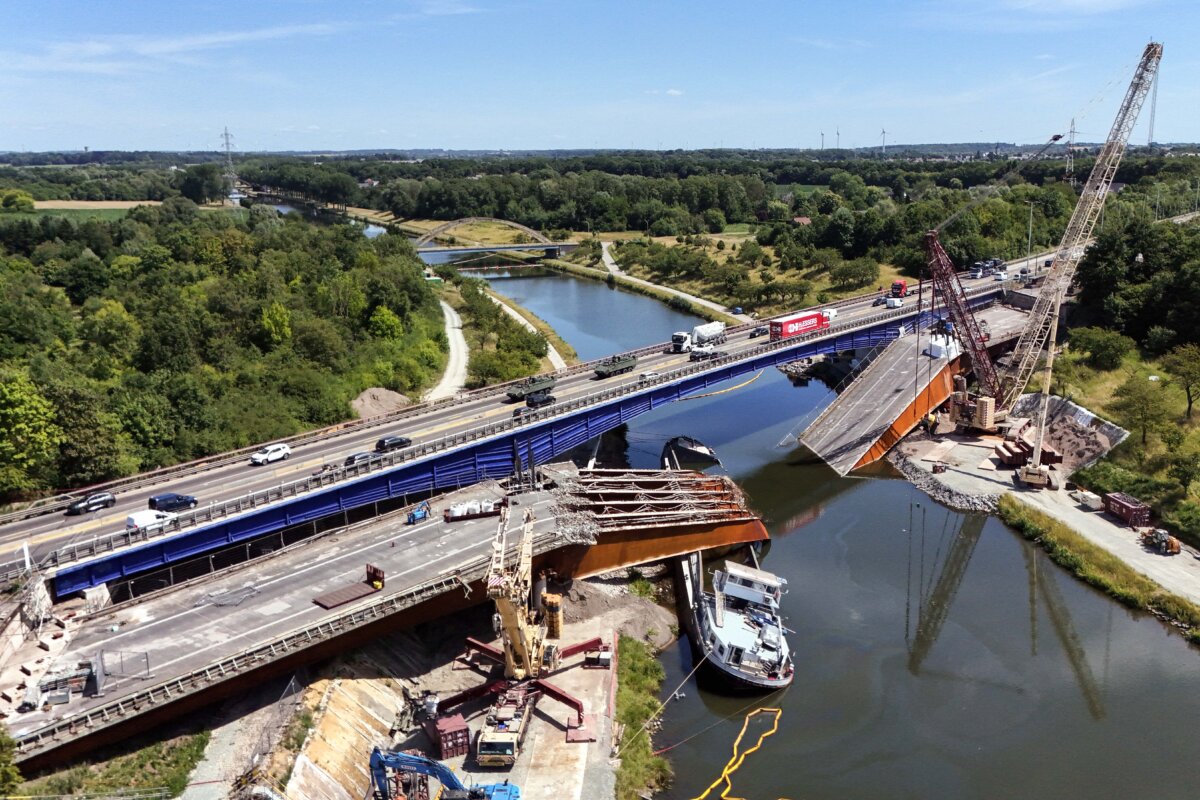

Europe’s roads, railways, and bridges are ill-suited for moving tanks, troops, and other military matériel in the event of a land war with Russia, the European Union’s transport chief said in an interview published Tuesday.
European Commissioner for Transport and Tourism Apostolos Tzitzikostas told the Financial Times that urgent upgrades are needed to the continent’s infrastructure to enable the movement of armed forces eastward. He said that under current conditions, soldiers and equipment could get stuck in tunnels, cause bridges to collapse, and become entangled in border protocols during a large-scale mobilization.
“We have old bridges that need to be upgraded,” Tzitzikostas said. “We have narrow bridges that need to be widened. And we have nonexistent bridges to be built.”
He added that this difficulty in logistics would render the continent almost impossible to defend.
“The reality today is that if we want to move military equipment and troops from the western side of Europe to the eastern side, it takes weeks and in some cases months,” Tzitzikostas said.
On July 1, the EU’s Directorate-General for Mobility and Transport said in a statement that EU member states and military staff identified four established mobility corridors with critical infrastructure investment needs.
These corridors include more than 500 priority infrastructure projects “ranging from reinforcing bridges and widening tunnels to constructing railway sidings, to be addressed as a matter of priority,” the EU transport department stated.
“Investments will be focused on projects with the most tangible dual-use impact, ensuring that infrastructure improvements serve both civilian and military needs,” the department said.
The European Commission also hopes to increase the amount it spends on what it calls the “military mobility” strand of its “Connecting Europe Facility” program by a factor of 10, from 1.7 billion euros ($1.97 billion) to 17 billion euros ($19.7 billion).
The commission announced this ambition on July 16 as part of its proposed new budget for the years 2028 to 2034.
“It will support dual-use infrastructure investments alongside civilian ones and contribute to a major boost for cybersecurity, infrastructure, and defence development overall,” the commission said in a July 16 statement. “To enhance energy security, the Connecting Europe Facility will provide financing to cross-border energy and transport projects.”
The total budget amounts to almost 2 trillion euros ($2.3 trillion) and requires the backing of all 27 member states at the European Council to pass, after obtaining consent from the European Parliament, according to EU regulations.
European Commission President Ursula von der Leyen said the new budget “will help protect European citizens, strengthen Europe’s social model and make our European industry thrive.”
“In a time of geopolitical instability, the budget will allow Europe to shape its own destiny, in line with its vision and ideals. A budget that supports peace and prosperity and promotes our values is the best tool we can have during these uncertain times,” she added.
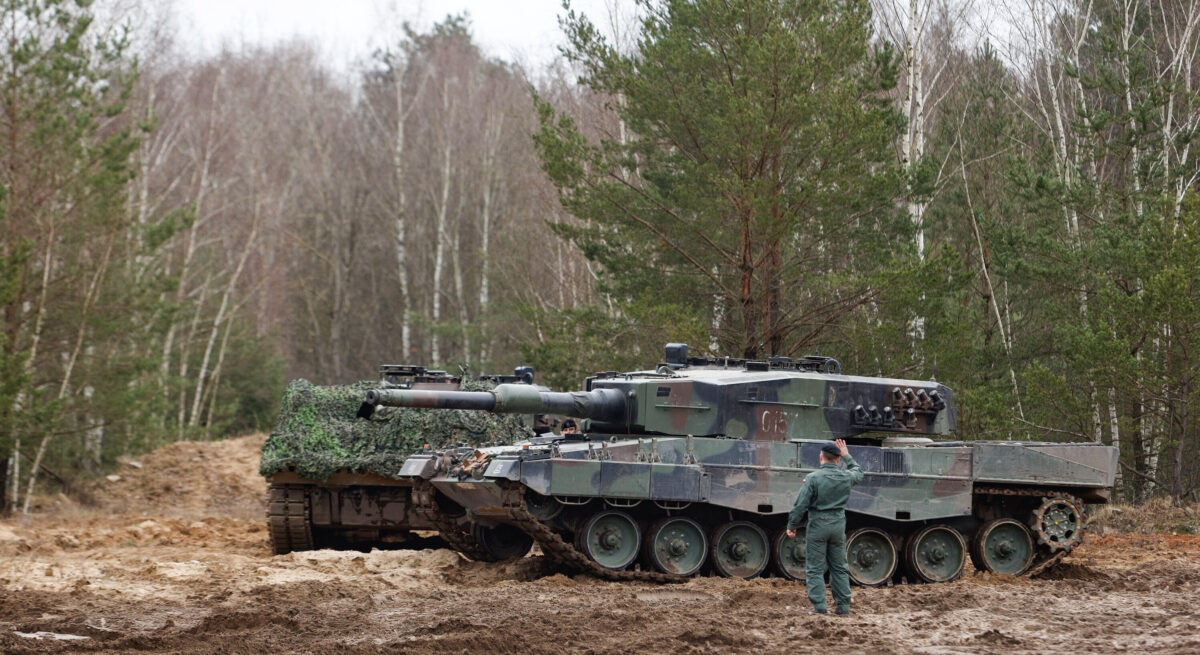
The Swedish government said in a July 16 statement that it could never accept common EU funds going to countries that don’t respect basic democratic principles and European values.
“We won’t solve the EU’s problems with a bigger budget and increased EU contributions, rather through using current resources in a smarter way and putting money where it is really needed,” the Swedish government said.
Hungarian Prime Minister Viktor Orban also voiced opposition to the budget last week, saying that it aimed to take money from Europeans and give it to Ukraine.
He said the plan was “weak even as a basis for negotiations,” adding that Hungary recommended that the draft be withdrawn and a new one prepared to serve “the interests of the European people and European farmers rather than those of [Ukrainian President Volodymyr] Zelenskyy and Ukraine”.
Dutch Finance Minister Eelco Heinen said that the proposed budget was too high.
“We should not always focus solely on how the EU can spend more, but rather on how existing funds can be spent better,” Heinen said.
France’s Europe minister, Benjamin Hadad, said he “welcomed the ambition.”
Reuters contributed to this report.
 Friends Read Free
Copy
Facebook
Tweet
Friends Read Free
Copy
Facebook
Tweet