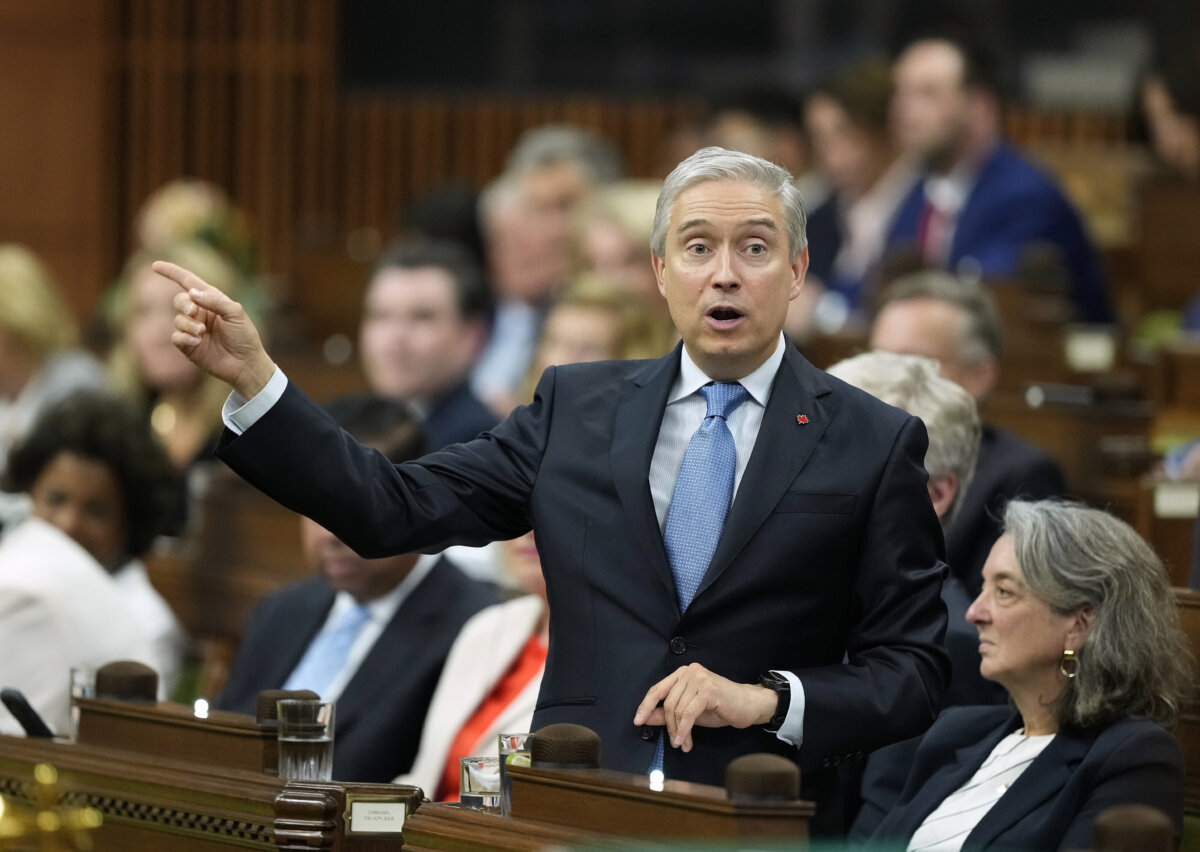

The federal government will table its first budget under Prime Minister Mark Carney in October, Finance Minister François-Philippe Champagne says.
The government has been “working all summer” to present an “ambitious plan” to Canadians, Champagne told CTV News in an Aug. 22 interview.
“This is rethinking Canada fit for the 21st century, at a time where our neighbour and friend decides to have a very different trade policy,” he said.
The minister added that as the world economy is “being restructured,” Canada needs to “diversify” its economy and have “one Canadian economy.”
“The tariff situation has been evolving, so the fact that we have a budget in October is helpful, because by that time, we have more certainty,” the minister said, adding that waiting to present the budget in October will allow the government to provide a “better picture” to Canadians.
Champagne initially said in mid-May that the Liberal government wouldn’t be tabling a budget at all this year but would instead issue an economic statement in the fall. However, four days later, Carney said the government would table a full budget in the fall, amid criticism from opposition parties and concern from some fiscal critics about the pace of spending and the size of the deficit.
Champagne has now specified that the budget will be released in October.
No Spring Budget
In May, following Champagne’s initial announcement, Conservative Leader Pierre Poilievre said it was “unacceptable” that the Liberals decided not to release a budget in the spring.
“As Canadian families struggle with rising costs and businesses face the crushing weight of American tariffs, the Liberal government is walking away from their responsibilities,” Poilievre said in a May 14 statement. “After months of building expectations and promising serious leadership, Carney announced he will deliver nothing.”
The Tory leader noted that Parliament had already been “shut down for nearly half a year” and Canada was facing “serious economic threats.” He called the Liberal’s decision not to present a budget a “betrayal of workers and families across the country who expected this government to lay out its plan.”
A Conservative motion calling for the government to introduce a budget before the summer failed in the House of Commons after the NDP and Liberals voted against it on June 10. A majority of MPs in the House of Commons had voted in favour of the Liberal government presenting a spring budget just a week before on June 2, however the vote was non-binding.
Carney defended his decision not to release a spring budget, as is customary, by noting the short parliamentary sitting before summer break and the fact that a new cabinet had only recently been appointed. He said there was no point in rushing the process.
“We will have a much more comprehensive, effective, ambitious, prudent budget in the fall,” Carney said during a May 18 press conference in Rome, noting that presenting a budget before holding in-depth discussions with the United States would have been premature.
“To have a budget before we substantially advance further our discussions with the Americans with respect to our economic partnership, … [we need] greater clarity around that,” he said. “Not saying we’ll have perfect clarity, but to have greater clarity.”
Additionally, the prime minister said at the time that the NATO summit in June would have financial implications for Canada.
The federal government under former Prime Minister Justin Trudeau had committed to meeting NATO’s defence spending target of 2 percent of GDP by 2032. Carney, for his part, had in February pledged to meet the target by 2030 during his Liberal leadership bid.
At the press conference in May, Carney also said his government was exploring methods to lower its expenses, which was another process that would impact the budget. He said his decision to delay presenting a budget was based on his experience in the financial sector, as a former governor of the Bank of Canada and the Bank of England, as well as former chair of Brookfield Asset Management.
The prime minister has said that his government’s budgetary priorities include passing legislation to make a “one Canadian economy” and launching nation-building projects to grow the economy.
Consultations
Ahead of the federal budget’s release this fall, Champagne launched consultations in mid-July to seek input from Canadians on defence spending and ways to best strengthen the economy during an ongoing trade war.
“Consultations are open for you to share your ideas on Canada’s economic future,” Champagne said in a July 14 video posted on X. “We want to hear from you. Your ideas will help us guide the choices we need to make as a nation.”
Champagne said he, Secretary of State for the Canada Revenue Agency and Financial Institutions Wayne Long, and Parliamentary Secretary Ryan Turnbull were set to meet with Canadians from across the country to “discuss key issues” as part of the pre-budget consultation process.
Consultations are to be held until Aug. 28 with a focus on lowering costs for Canadians, creating jobs, building more homes, accelerating nation-building projects, and strengthening Canada’s defence industrial capacity, the government said in a July 14 press release.
Canadians can also submit a letter or paper or fill out a multiple-choice questionnaire to offer suggestions to the federal government.
Jennifer Cowan and Matthew Horwood contributed to this report.
 Friends Read Free
Copy
Facebook
Tweet
Friends Read Free
Copy
Facebook
Tweet