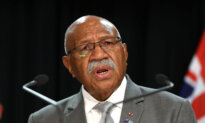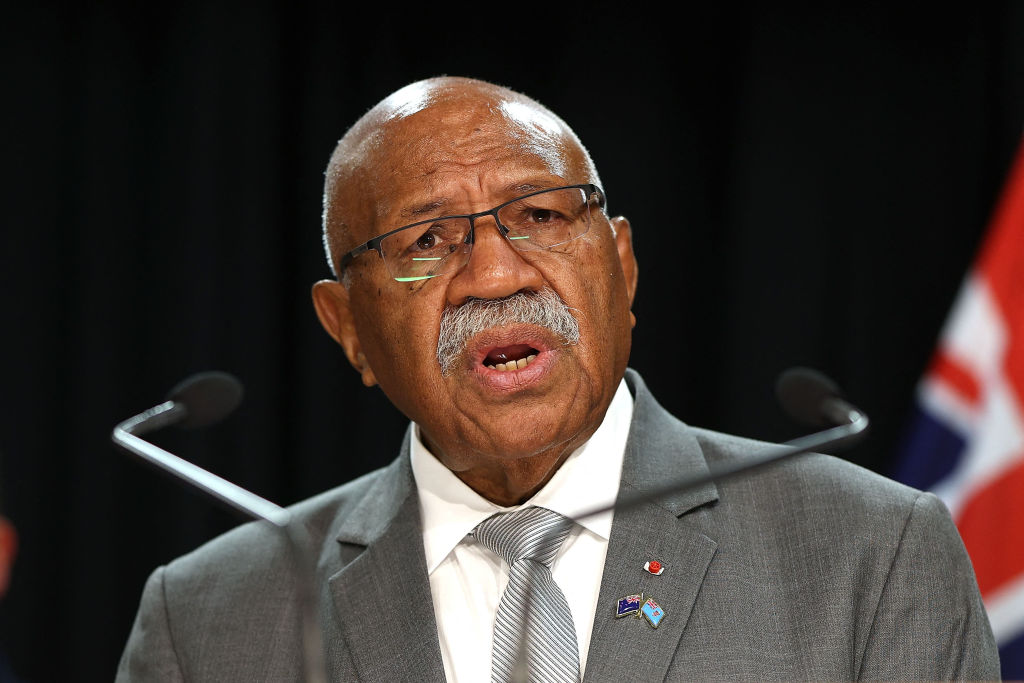

Pacific nations are trying to navigate a geopolitical environment dominated by “a China that is big, really big,” and which would “probably like to spread its influence” in the region, Fiji’s prime minister has told the Australian National Press Club.
He reiterated the official stance taken by members of the Pacific Island Forum (PIF), which is that the nations would be “friendly to all and enemies to none,” but acknowledged that it would be a “fairly tough course to steer.”
Sitiveni Rabuka, whose nation is a key regional ally of Australia, has previously advocated for the Pacific to be an “ocean of peace.”
Asked whether he believed Beijing should be allowed to establish a military base in the region, he replied, “Who would want them? Not Fiji.”
The leader promised to use his influence in the region to prevent it from happening. And said he believed, “China understands that well.”
However, Fiji is not one of the Pacific nations that recognise Taiwan—that’s the Marshall Islands, Palau, and Tuvalu—and Rabuka also praised the head of the Chinese Communist Party (CCP) Xi Jinping as a “great leader.”
He also downplayed Beijing’s territorial ambitions, saying he didn’t believe the CCP was actively seeking a military foothold in the Pacific.
“They have proven that they do not need a base outside China to be able to launch what they have into any other area of the world,” he said.
“So they can go east of China and go as far east to America as they like, or go west and go to the furthest point in Europe if they like, so there is really no need for them to set up any other bases in the Pacific.”
Beijing Ready to Invade Taiwan: Rabuka
Asked about Taiwan, he said that he believed the CCP was ready to invade, but that he also believed “the rest of the world is also ready” if that were to occur.
It would “draw the major powers together into a conflict area,” with CCP likely to be “better positioned” if it escalates into a prolonged confrontation, he believed.
In recent months, the Albanese Labor government has signed several new strategic agreements with Pacific nations, including Tuvalu, Nauru and Papua New Guinea, and is in the early stages of negotiations on new pacts with Tonga and Vanuatu.
Rabuka said it was time for Fiji to consider a new agreement with Australia, as the relationship may have “reached a point … where our renewed and elevated partnership needs to step up to an agreement or treaty.”
Blake Johnson, a senior analyst at the Australian Strategic Policy Institute’s Pacific Centre, said Rabuka was trying to “unite the Pacific to push back against some of the competition that’s taking place and to push for a cohesive approach in trying to resolve the region’s security challenges.
“That’s something that Australia has been getting better at over the last 12 months,” he said.
“A lot of its different initiatives are trying to support a Pacific-driven security solution that doesn’t involve drawing in all of this additional support from Beijing or from the U.S.”
“The security of Australia depends on the security of our surrounding region,” Johnson explained. “There can sometimes be unrest in Pacific Island countries, and if that all spills over, it creates an unstable region around Australia, and that’s not good for our overall security.”
AAP contributed to this story.
 Friends Read Free
Copy
Facebook
Tweet
Friends Read Free
Copy
Facebook
Tweet