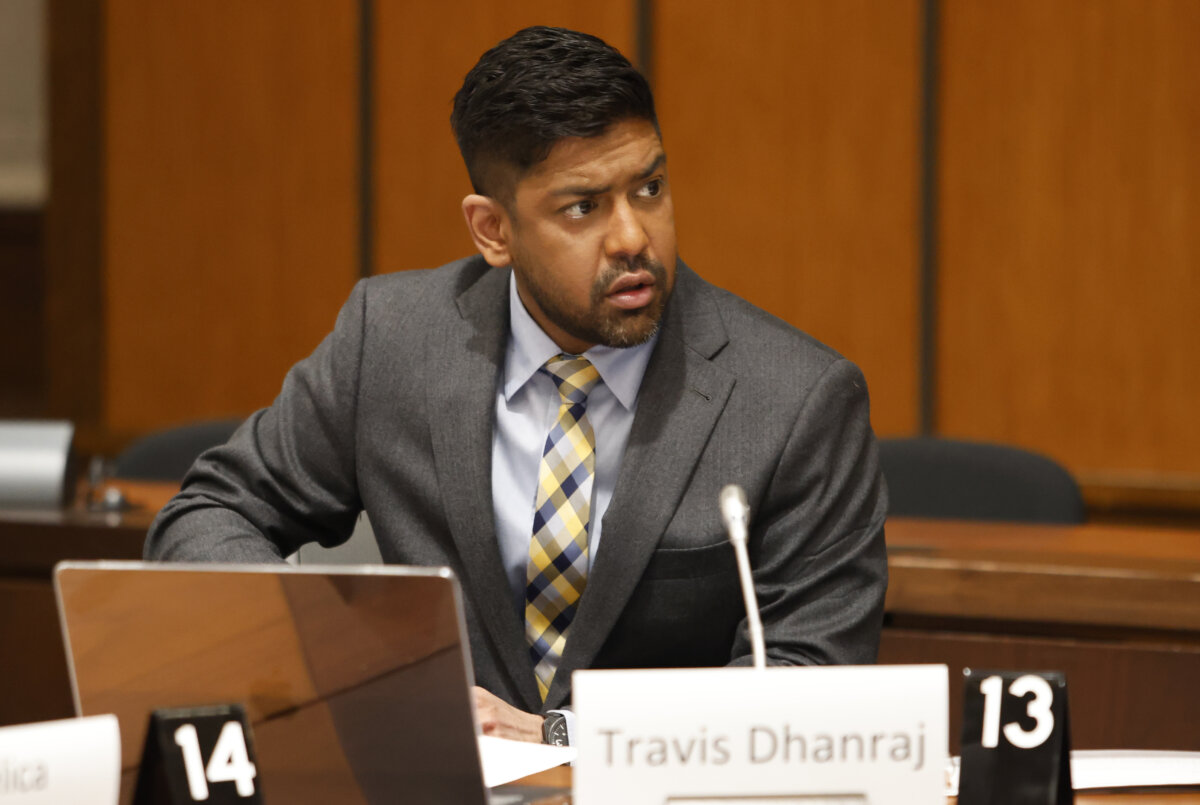
Former CBC journalist Travis Dhanraj described a “toxic culture” of bullying, tokenism, and editorial bias at the public broadcaster during testimony before a House of Commons committee.
The former host of the “Canada Tonight” program named individuals at the CBC who he says engaged in intimidation, censorship, and editorial strong-arming.
“This is not about left or right,” Dhanraj told MPs in his testimony before the House Committee on Canadian Heritage on March 10. “It’s about systemic control, tokenism, selective enforcement, and a toxic culture where intimidation went unchecked.”
Dhanraj’s testimony was part of the committee’s broader discussion on the state of journalism in Canada and the funding of the CBC, which receives over $1.4 billion per year in taxpayer funds.
“If it is to endure as a public broadcaster worthy of Canadians’ trust, it must be strong enough to withstand accountability,” Dhanraj said.
The CBC is denying Dharanj’s allegations, characterizing his comments as misleading.
Removal and Resignation
Dhanraj was a general assignment reporter for CBC Edmonton and CBC Toronto in the early 2000s before leaving for positions at other networks. He returned to CBC in 2021 as a senior parliamentary reporter and later hosted “Marketplace” and “Canada Tonight.”
He said he was taken off the air in 2024 after posting on social media saying CBC President Catherine Tait had declined a request for an interview with “Canada Tonight” to discuss executive bonuses given out while layoffs were occurring at CBC.
The request was made “at a time when the public broadcaster is under increasing scrutiny and when transparency is needed,” the April 2024 tweet read. “We wanted to discuss new budget funding, what it means for jobs & the corporation’s strategic priorities ahead. Our request was declined. This is unfortunate.”
According to his testimony, CBC management said his tweet violated internal editorial policies by creating a perception of bias on his part. Dhanraj insists his post simply made the factual point that Tait didn’t want to be interviewed.
After he was taken off the air, Dhanraj said he was asked to sign a confidentiality agreement by CBC management. He said he was asked to waive certain legal rights and agree to “seek no right or remedy under the Canadian Human Rights Act.”
He said he refused to sign and subsequently his role at CBC was not renewed.
“That should be shocking to every member on this committee,” Dhanraj told the committee. “We should not have a public institution silencing their own employees and having them waive their rights under the Canadian Human Rights Act.”
Dhanraj announced his resignation from the CBC in July 2025 with a resignation letter to executives and an email explaining his decision to colleagues.
He then filed a human rights complaint against the CBC in September 2025 alleging discrimination and retaliation against him for his social media post and disagreements about editorial independence. The case remains pending.
Responding to the allegations, CBC spokesperson Chuck Thompson said a number of Dhanraj’s statements in his March 10 testimony were false and misleading.
“Today, Mr. Dhanraj made numerous misleading statements, mischaracterizations and/or false allegations about his time at CBC,” Thompson wrote in a March 10 statement to The Epoch Times. “We have replied to the bulk of these claims in a robust and detailed response filed with the Human Rights Commission, which is the proper venue for these complaints.”
Political Guests
In his March 10 testimony, Dhanraj said his April 2024 social media post was the “breaking point” rather than the cause of his removal.
“The tweet was not the beginning,” he said. “For months prior, tensions had been building, not over performance, but over control.”
Dhanraj said that his authority to bring on political guests was blocked “under guardrails governed by an internal document never made public, titled, ‘Parameters for Political Guests.'”
Specifically, Dhanraj said management told him certain MPs, including Conservatives, could not be brought on his political affairs show.
“It should blow the Canadian public’s mind that this was the stuff that was going on,” he said, adding that his objections to the restrictions on guests was not political.
“I am not a cheerleader for the Conservatives,” he told the committee. “I’m not a cheerleader for the Liberals either. I was trying to do my job as a journalist.”
‘Toxic Culture’
Dhanraj also read out statements he said were sent to him by current and former CBC staff who were reluctant to speak publicly.
One of the claims he said was from a current employee who described “multiple incidents of the misuse of taxpayer dollars, racism, favouritism, nepotism, sexual harassment, and verbal abuse.”
Dhanraj said another former journalist told him she was removed from her job at the CBC because she was white.
“I was suddenly removed from the anchor desk. I was told the decision was related to the colour of my skin, that as a white person, I did not fit the diversity targets they were trying to meet,” Dhanraj read from her alleged statement. “No concerns about my performance had ever been raised.”
Specific Accusations
Dhanraj said former CBC President Catherine Tait misled the committee when she said in prior testimony that she was unaware of any consequences resulting from his April 2024 social media post.
“On May 7, 2024, Tait told this very committee she was, ‘not aware of any repercussions,'” Dhanraj said. “Yet 24 hours earlier, ATIP [Access to Information and Privacy] records show, her vice-president Barb Williams briefed her directly about my situation.”
Dhanraj also accused CBC’s “Power & Politics” host David Cochrane of controlling who came on Dhanraj’s show and of bullying staff.
“I and others raised concerns about bullying behaviour by senior figures including Mr. Cochrane, but while he remained on air, I faced discipline and marginalization,” Dhanraj said. He then read a statement from a former producer who said Cochrane “actively undermined” minority colleagues.
Dhanraj also levelled accusations against CBC chief political correspondent Rosemary Barton, saying she tried to undermine his program after he interviewed former House Speaker Greg Fergus during Black History Month. He also accused CBC editor-in-chief Brodie Fenlon, CBC senior news executive Andre Lau, as well as Chris Carter and Kathy Perry of CBC management of putting CBC’s public reputation above addressing his concerns.
CBC spokesperson Thompson said that while the CBC can only legally respond in a limited manner at this time due to privacy laws, Dhanraj’s statements about unethical behaviour by CBC employees are false.
“While we are limited in what we can say due to privacy and confidentiality considerations, CBC categorically rejects Mr. Dhanraj’s accusations about CBC News, our journalists and management,” Thompson wrote. “David Cochrane, Rosemary Barton and our news leaders have CBC’s full and unwavering support.”
 Friends Read Free
Copy
Facebook
Tweet
Friends Read Free
Copy
Facebook
Tweet