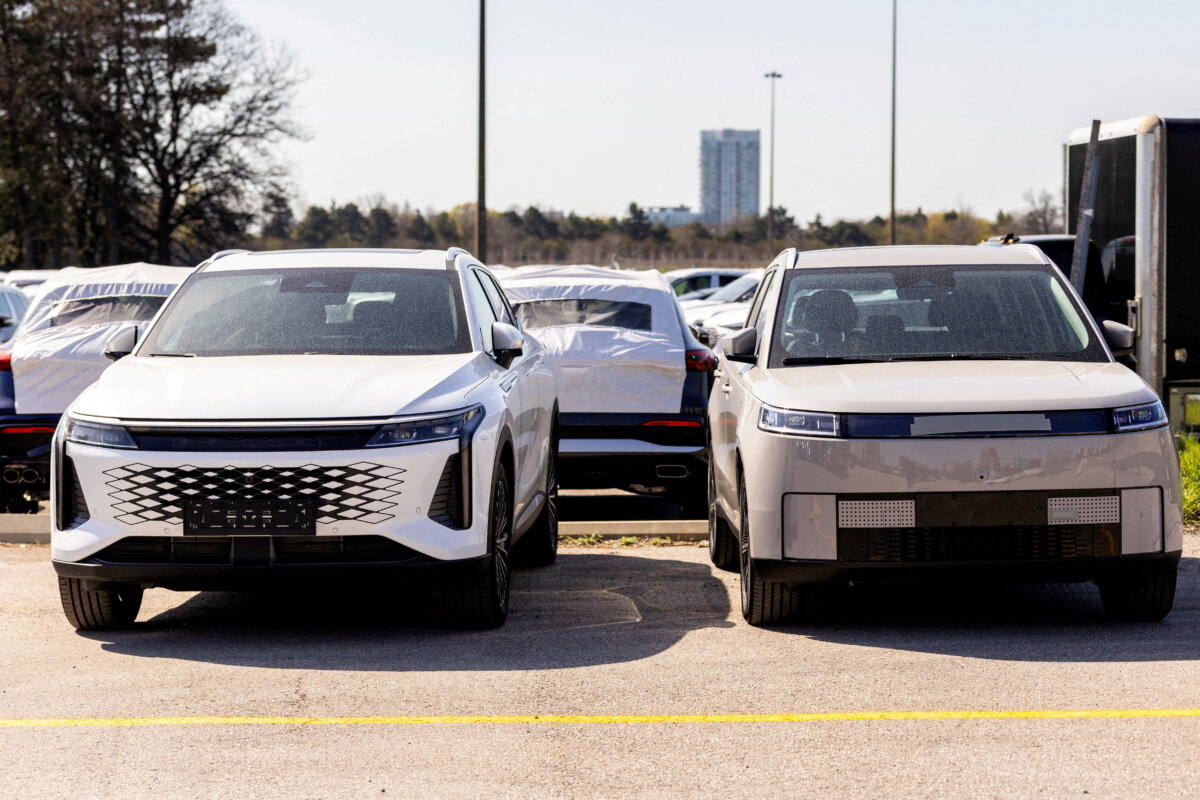

Canada’s former spy chief is warning that China could use data collected by Chinese-made electric vehicles to gather vast amounts of personal information on Canadians that Beijing could later weaponize.
David Vigneault, former head of the Canadian Security Intelligence Service (CSIS), made the comments during a recent appearance on a BBC podcast. As more Chinese electric vehicles (EVs) are set to enter the Canadian market, Vigneault says they could expose users to surveillance by Beijing.
“There is the reality that all of your data, what you say, where you go, with whom you are, who you associate with, everything you do around your car, will be acquired by China,” Vigneault said on BBC’s The interview, which aired on Sept. 16.
 CSIS Director David Vigneault appears as a witness at the Public Inquiry Into Foreign Interference in Federal Electoral Processes and Democratic Institutions in Ottawa on April 4, 2024. (The Canadian Press/Sean Kilpatrick)
Vigneault now serves as chief intelligence officer at Strider Technologies, a U.S.-based strategic intelligence firm. When asked if he thought China would use Chinese-made EVs for “spying,” Vigneault said he had no doubt.
“It is not a question for me. It is a reality,” Vigneault said.
The former CSIS chief says he believes China wants to acquire an “extremely large amount of data” so it can weaponize that data.
Security Concerns
Vigneault is among several intelligence and China experts who have expressed concern over the past year about Chinese EVs set to enter the Canadian market.
In April, former CSIS officer Neil Bisson told the House of Commons industry committee that Chinese-manufactured EVs serve not only as “potential eyes and ears” for Beijing, but also pose a threat to Canada’s electric grid. He said the cars introduce “potential avenues of exploitation, including data collection, system access, or disruption” once connected to critical infrastructure.
In March, China expert and former senior government official Margaret McCuaig-Johnston told the standing committee on international trade that Chinese EVs can collect camera, microphone, and GPS data via integrated Chinese software and transmit it back to China.
Chinese-made EVs give Beijing a view of “minute details of our streets and homes,” Margaret McCuaig-Johnston told a panel hosted by the Macdonald-Laurier Institute earlier this month. McCuaig-Johnston said EVs can copy data from phones connected to them, even when the vehicle is turned off.
Former Canadian diplomat Michael Kovrig told the House science and research committee in early April that Prime Minister Mark Carney’s recent trade deal with China was a “tactical gamble that risks deep entanglement with an increasingly totalitarian one-party state.”
China expert Charles Burton, a senior fellow at Sinopsis, noted that Chinese corporations are “legally obligated to support state intelligence apparatuses.” Testifying before a parliamentary committee in April, he said the vehicles could potentially be controlled remotely, warning of a future scenario in which “cities and transportation arteries are suddenly paralyzed by legions of immobilized Chinese vehicles.”
EV Deal
The warnings follow Prime Minister Mark Carney’s January deal with Chinese leaders during his visit to Beijing, which allows Chinese electric vehicles (EVs) into Canada in exchange for China removing or reducing tariffs on some Canadian agricultural and seafood products. Under the agreement, the tariff rate on an initial 49,000 Chinese EVs was reduced from 100 percent to 6.1 percent. The quota is expected to rise to about 70,000 vehicles after five years.
Carney said during his January Beijing trip that Ottawa and Beijing were in a “strategic partnership,” and that relations between the two countries had entered a “new era.”
The stance marks a shift from his position during the 2025 election campaign when he said that China is the number one security threat to Canada, and suggested that China does not share Canada’s values.
Carney’s decision came amid U.S. tariffs imposed on the Canadian auto sector. Ottawa said it needs to diversify trade in response to increasing U.S. protectionism, while also seeking to import affordable EV options to reduce emissions.
Several House of Commons committees have since held hearings to hear from industry and policy experts about the potential consequences of Canada’s EV deal with China. Some warned that seeking to hedge against uncertainty in trade relations with the United States by strengthening ties with China would offer Canada no long-term benefits. The United States has effectively barred Chinese vehicles from its market by imposing a 100 percent tariff on them.
Commenting on Canada’s trade policy with China, Vigneault said even if Ottawa engages with Beijing with “eyes wide open,” it is not enough.
“[Y]ou need to have more than your eyes wide open,” Vigneault told the BBC in September. “You need to also make sure that you’re protecting your wallet in your back pocket.”
Industry Minister Mélanie Joly, who accompanied Carney on the Beijing trip, had said at the time that Ottawa is engaging with China with “eyes wide open.” In June, she outlined four conditions that Chinese automakers must meet to establish a production base in Canada: that joint ventures be majority Canadian-owned, labour standards to be on par with Canadian auto sector, supply chain to be local, and “everything linked to security of software and security of data.”
 Friends Read Free
Copy
Facebook
Tweet